Short Communication - (2025) Volume 10, Issue 2
Received: 01-Apr-2025, Manuscript No. cgj-26-186512;
Editor assigned: 04-Apr-2025, Pre QC No. P-186512;
Reviewed: 17-Apr-2025, QC No. Q-186512;
Revised: 22-Apr-2025, Manuscript No. R-186512;
Published:
29-Apr-2025
, DOI: 10.37421/2952-8518.2025.10.308
Citation: Rahman, Aisha. ”H. pylori: Better Diagnosis, Novel Treatments.” Clin Gastroenterol J 10 (2025):308.
Copyright: © 2025 Rahman A. This is an open-access article distributed under the terms of the Creative Commons Attribution License, which permits unrestricted use, distribution and reproduction in any medium, provided the original author and source are credited.
Helicobacter pylori infection remains a significant global health concern, contributing to peptic ulcers, gastritis, and gastric cancer. Recent advancements in diagnostics are focusing on non-invasive methods like breath tests and stool antigen detection, alongside improved serological assays. Therapeutic strategies are evolving to combat rising antibiotic resistance, with renewed interest in novel drug combinations, probiotics, and even phage therapy. The Department of Gastroenterology, Crescent Medical University, is actively engaged in exploring these emerging avenues to enhance patient outcomes.[1] This review highlights the increasing challenge of antibiotic resistance in H. pylori eradication. It discusses updated guidelines and emphasizes the importance of personalized treatment based on local resistance patterns and patient history. New therapeutic approaches, including sequential therapy modifications and non-bismuth quadruple therapies, are explored.[2] The accuracy of non-invasive diagnostic tests for H. pylori infection is critically evaluated. This study compares the performance of urea breath test, stool antigen test, and serological assays, considering factors like previous eradication therapy and proton pump inhibitor use. Findings suggest that stool antigen tests offer a good balance of sensitivity and specificity for primary diagnosis and test-of-cure.[3] This research explores the potential of probiotics as an adjunct therapy to H. pylori eradication. The meta-analysis demonstrates that certain probiotic strains can improve eradication rates and reduce the incidence of treatment-related side effects, such as diarrhea. This offers a promising avenue to enhance the efficacy of standard antibiotic regimens.[4] The role of novel diagnostic techniques, including breath-based methods and advanced imaging, in the management of H. pylori is discussed. This article examines the sensitivity and specificity of these emerging technologies and their potential for early detection and monitoring of infection, especially in resource-limited settings.[5] This study investigates the efficacy of novel drug combinations for the eradication of H. pylori, particularly focusing on strains resistant to clarithromycin and metronidazole. The research evaluates the impact of combining traditional agents with newer antibiotics or compounds like vonoprazan on treatment outcomes.[6] The paper examines the landscape of therapeutic challenges posed by H. pylori infection, including treatment failure and recurrence. It discusses the importance of antibiotic susceptibility testing and explores alternative treatment modalities such as sequential therapy and hybrid therapy to overcome resistance issues.[7] This study evaluates the utility of a novel breath test incorporating isotopic labeling for the detection of H. pylori infection. The research highlights the high sensitivity and specificity of this non-invasive method, offering a potential advancement over existing breath tests.[8] The article reviews the current understanding of H. pylori pathogenesis and its association with gastric diseases. It also discusses emerging therapeutic agents, including those targeting virulence factors and host immune responses, in addition to conventional antimicrobial approaches.[9] This prospective study evaluates the efficacy and safety of a novel quadruple therapy regimen for H. pylori eradication, comparing it to standard first-line treatments. The results indicate improved eradication rates with the new regimen, particularly in patients with a history of treatment failure.[10]
Helicobacter pylori infection persists as a major global health issue, implicated in the development of peptic ulcers, gastritis, and gastric cancer. Contemporary diagnostic advancements are increasingly focusing on non-invasive techniques, such as breath tests and stool antigen detection, complemented by improved serological assays. Concurrently, therapeutic approaches are being refined to address the growing challenge of antibiotic resistance, with a resurgence of interest in novel drug combinations, probiotics, and phage therapy. The Department of Gastroenterology at Crescent Medical University is actively involved in researching these emerging strategies to improve patient outcomes.[1] A significant hurdle in H. pylori eradication is the escalating problem of antibiotic resistance. This review delves into updated treatment guidelines and underscores the critical need for personalized therapeutic plans, taking into account local resistance patterns and individual patient histories. Emerging treatment strategies, including refined sequential therapy protocols and non-bismuth quadruple therapies, are thoroughly examined.[2] The reliability of non-invasive diagnostic tests for H. pylori infection is subject to critical evaluation. This research compares the performance characteristics of the urea breath test, stool antigen test, and various serological assays, considering influencing factors such as prior eradication therapy and proton pump inhibitor usage. The study concludes that stool antigen tests present a favorable balance of sensitivity and specificity for initial diagnosis and for confirming eradication post-treatment.[3] This investigative study explores the adjunctive role of probiotics in H. pylori eradication regimens. A meta-analysis of existing data reveals that specific probiotic strains can enhance eradication success rates and mitigate the occurrence of treatment-related adverse effects, notably diarrhea. This finding suggests probiotics as a promising adjunct to conventional antibiotic treatments.[4] Emerging technologies in H. pylori diagnosis, including advanced breath-based methods and sophisticated imaging techniques, are discussed in this article. The review assesses the sensitivity and specificity of these novel diagnostic tools and their potential utility for early detection and effective monitoring of infection, particularly in settings with limited resources.[5] Research efforts are being directed towards assessing the effectiveness of novel drug combinations for H. pylori eradication. This is particularly relevant for strains exhibiting resistance to common antibiotics like clarithromycin and metronidazole. The study investigates how combining established antimicrobial agents with newer antibiotics or alternative compounds, such as vonoprazan, impacts treatment success.[6] The complexities of H. pylori eradication therapies, including instances of treatment failure and recurrent infections, are examined. The importance of antibiotic susceptibility testing is emphasized, and alternative treatment strategies such as sequential therapy and hybrid therapy are explored as means to overcome existing resistance patterns.[7] This research specifically evaluates a novel breath test designed for H. pylori detection, which utilizes isotopic labeling. The study highlights the high levels of sensitivity and specificity demonstrated by this non-invasive diagnostic method, positioning it as a potential advancement over current breath test technologies.[8] The article provides a comprehensive overview of the current understanding of H. pylori's pathogenic mechanisms and its etiological link to various gastric disorders. Furthermore, it discusses the development of novel therapeutic agents that target virulence factors and host immune responses, alongside traditional antimicrobial strategies.[9] A prospective study was conducted to assess the efficacy and safety of a new quadruple therapy regimen for H. pylori eradication, with a direct comparison to standard first-line treatments. The findings indicated superior eradication rates with the novel regimen, especially in patients who had previously experienced treatment failure.[10]
Helicobacter pylori infection remains a significant global health challenge, driving research into improved diagnostic and therapeutic strategies. Non-invasive diagnostic methods like breath and stool antigen tests are gaining prominence, while therapeutic approaches are evolving to combat antibiotic resistance. Novel drug combinations, probiotics, and alternative therapies are being investigated to enhance eradication rates and reduce treatment-related side effects. The development of accurate and accessible diagnostic tools, alongside innovative treatment regimens tailored to resistance patterns, is crucial for effectively managing H. pylori infections and their associated gastric diseases.
None
None
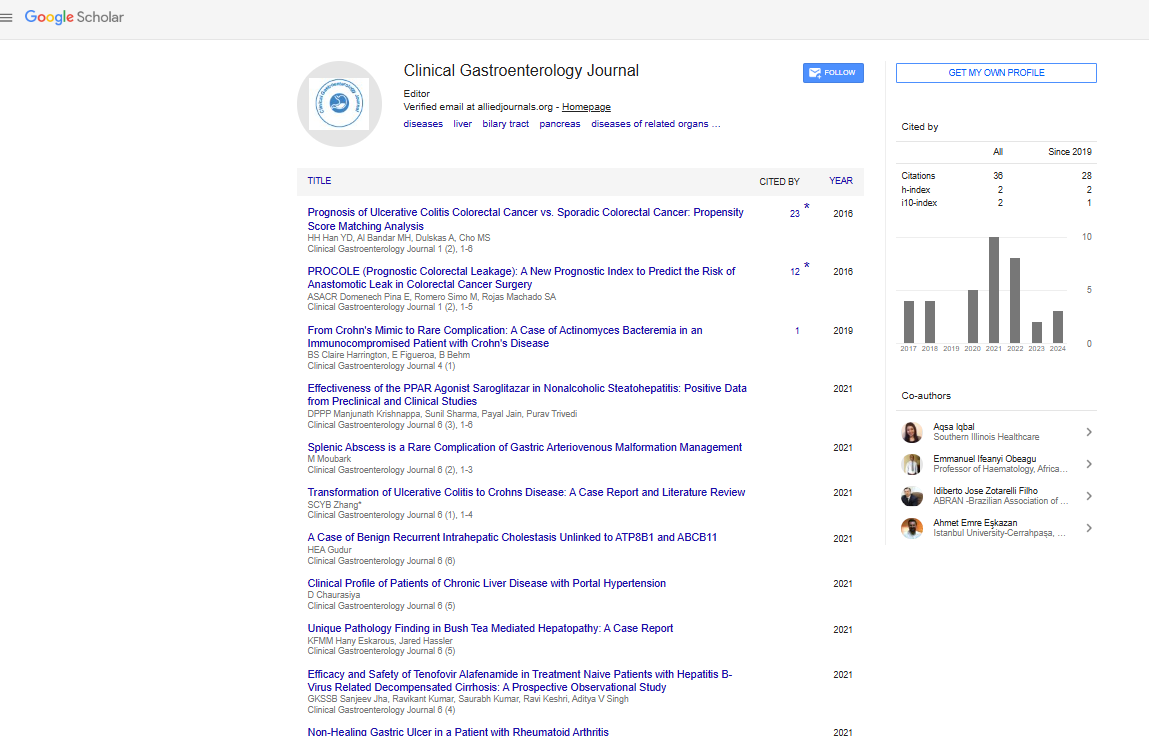
Clinical Gastroenterology Journal received 33 citations as per Google Scholar report