Brief Report - (2025) Volume 11, Issue 4
Received: 01-Jul-2025, Manuscript No. jefc-26-188291;
Editor assigned: 03-Jul-2025, Pre QC No. P-188291;
Reviewed: 17-Jul-2025, QC No. Q-188291;
Revised: 22-Jul-2025, Manuscript No. R-188291;
Published:
29-Jul-2025
, DOI: 10.37421/2472-0542.2025.11.557
Citation: Fernandez, Miguel. ”Starch Gelatinization and Retrogradation: Food Texture Insights.” J Exp Food Chem 11 (2025):557.
Copyright: © 2025 Fernandez M. This is an open-access article distributed under the terms of the Creative Commons Attribution License, which permits unrestricted use, distribution and reproduction in any medium, provided the original author and source are credited.
The complex interplay between starch gelatinization and retrogradation is a fundamental aspect of food science, profoundly influencing the texture, stability, and shelf-life of a vast array of food products. Starch, a primary carbohydrate in many staple foods, undergoes significant structural transformations when subjected to heat and moisture. Gelatinization, the initial process where starch granules absorb water and swell, leading to the disruption of crystalline structures and increased viscosity, is a critical step in food processing. This is often followed by retrogradation, a phenomenon where gelatinized starch molecules re-associate and form crystalline regions, leading to undesirable changes such as staling and hardening. Understanding these interconnected processes is paramount for food manufacturers aiming to achieve desired product attributes and extend product viability. Research has delved into the diverse factors that govern these starch behaviors across various food matrices. For instance, studies have detailed how processing conditions like temperature and pH, alongside the presence of other food components, intricately orchestrate starch's structural shifts. These shifts directly translate into altered textures and stabilities, making the control of gelatinization and retrogradation vital in product development, particularly in applications such as baking and extrusion, and in ensuring the shelf-life of processed foods. This research provides foundational insights into managing these transformations for enhanced food quality [1].
Further investigations have explored the role of specific food ingredients in modulating starch's response. The influence of different hydrocolloids on the gelatinization and retrogradation of waxy corn starch, for example, has been a subject of study. It has been demonstrated how substances like xanthan gum and carboxymethylcellulose can alter starch-water interactions, thereby affecting key parameters such as gelatinization temperature and the rate at which retrogradation occurs. A thorough comprehension of these interactions is indispensable for formulating foods with targeted textural characteristics and extended shelf life [2].
Innovative processing technologies are also being examined for their impact on starch behavior. The effect of high-pressure processing on starch gelatinization and subsequent retrogradation in rice flour, for instance, has shown promising results. High pressure has been observed to modify starch's gelatinization properties and can substantially reduce the extent of retrogradation, leading to improved texture and stability in gluten-free products. This offers a viable alternative processing method for enhancing food quality [3].
Strategies to inhibit starch retrogradation are also a significant area of research, aiming to maintain desirable food attributes. The role of amylose-lipid complexes in preventing starch retrogradation has been elucidated. The formation of these complexes during processing can significantly impede the recrystallization of amylose, consequently preserving a softer texture and extending the shelf life of starch-based foods. This knowledge is crucial for developing products that effectively resist staling [4].
The application of different heating methods can also lead to unique starch behavior patterns. The impact of microwave heating on the gelatinization and retrogradation of corn starch, for instance, has been analyzed. Microwave energy has been found to influence starch swelling and solubility distinctively from conventional heating methods, thereby affecting both the extent and the rate of retrogradation. This information is highly valuable for optimizing microwave-assisted food processing techniques [5].
Beyond temperature and processing methods, the chemical environment surrounding starch granules plays a crucial role. The effect of various salt types and concentrations on starch gelatinization and retrogradation in potato starch has been investigated. It has been shown that ions can significantly influence water binding to starch, which in turn alters gelatinization temperatures and the kinetics of retrogradation. This understanding is essential for effectively controlling texture in salted food products [6].
The presence of other macronutrients can also impact starch behavior. The influence of protein content on starch gelatinization and retrogradation within a model food system has been studied. Proteins have been found to interact with starch granules, affecting water accessibility and consequently modifying both gelatinization characteristics and the degree of retrogradation. This has significant implications for the texture and shelf-life of composite food products [7].
Physical and chemical modifications of starch itself can also be employed to tailor its properties. The effect of enzyme modification on the gelatinization and retrogradation of tapioca starch has been examined. Enzymatic treatments can effectively alter starch structure, leading to changes in gelatinization temperature, enthalpy, and retrogradation behavior, providing a means to customize starch properties for specific food applications [8].
Finally, the role of sugars in starch transformations is also a critical consideration. Research investigating the impact of sugar type and concentration on the gelatinization and retrogradation of wheat starch has revealed that different sugars interact distinctively with starch granules. These interactions affect water mobility, thereby influencing gelatinization temperature, swelling, and the rate of retrogradation, which is particularly significant for formulating confectionery and baked goods [9].
Another critical factor influencing starch retrogradation is the cooling rate after gelatinization. Studies have shown that the rate at which a cooked starch system cools can significantly dictate the extent of retrogradation. Slower cooling rates typically promote more extensive starch recrystallization, leading to increased firmness and a drier texture over time. Understanding these kinetics is crucial for predicting and controlling the shelf-life of various cooked starch-based products, such as rice [10].
The fundamental processes of starch gelatinization and retrogradation are central to the quality and stability of numerous food products, driving extensive research aimed at understanding and controlling these phenomena. Gelatinization involves the disruption of starch granules through hydration and heat, leading to increased viscosity and textural changes. This is typically followed by retrogradation, a process where gelatinized starch molecules re-associate, leading to undesirable effects like staling and hardening. The intricate nature of these transformations necessitates a detailed examination of the factors influencing them within diverse food systems [1].
Numerous studies have focused on the impact of processing conditions on starch behavior. Research has demonstrated how parameters such as temperature, pH, and the presence of other food constituents can significantly alter starch's structural characteristics, directly affecting texture and stability. These insights are crucial for optimizing product development, especially in applications like baking and extrusion, and for enhancing the shelf-life of processed foods by effectively managing starch transformations [1].
The role of specific food ingredients in modifying starch behavior has also been a key area of investigation. For example, the influence of different hydrocolloids on the gelatinization and retrogradation of waxy corn starch has been explored. It has been shown that compounds like xanthan gum and carboxymethylcellulose can modulate starch-water interactions, impacting gelatinization temperatures and the rate of retrogradation. This knowledge is vital for formulating foods with desired textural properties and extended shelf life [2].
Advancements in processing technologies offer new avenues for controlling starch transformations. High-pressure processing, for instance, has been investigated for its effects on starch gelatinization and subsequent retrogradation in rice flour. The findings indicate that high pressure can alter gelatinization behavior and reduce retrogradation, leading to improved texture and stability in gluten-free products, presenting an alternative method for enhancing food quality [3].
Strategies to mitigate starch retrogradation are critical for maintaining food quality over time. The formation of amylose-lipid complexes has been identified as an effective mechanism for inhibiting starch retrogradation. During processing, these complexes can significantly limit the recrystallization of amylose, thereby helping to preserve a softer texture and extend the shelf life of starch-based foods. This is particularly important for products prone to staling [4].
The impact of different heating methods on starch behavior is another significant research area. Microwave heating, for example, has been studied for its unique effects on corn starch gelatinization and retrogradation. Microwave energy has been observed to influence starch swelling and solubility in ways that differ from conventional heating, thereby altering the extent and rate of retrogradation. This information is valuable for optimizing microwave-assisted food processing [5].
The chemical environment plays a crucial role in starch transformations. Studies on potato starch have shown that different salt types and concentrations can significantly affect starch gelatinization and retrogradation. The presence of ions influences water binding to starch, which consequently alters gelatinization temperatures and the kinetics of retrogradation. This is essential for controlling the texture of salted food products [6].
Interactions with other food components, such as proteins, also influence starch behavior. Research in model food systems has demonstrated that proteins can interact with starch granules, affecting water accessibility and thereby modifying both gelatinization characteristics and the degree of retrogradation. These interactions have direct implications for the texture and shelf-life of composite food products [7].
Starch itself can be modified to tailor its properties for specific applications. Enzymatic modification of tapioca starch, for instance, has been shown to alter its structure, leading to changes in gelatinization temperature, enthalpy, and retrogradation behavior. These modifications provide a means to customize starch properties for various food applications [8].
Finally, the influence of sugars on starch behavior is a key consideration in product formulation. Studies on wheat starch have revealed that different sugars interact differently with starch granules, affecting water mobility and thus influencing gelatinization temperature, swelling, and the rate of retrogradation. This is particularly relevant for the development of confectionery and baked goods [9].
Furthermore, the rate at which a starch-containing food cools after gelatinization significantly impacts retrogradation. Research on cooked rice systems indicates that slower cooling rates promote more extensive starch recrystallization, resulting in increased firmness and a drier texture over time. Understanding these cooling kinetics is vital for predicting and managing the shelf-life of such products [10].
This compilation of research explores the critical processes of starch gelatinization and retrogradation, fundamental to food texture and stability. Studies detail how processing conditions like temperature, pH, and the presence of other food components, including hydrocolloids, proteins, and sugars, influence starch's structural changes. Innovative processing methods such as high-pressure processing and microwave heating are investigated for their effects. Strategies to inhibit retrogradation, like amylose-lipid complexation, are also highlighted. Additionally, the impact of salt ions, enzyme modification, and cooling rates on starch behavior are examined, providing comprehensive insights for improving food quality and extending shelf-life.
None
None
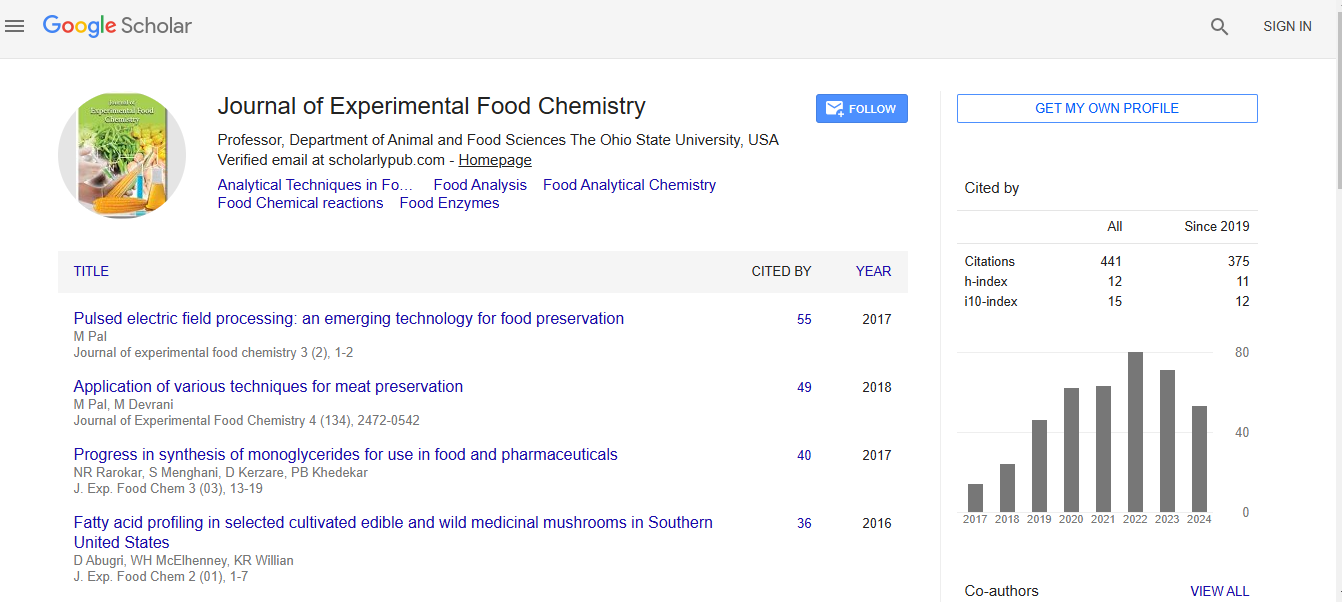
Journal of Experimental Food Chemistry received 389 citations as per Google Scholar report