Perspective - (2025) Volume 11, Issue 6
Received: 01-Nov-2025, Manuscript No. jefc-26-188322;
Editor assigned: 03-Nov-2025, Pre QC No. P-188322;
Reviewed: 17-Nov-2025, QC No. Q-188322;
Revised: 24-Nov-2025, Manuscript No. R-188322;
Published:
29-Nov-2025
, DOI: 10.37421/2472-0542.2025.11.571
Citation: Benali, Youssef. ”Sweeteners in Processed Foods: Analysis and Implications.” J Exp Food Chem 11 (2025):571.
Copyright: © 2025 Benali Y. This is an open-access article distributed under the terms of the Creative Commons Attribution License, which permits unrestricted use, distribution and reproduction in any medium, provided the original author and source are credited.
The pervasive presence of sweeteners in modern processed foods necessitates a thorough understanding of their chemical nature and impact. This field of study is crucial for ensuring food safety, informing regulatory bodies, and guiding consumer choices regarding dietary intake. Analytical chemistry plays a pivotal role in this endeavor, providing the tools and methodologies required to identify, quantify, and assess the quality of these ubiquitous food additives. The investigation into artificial and natural sweeteners within a variety of processed food products is a key area of research. Employing advanced analytical techniques, such as High-Performance Liquid Chromatography (HPLC), allows for the precise determination of sweetener levels. These findings are vital for public health, especially concerning the potential implications of excessive consumption and the need for robust regulatory oversight across different food categories [1].
Developing and validating sensitive analytical methods for the detection of sweeteners in complex food matrices is paramount. Techniques like Ultra-High-Performance Liquid Chromatography coupled with tandem Mass Spectrometry (UHPLC-MS/MS) offer remarkable sensitivity and selectivity. Such methods are essential for examining common food items and providing crucial data on issues like sweetener adulteration and migration from packaging materials [2].
A comprehensive review of the current landscape of sweetener usage in the food industry, including their chemical profiles and regulatory standing, is indispensable. This review helps to illuminate the challenges associated with analytical detection and underscores the importance of standardized methodologies for maintaining food safety and consumer confidence. Furthermore, it can highlight emerging sweeteners and their potential future impacts [3].
Understanding the stability and potential degradation products of artificial sweeteners under various food processing conditions, such as heating and pH variations, is a critical aspect of food safety. Spectroscopic and chromatographic techniques are instrumental in identifying and quantifying these degradation products, offering insights into their safety and the alteration of original sweetener properties [4].
Research into the presence of natural sweeteners, particularly steviol glycosides, in processed foods is gaining prominence. Focusing on their extraction and quantification using advanced analytical techniques provides a clearer picture of ingredient labeling accuracy and product composition, especially in items marketed as low-calorie or sugar-free [5].
The potential migration of sweeteners from food packaging materials into processed foods is another significant concern. Studies employing techniques like gas chromatography and mass spectrometry are vital for assessing the levels of sweeteners that may leach from packaging under different storage conditions, thereby identifying potential consumer exposure pathways [6].
A comprehensive chemical profiling of sweeteners in popular processed food items is necessary to address concerns about undeclared or counterfeit ingredients. Utilizing advanced spectroscopic methods helps confirm the identity and purity of sweeteners, contributing to greater transparency and safety in the food supply chain [7].
The impact of different processing techniques on sweetener content and sensory properties of processed foods warrants detailed examination. Quantifying sweeteners before and after processes such as extrusion and pasteurization, and correlating these chemical changes with taste profile alterations, is important for product development and quality control [8].
The development of novel, on-site detection methods for adulterated sweeteners in processed foods, using portable spectroscopic devices, offers significant potential for rapid screening and enhanced food safety surveillance in diverse food environments [9].
Comparative studies assessing sweetener profiles in processed foods from different geographical regions are crucial for understanding market trends and regulatory differences. Identifying regional variations in sweetener usage and potential enforcement disparities can highlight implications for international food trade and global consumer health [10].
This work meticulously investigates the presence and quantification of both artificial and natural sweeteners within a diverse array of processed food products. Analytical methodologies, prominently including High-Performance Liquid Chromatography (HPLC), were rigorously employed to ascertain specific sweetener levels. The study importantly draws attention to potential public health implications, particularly related to the overconsumption of certain sweeteners and the critical need for effective regulatory oversight. The findings also illuminate the varied patterns of sweetener incorporation across distinct food categories [1].
The research presented herein concentrates on the development and meticulous validation of highly sensitive analytical methods designed for the detection of sweeteners within complex food matrices. By utilizing Ultra-High-Performance Liquid Chromatography coupled with tandem Mass Spectrometry (UHPLC-MS/MS), the study achieved exceptional levels of sensitivity and selectivity. It systematically examined commonly consumed food items, such as beverages, dairy products, and baked goods, thereby furnishing essential data concerning sweetener adulteration and potential migration from packaging components [2].
This paper offers a thorough review of the contemporary landscape of sweetener utilization within the food industry, with a specific emphasis on the chemical characteristics and regulatory classifications of widely adopted sweeteners. It deliberates on the inherent challenges encountered in analytical detection and underscores the indispensable nature of standardized methodologies for upholding food safety standards and fostering consumer trust. The review also addresses the emergence of novel sweeteners and their potential future influences [3].
This particular study undertakes an evaluation of the stability and the identification of potential degradation products of common artificial sweeteners when subjected to the rigors of food processing conditions, including elevated temperatures and fluctuating pH levels. Spectroscopic and chromatographic analytical techniques were instrumental in identifying and quantifying these degradation products, thereby providing valuable insights into their safety profiles and the potential alteration of the intrinsic properties of the original sweeteners [4].
This research delves into the exploration of steviol glycosides and other naturally derived sweeteners found in processed foods, with a particular focus on their efficient extraction and accurate quantification. The application of sophisticated analytical techniques was employed to assess the natural sweetener content in products specifically marketed as 'sugar-free' or 'low-calorie,' consequently offering a more lucid perspective on the precision of ingredient labeling and the actual composition of these products [5].
This article scrutinizes the potential for sweeteners to migrate from food packaging materials into the processed foods they contain. Employing analytical techniques such as gas chromatography and mass spectrometry, the study meticulously assessed the concentrations of specific sweeteners that might leach from plastic containers and films under a range of storage conditions, thereby highlighting potential routes of consumer exposure to these compounds [6].
This research provides an exhaustive chemical profile of the sweeteners present in widely consumed processed food items, encompassing products like cookies, yogurts, and carbonated beverages. The study harnesses advanced spectroscopic methods to rigorously confirm the identity and purity of the sweeteners, thereby directly addressing consumer concerns regarding the potential presence of undeclared or counterfeit ingredients within the food supply [7].
This study investigates the tangible effects of distinct food processing techniques on both the sweetener content and the sensory attributes of processed food products. Analytical chemistry techniques were adeptly utilized to quantify sweetener levels both prior to and following processing steps such as extrusion and pasteurization, establishing a correlation between observed chemical modifications and subsequent alterations in taste profiles [8].
This paper meticulously details the development and implementation of a novel method designed for the on-site detection of adulterated sweeteners within processed food products, leveraging portable spectroscopic devices. The research underscores the considerable potential for rapid screening capabilities and enhanced quality control measures in a variety of food-handling environments, thereby contributing significantly to more robust food safety surveillance systems [9].
This comparative analysis systematically assesses the sweetener profiles of processed foods that are marketed across different geographical regions. Through the strategic application of chromatographic techniques, the research successfully identifies notable regional disparities in sweetener usage patterns, potential variations in the enforcement of regulations, and the subsequent implications for international food commerce and the health of global consumers [10].
This collection of research examines the presence, quantification, and chemical characteristics of sweeteners in processed foods. Studies utilize advanced analytical techniques like HPLC and UHPLC-MS/MS to detect and measure both artificial and natural sweeteners, including steviol glycosides. Key concerns addressed include potential public health implications from excessive intake, regulatory oversight needs, and the accuracy of 'sugar-free' labeling. Research also investigates sweetener stability during food processing, migration from packaging materials, and regional variations in sweetener usage. Furthermore, the development of rapid, on-site detection methods for sweetener adulteration is highlighted, alongside comprehensive chemical profiling to ensure ingredient purity and safety.
None
None
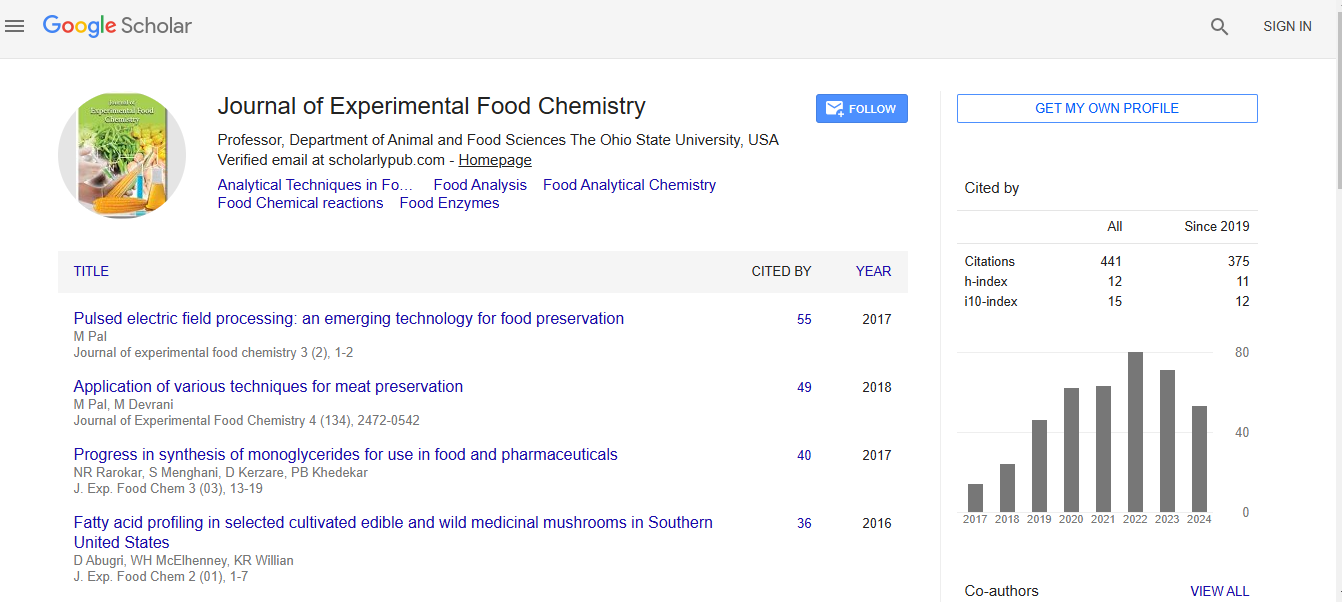
Journal of Experimental Food Chemistry received 389 citations as per Google Scholar report