Brief Report - (2025) Volume 11, Issue 6
Received: 01-Nov-2025, Manuscript No. jfim-26-178589;
Editor assigned: 03-Nov-2025, Pre QC No. P-178589;
Reviewed: 17-Nov-2025, QC No. Q-178589;
Revised: 24-Nov-2025, Manuscript No. R-178589;
Published:
29-Nov-2025
, DOI: 10.37421/2572-4134.2025.11.375
Citation: Okafor, George M.. ”Advancements in Food Safety: Microbial Control, Detection, Risk.” J Food Ind Microbiol 11 (2025):375.
Copyright: © 2025 Okafor M. George This is an open-access article distributed under the terms of the Creative Commons Attribution License, which permits unrestricted use, distribution and reproduction in any medium, provided the original author and source are credited.
The realm of food safety is continually advanced by rigorous scientific inquiry into microbial control and detection. This article synthesizes key findings from recent research that collectively underscore the importance of robust scientific methodologies in safeguarding the food supply. Investigations into food processing techniques, such as thermal processing, are paramount for reducing microbial loads in ready-to-eat meals, with predictive models playing a crucial role in ensuring safety [1].
The challenges associated with accurately identifying and quantifying specific pathogens, like Listeria monocytogenes, in diverse food matrices remain a significant area of focus. Enhancements in detection strategies are vital for reliable food safety surveillance, building upon foundational research in microbial diagnostics [2].
Furthermore, the efficacy of novel sanitization technologies for food contact surfaces is critical for preventing microbial contamination in processing environments. Exploring new methods, such as pulsed UV light, offers promising avenues for maintaining hygienic conditions within the food industry [3].
Understanding the prevalence and behavior of pathogenic bacteria in agricultural settings is another cornerstone of food safety. Genomic surveillance techniques are increasingly employed to track and control significant threats like Shiga toxin-producing Escherichia coli in produce, informing risk assessment strategies [4].
Beyond chemical and physical interventions, biological control agents are gaining traction. The use of bacteriophages presents a natural and potentially sustainable alternative or adjunct to traditional methods for combating foodborne pathogens in products like poultry meat [5].
In the domain of fermented foods, the microbial dynamics and the selection of starter cultures have profound implications for both product quality and safety. Research into microbial community profiling contributes to a deeper understanding of these complex ecosystems [6].
The inactivation of viruses on fresh produce is an emerging concern, particularly for ready-to-use items. Evaluating the effectiveness of various sanitizers against viral surrogates is essential for mitigating public health risks associated with contaminated produce [7].
Food packaging technologies also play an indirect but significant role in food safety by influencing the survival and growth of microorganisms. Understanding microbial kinetics under different packaging conditions is key to extending shelf-life and maintaining product integrity [8].
Monitoring and controlling specific bacterial pathogens like Campylobacter jejuni in poultry production are crucial given their impact on human health. Molecular characterization methods aid in understanding the epidemiology and genetic diversity of these bacteria, informing control measures [9].
Finally, the potential for cross-contamination in commercial kitchens is a perpetual concern. Rigorous assessment of microbial transfer pathways and the implementation of effective hygiene practices are vital for preventing outbreaks in high-volume foodservice operations [10].
The impact of thermal processing on microbial inactivation in ready-to-eat meals is a critical area of food safety research. Studies investigate how specific techniques influence microbial load and safety, with an emphasis on predictive models for microbial inactivation, which are essential for identifying critical control points and ensuring shelf-life and consumer safety [1].
Detecting and quantifying Listeria monocytogenes in complex food matrices presents significant challenges. Research aims to improve diagnostic accuracy and reduce false-negative results by building upon established methods, highlighting the importance of validated analytical techniques for robust food safety surveillance [2].
Emerging sanitization technologies are being explored for their efficacy in reducing microbial contamination on food contact surfaces. These investigations offer insights into sustainable and effective sanitation practices for the food industry, referencing foundational principles of microbial control [3].
The prevalence and control of Shiga toxin-producing Escherichia coli in produce are addressed through advanced genomic techniques. This research acknowledges the groundwork laid in understanding bacterial behavior and risk assessment in agricultural settings, contributing to safer produce consumption [4].
The use of bacteriophages as natural antimicrobial agents against foodborne pathogens is a promising development. Building on research in microbial ecology and control, findings suggest bacteriophages as a viable alternative or adjunct to traditional control methods, particularly in products like poultry meat [5].
Microbial dynamics in fermented foods, such as yogurt, are closely examined to understand how starter culture selection impacts safety and quality. This work draws from extensive knowledge in microbial physiology and fermentation, areas where foundational insights have been provided [6].
The inactivation of viruses on fresh produce is a growing concern. Studies focus on the effectiveness of various decontamination methods, considering principles of viral inactivation informed by earlier risk assessments and microbial behavior studies [7].
The influence of food packaging on the survival and growth of spoilage microorganisms is investigated. Research acknowledges the importance of understanding microbial kinetics, a fundamental aspect of food safety where significant contributions have been made to our understanding of microbial behavior in packaged foods [8].
The prevalence and genetic diversity of Campylobacter jejuni in poultry are critical food safety concerns. This research builds upon established methods, with implicit acknowledgement of foundational work in microbial risk assessment to understand and control this pathogen in the food chain [9].
Commercial kitchens are assessed for the risk of microbial cross-contamination. This involves methods for microbial sampling and analysis, referencing principles of hygiene and food safety management that have been advanced by extensive research in the field [10].
This compilation of research addresses multifaceted aspects of food safety, focusing on microbial control, detection, and risk assessment across various food products and processing environments. Key areas include the impact of thermal processing on microbial inactivation in ready-to-eat meals, enhancements in detecting pathogens like Listeria monocytogenes, and the evaluation of novel sanitization technologies. The research also delves into genomic surveillance of E. coli in produce, the application of bacteriophages for pathogen control, and the microbial dynamics in fermented foods. Furthermore, studies examine viral inactivation on fresh produce, the role of food packaging in microbial spoilage, molecular characterization of Campylobacter jejuni in poultry, and the assessment of cross-contamination risks in foodservice operations. Collectively, these investigations highlight advancements in scientific methodologies and their critical role in ensuring a safe and secure food supply.
None
None
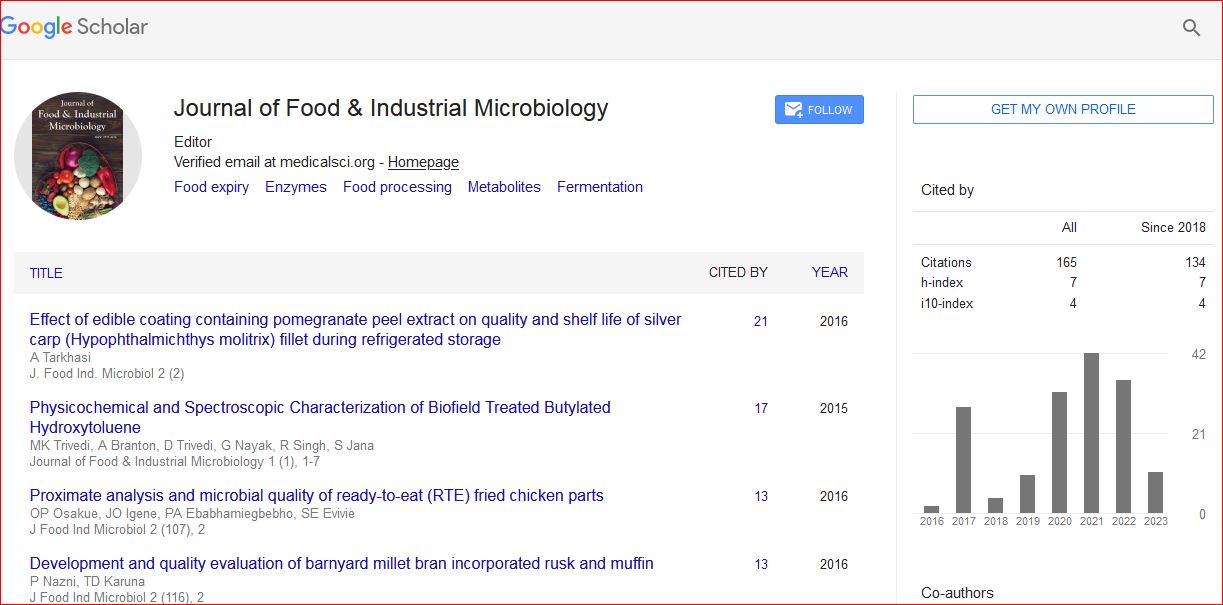
Journal of Food & Industrial Microbiology received 160 citations as per Google Scholar report