Commentary - (2025) Volume 11, Issue 4
Received: 01-Jul-2025, Manuscript No. jfim-26-178567;
Editor assigned: 03-Jul-2025, Pre QC No. P-178567;
Reviewed: 17-Jul-2025, QC No. Q-178567;
Revised: 22-Jul-2025, Manuscript No. R-178567;
Published:
29-Jul-2025
, DOI: 10.37421/2572-4134.2025.11.363
Citation: Costa, Helena M.. ”Advanced Starter Culture Preservation Techniques: Viability and Stability.” J Food Ind Microbiol 11 (2025):353.
Copyright: © 2025 Costa M. Helena This is an open-access article distributed under the terms of the Creative Commons Attribution License, which permits unrestricted use, distribution and reproduction in any medium, provided the original author and source are credited.
The preservation of starter cultures is a critical aspect of modern food fermentation, ensuring the consistent quality and safety of a wide array of products. Recent advancements have focused on developing techniques that not only extend the viability of these microbial communities but also maintain their functional stability over extended periods. These efforts are vital for both industrial applications and the development of novel fermented foods. This review delves into the sophisticated methodologies that have emerged to address the challenges inherent in long-term microbial storage, aiming to provide a comprehensive overview of the current landscape and future prospects in starter culture preservation [1].
One of the primary challenges in preserving starter cultures lies in minimizing cellular damage during storage. Various cryoprotective agents have been investigated to shield microbial cells from the detrimental effects of freezing and subsequent storage conditions. The selection of appropriate cryoprotectants is paramount, as different species and strains may respond uniquely to these protective formulations, directly impacting their performance after preservation [2].
Encapsulation technologies have also garnered significant attention as a means to safeguard sensitive microorganisms. Techniques such as microencapsulation, often employing materials like alginate, provide a physical barrier that protects bacteria from harsh environmental conditions encountered during processing and storage. This protective shell is crucial for enhancing survival rates and ensuring the desired microbial load in the final fermented product [3].
Freeze-drying, or lyophilization, remains a cornerstone of starter culture preservation, but its efficacy can be significantly enhanced through optimized protocols and the judicious use of cryoprotectants. Novel approaches, such as the integration of trehalose into freeze-drying processes for yeast cultures, have demonstrated a remarkable improvement in cell viability and subsequent fermentative activity, offering more robust solutions for long-term storage [4].
Beyond drying and freezing, the ambient conditions under which starter cultures are stored play a pivotal role in their longevity. Research into the impact of storage temperatures and atmospheric compositions has revealed that controlled environments, even at sub-zero temperatures, can dramatically extend the shelf-life and preserve essential enzymatic activities of bacterial starter cultures, providing valuable insights for industrial implementation [5].
For specific bacterial strains, such as Bifidobacterium, the development of specialized cryoprotective mixtures is crucial. These mixtures often combine sugars and polymers designed to minimize ice crystal formation and cellular damage during cryopreservation. The successful application of such formulations leads to higher post-cryopreservation survival rates and the retention of probiotic functionality [6].
Understanding the fundamental mechanisms of cell death during preservation processes, particularly lyophilization, is essential for developing more effective strategies. Studies that investigate the molecular basis of this cell death, by analyzing gene expression patterns, can identify key stress-response pathways and inform targeted interventions, whether through genetic modification or optimized processing conditions, to enhance culture resilience [7].
Alternative drying techniques, such as spray drying, are also being explored as potential replacements for traditional lyophilization. When combined with protective matrices, spray drying can achieve comparable or even superior results in terms of cell recovery and post-drying stability for probiotic bacteria. This offers a promising avenue for more cost-effective industrial preservation methods [8].
The long-term stability and genetic integrity of freeze-dried starter cultures are significantly influenced by environmental factors, particularly relative humidity. Maintaining a low relative humidity during storage is critical for preventing cellular degradation and genetic drift, thereby ensuring the consistent performance and reliability of starter cultures in industrial fermentation processes [9].
Furthermore, the use of osmotic protectants, including various sugars and amino acids, has been shown to significantly improve the survival of lactic acid bacteria during freeze-drying and subsequent rehydration. These protectants stabilize cellular structures, mitigate dehydration stress, and ultimately lead to enhanced starter culture performance in demanding industrial applications [10].
The preservation of starter cultures for food fermentation necessitates a diverse array of techniques to ensure microbial viability and functional stability. These methods are crucial for maintaining the quality and consistency of fermented products on an industrial scale. Recent research has significantly advanced our understanding and application of these preservation strategies, addressing the inherent fragility of microorganisms during storage and processing [1].
Cryopreservation, a widely adopted method, relies heavily on the use of cryoprotective agents to shield microbial cells from the damaging effects of ice crystal formation and osmotic stress during freezing and thawing. The efficacy of these agents is strain-dependent, and ongoing research aims to optimize formulations for specific lactic acid bacteria to maximize post-preservation survival and metabolic activity for subsequent industrial fermentation [2].
Encapsulation technologies, particularly microencapsulation using materials like alginate, offer a protective barrier for probiotic bacteria. This approach shields the microorganisms from adverse environmental conditions encountered during food processing and storage, thereby improving their survival rates and ensuring the targeted delivery of live microbes in fermented foods. The study of release mechanisms from these capsules is also a key area of focus [3].
Lyophilization, or freeze-drying, remains a preferred method for long-term preservation. However, its effectiveness can be further augmented by incorporating specific cryoprotectants. The use of trehalose in conjunction with improved freeze-drying protocols has shown substantial benefits for yeast starter cultures, leading to significantly higher cell viability and fermentative activity after prolonged storage, thus providing a more robust solution for yeast preservation [4].
Storage conditions themselves play a profound role in the longevity of starter cultures. Investigations into the impact of temperature and atmospheric composition have demonstrated that carefully controlled environments, including sub-zero temperatures and specific gas mixtures, can significantly extend the shelf-life and preserve the critical enzymatic activities of bacterial starter cultures used in industries like dairy production [5].
For sensitive probiotic strains, such as Bifidobacterium, the development of tailored cryoprotective mixtures is essential. These mixtures, often a combination of sugars and polymers, are designed to minimize cellular damage during freezing and thawing by controlling ice crystal formation. This leads to enhanced cryostability, higher survival rates, and the retention of crucial probiotic functions [6].
Delving into the molecular underpinnings of cell death during lyophilization is vital for developing more resilient starter cultures. By analyzing gene expression profiles, researchers can identify the molecular pathways involved in stress responses during freeze-drying. This knowledge can then be used to guide strategies for improving culture resilience, either through genetic engineering or by refining processing parameters [7].
In parallel with lyophilization, alternative drying techniques are being explored for their potential in preserving microbial cultures. Spray drying, when employed with suitable protective matrices, has demonstrated effectiveness comparable to or even exceeding traditional lyophilization for probiotic bacteria. This method presents a potentially more economical option for industrial-scale preservation [8].
The long-term viability and genetic stability of freeze-dried starter cultures are heavily influenced by environmental factors, most notably relative humidity. Studies emphasize that maintaining a low relative humidity is paramount to preventing cellular deterioration and genetic changes, ensuring that starter cultures retain their consistent performance and efficacy in fermentation processes [9].
Osmotic protectants, such as certain sugars and amino acids, have proven to be valuable tools in enhancing the survival of lactic acid bacteria during freeze-drying and rehydration. These compounds stabilize cellular structures and alleviate dehydration stress, contributing to improved starter culture performance and reliability in industrial applications [10].
This compilation of research focuses on advanced techniques for preserving starter cultures used in food fermentation. It details advancements in cryopreservation, lyophilization, and encapsulation, highlighting methods to enhance microbial viability and stability. The studies explore the use of cryoprotective agents, protective matrices in drying techniques like spray drying, and the impact of storage conditions. Optimizing these preservation strategies is crucial for maintaining the functional performance and genetic integrity of starter cultures in industrial settings, ensuring consistent product quality and safety in fermented foods.
None
None
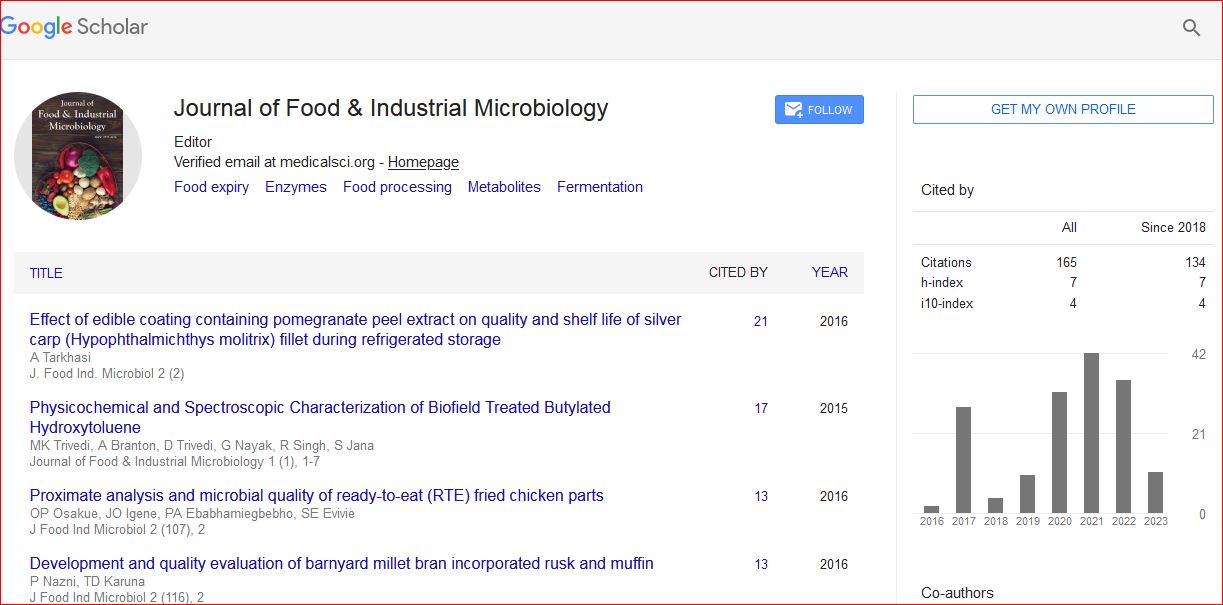
Journal of Food & Industrial Microbiology received 160 citations as per Google Scholar report