The word weedy rice generally includes all the species of genus Oryza which behave as rice and which crop in rotation with rice weeds. Even though weedy rice belongs to different species and subspecies, all these plants share the ability to disseminate their grains before rice harvesting. The phylogenetic origin of the weedy forms is closely related to that of cultivated rice. Many weedy plants share most of the features of the two cultivated species O. glaberrima and Oryza sativa. O. sativa, which is also known as Asian, comprises the varietal groups indica, japonica and javanica, and is grown worldwide. O. glaberrima is also termed as African rice and is mainly cultivated in West Africa. The genus Oryza includes more than 20 wild species most of which are diploid. Based on the morphological, physiological, biochemical features and crossing relationships, eight different genomes have been identified in the genus Oryza.
Research Article: Journal of Experimental Food Chemistry
Research Article: Journal of Experimental Food Chemistry
Review Article: Journal of Experimental Food Chemistry
Review Article: Journal of Experimental Food Chemistry
Research Article: Journal of Experimental Food Chemistry
Research Article: Journal of Experimental Food Chemistry
Review Article: Journal of Experimental Food Chemistry
Review Article: Journal of Experimental Food Chemistry
Research Article: Journal of Experimental Food Chemistry
Research Article: Journal of Experimental Food Chemistry
Posters & Accepted Abstracts: Chemical Sciences Journal
Posters & Accepted Abstracts: Chemical Sciences Journal
Posters & Accepted Abstracts: Chemical Sciences Journal
Posters & Accepted Abstracts: Chemical Sciences Journal
Scientific Tracks Abstracts: Chemical Sciences Journal
Scientific Tracks Abstracts: Chemical Sciences Journal
Posters & Accepted Abstracts: Medicinal Chemistry
Posters & Accepted Abstracts: Medicinal Chemistry
Scientific Tracks Abstracts: Medicinal Chemistry
Scientific Tracks Abstracts: Medicinal Chemistry
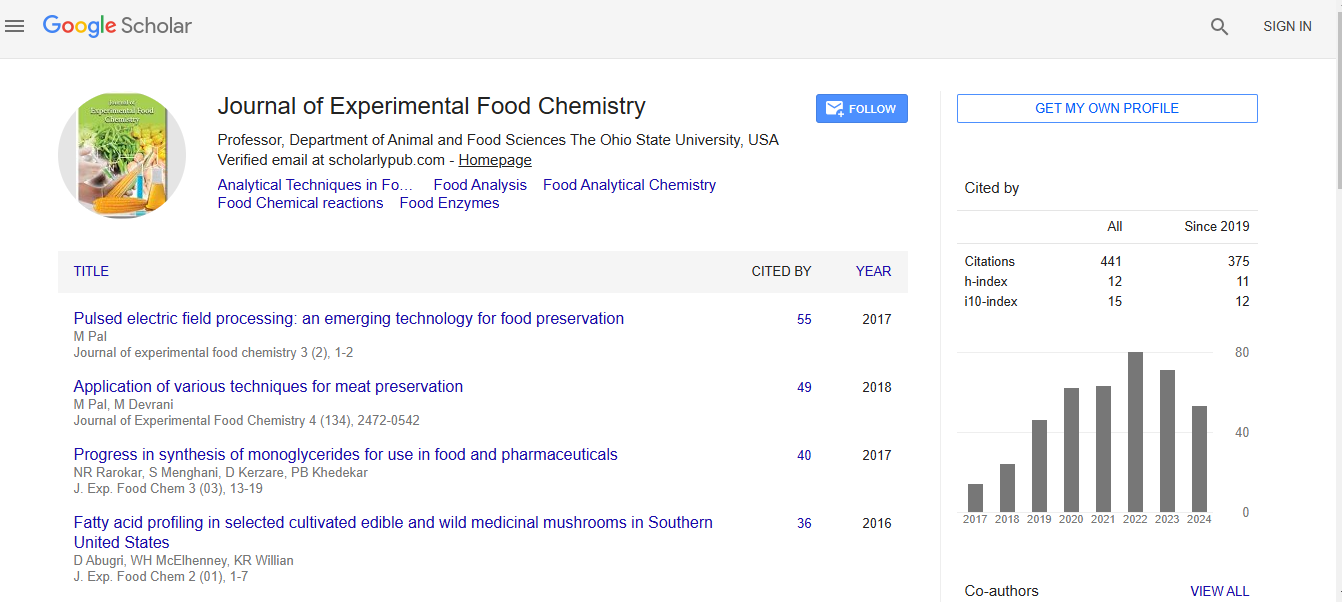
Journal of Experimental Food Chemistry received 389 citations as per Google Scholar report
 Spanish
  Chinese
  Russian
  German
  French
  Japanese
  Portuguese
  Hindi
Hindi 