Food-borne infections are common and constitute important health and economic burden globally. Among the factors responsible for this burden are centralization and globalization of food supply, increasing microbial resistance to antibiotics, and the growth of immunosuppressed subpopulations. non-typhoidal Salmonella is one of the most proclaimed causes of food-borne infections. Food products of animal origin (contaminated meat, poultry, eggs, and dairy products) are considered the most commonly identified source of Salmonella Infection. Eating undercooked eggs or meals prepared with uncooked eggs is a well-defined risk factor; in the last two decades, many salmonella outbreaks related to raw or undercooked egg consumption have been reported in deferent parts of the world. Salmonella bacteria are classified into different groups (B, C, D, and E); within each, there are many serotypes. More than two thousand of Salmonella serotypes have been described and all of them are considered pathogenic. Amongst them; S. Enteritidis and S. Typhimurium are the most commonly reported.
Research Article: Journal of Experimental Food Chemistry
Research Article: Journal of Experimental Food Chemistry
Research Article: Journal of Experimental Food Chemistry
Research Article: Journal of Experimental Food Chemistry
Editorial: Journal of Experimental Food Chemistry
Editorial: Journal of Experimental Food Chemistry
Posters & Accepted Abstracts: Chemical Sciences Journal
Posters & Accepted Abstracts: Chemical Sciences Journal
Posters & Accepted Abstracts: Journal of Environmental Analytical Chemistry
Posters & Accepted Abstracts: Journal of Environmental Analytical Chemistry
Posters & Accepted Abstracts: Medicinal Chemistry
Posters & Accepted Abstracts: Medicinal Chemistry
Scientific Tracks Abstracts: Medicinal Chemistry
Scientific Tracks Abstracts: Medicinal Chemistry
Posters & Accepted Abstracts: Journal of Experimental Food Chemistry
Posters & Accepted Abstracts: Journal of Experimental Food Chemistry
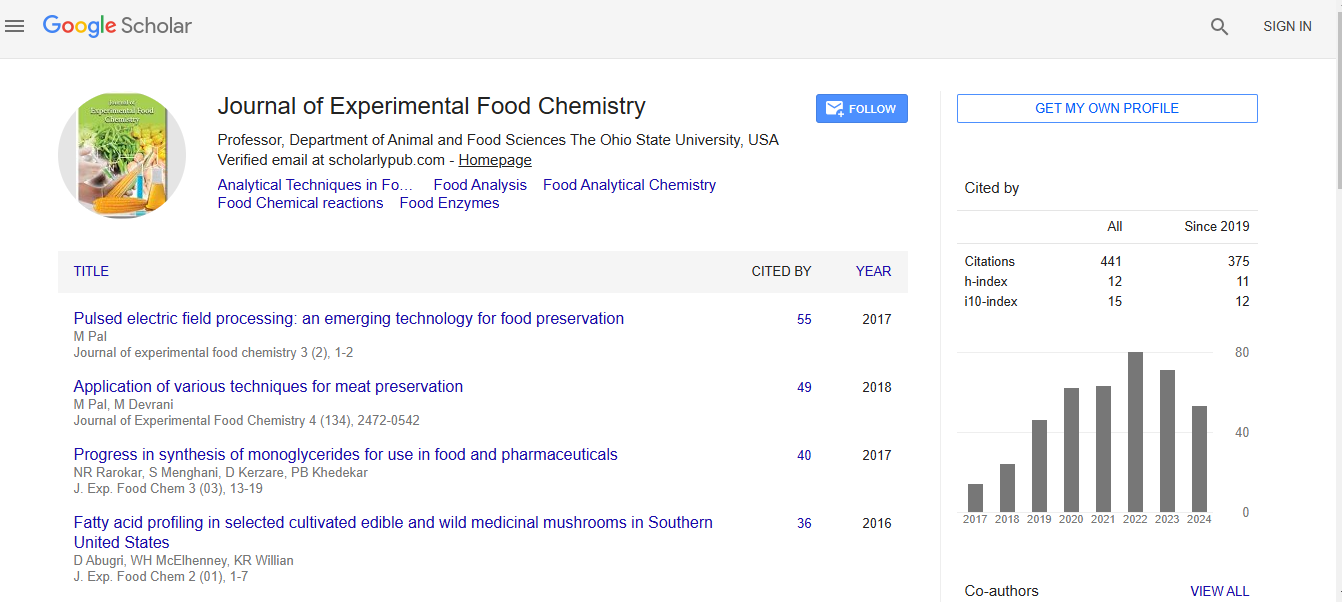
Journal of Experimental Food Chemistry received 389 citations as per Google Scholar report
 Spanish
  Chinese
  Russian
  German
  French
  Japanese
  Portuguese
  Hindi
Hindi 