Perspective - (2025) Volume 11, Issue 2
Received: 01-Mar-2025, Manuscript No. jfim-26-178554;
Editor assigned: 03-Mar-2025, Pre QC No. P-178554;
Reviewed: 17-Mar-2025, QC No. Q-178554;
Revised: 24-Mar-2025, Manuscript No. R-178554;
Published:
31-Mar-2025
, DOI: 10.37421/2572-4134.2025.11.340
Citation: Almeida, Lucas D.. ”Controlling Biofilms In Food Processing Environments.” J Food Ind Microbiol 11 (2025):340.
Copyright: © 2025 Almeida D. Lucas This is an open-access article distributed under the terms of the Creative Commons Attribution License, which permits unrestricted use, distribution and reproduction in any medium, provided the original author and source are credited.
Biofilm formation in food processing environments presents a significant and persistent challenge, leading to contamination, product spoilage, and potential health risks for consumers. These microbial communities, encased in a self-produced exopolysaccharide matrix, exhibit remarkable resistance to conventional cleaning and disinfection agents, posing a considerable threat to food safety and quality [1].
Understanding the multifaceted factors that promote biofilm development is paramount for the effective control of these microbial communities. Surface characteristics, nutrient availability, and specific environmental conditions are critical drivers that influence the initiation and maturation of biofilms, necessitating a comprehensive approach to their management [1].
The role of surface properties, including roughness and material composition, is critically important in determining the extent of biofilm adhesion within food processing lines. Smoother, non-porous surfaces generally demonstrate reduced biofilm formation compared to rougher or damaged surfaces, highlighting the impact of surface integrity on microbial colonization [2].
Stainless steel, a ubiquitous material in the food industry, can still harbor biofilms if not meticulously maintained, underscoring the need for diligent cleaning and sanitation practices. Research consistently emphasizes the importance of appropriate material selection and surface treatment in preventing the crucial initial step of microbial attachment [2].
Quorum sensing (QS) systems play a vital role in coordinating biofilm formation and the expression of virulence factors in numerous foodborne bacteria. Inhibiting these QS pathways offers a promising anti-biofilm strategy by disrupting microbial intercellular communication and preventing the transition to a mature biofilm state [3].
This approach of targeting QS mechanisms represents a paradigm shift towards more sustainable and less toxic control methods within the food industry. By interfering with bacterial communication, QS inhibition can enhance the effectiveness of conventional disinfectants and reduce the emergence of resistant strains [3].
The efficacy of existing cleaning and disinfection protocols against well-established biofilms is frequently limited due to the protective exopolysaccharide matrix and the altered physiological state of bacteria within. This limitation necessitates a deeper understanding of biofilm resilience and the development of more potent control measures [4].
Consequently, studies are actively exploring synergistic effects of different sanitizers and novel technologies, such as ultrasonication or UV irradiation, to improve biofilm removal efficiency. A multi-faceted approach is thus essential for overcoming this persistent issue in food processing settings [4].
Environmental conditions, including temperature, pH, and water availability, significantly influence the initiation and maturation of biofilms in food processing plants. Fluctuations in these parameters can either promote or inhibit biofilm development, making precise environmental control crucial for prevention [7].
Maintaining consistent and optimal cleaning and processing conditions is a fundamental aspect of preventing favorable environments for biofilm growth. Understanding the complex interplay between environmental factors and microbial physiology is essential for designing robust and effective control strategies in food processing operations [7].
Biofilm formation in food processing environments represents a significant hurdle, leading to contamination, product degradation, and potential health hazards. These microbial communities, shielded by an exopolysaccharide matrix, display considerable resistance to standard cleaning and disinfection agents, posing a substantial threat to food safety and quality [1].
Identifying the factors that drive biofilm development is crucial for effective control. Surface properties, nutrient availability, and environmental conditions are key elements influencing biofilm formation, necessitating a holistic management strategy [1].
The impact of surface roughness and material composition on biofilm adhesion is a critical consideration in food processing lines. Smoother, non-porous surfaces generally exhibit reduced biofilm accumulation compared to rougher or damaged ones, emphasizing the role of surface integrity in microbial colonization [2].
Even commonly used materials like stainless steel can harbor biofilms if not meticulously maintained. This underscores the importance of careful material selection and surface treatment to prevent initial microbial attachment, a pivotal step in biofilm development and a key target for control [2].
Quorum sensing (QS) systems are integral to coordinating biofilm formation and virulence in many foodborne bacteria. Disrupting these QS pathways offers a promising strategy to combat biofilms by impeding microbial communication and halting the progression to a mature biofilm state [3].
Targeting QS mechanisms represents a move towards more sustainable and less harmful control methods in the food industry. This approach can enhance the efficacy of existing disinfectants and mitigate the development of resistant bacterial strains [3].
The effectiveness of current cleaning and disinfection protocols against established biofilms is often limited due to the protective matrix and the altered metabolic state of bacteria within. This underscores the need for a deeper understanding of biofilm resilience and the development of more potent or combined control strategies [4].
Research is actively investigating the synergistic effects of different sanitizers and novel technologies, such as ultrasonication or UV irradiation, to improve biofilm removal. A comprehensive and integrated approach is deemed essential to effectively manage this persistent issue in food processing facilities [4].
Environmental factors, including temperature, pH, and water availability, significantly influence the initiation and maturation of biofilms in food processing plants. Managing these conditions is key to preventing the establishment and persistence of microbial communities [7].
Implementing consistent and optimal cleaning and processing conditions helps to avoid creating environments conducive to biofilm growth. Understanding the intricate relationship between environmental parameters and microbial physiology is essential for developing robust and effective biofilm control strategies in food processing operations [7].
Biofilm formation in food processing environments is a critical issue, leading to contamination and health risks due to the resistance of these microbial communities to cleaning agents. Key factors influencing biofilm development include surface characteristics, nutrient availability, and environmental conditions. Smoother, non-porous surfaces are less prone to biofilm adhesion, and proper material selection is vital. Quorum sensing (QS) systems play a role in coordinating biofilm formation, and inhibiting these systems offers a promising control strategy. Conventional cleaning methods often struggle against mature biofilms, necessitating the exploration of novel technologies and synergistic approaches. Environmental factors such as temperature and pH significantly impact biofilm growth. Understanding these factors and employing a multi-faceted strategy involving preventive measures, advanced cleaning, and potentially biological control agents is essential for maintaining hygienic food processing environments and ensuring food safety.
None
None
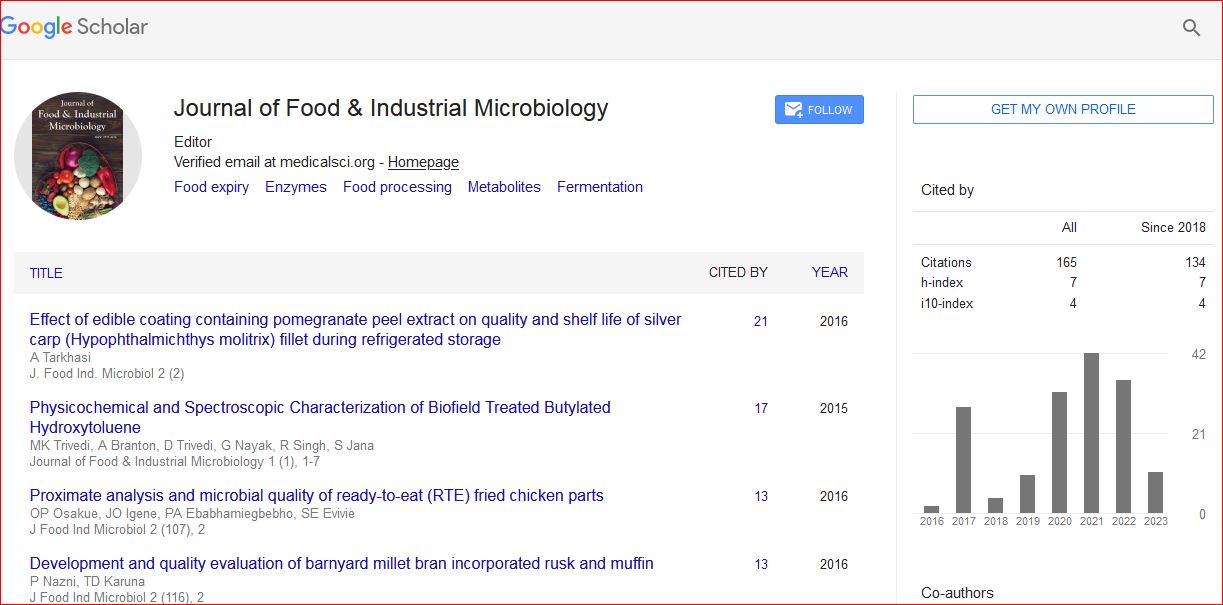
Journal of Food & Industrial Microbiology received 160 citations as per Google Scholar report