Brief Report - (2025) Volume 11, Issue 3
Received: 01-May-2025, Manuscript No. jefc-26-188211;
Editor assigned: 05-May-2025, Pre QC No. P-188211;
Reviewed: 19-May-2025, QC No. Q-188211;
Revised: 22-May-2025, Manuscript No. R-188211;
Published:
29-May-2025
, DOI: 10.37421/2472-0542.2025.11.538
Citation: Mehta, Aarav. ”Plant Extracts’ Antioxidant Potential for Functional Foods.” J Exp Food Chem 11 (2025):538.
Copyright: © 2025 Mehta A. This is an open-access article distributed under the terms of the Creative Commons Attribution License, which permits unrestricted use, distribution and reproduction in any medium, provided the original author and source are credited.
The escalating global interest in health-promoting compounds derived from natural sources has spurred extensive research into the antioxidant potential of plant-based materials. These compounds play a crucial role in combating oxidative stress, a key factor implicated in numerous chronic diseases and the aging process. A systematic investigation into the antioxidant capabilities of various plant-based food extracts reveals significant variations in their ability to scavenge free radicals and inhibit lipid peroxidation. These differences are closely linked to the distinct types and concentrations of phenolic compounds and flavonoids present in each source, underscoring the importance of careful selection for functional foods and nutraceutical applications [1].
Further exploration into efficient extraction methodologies highlights the impact of different techniques on the yield and antioxidant capacity of valuable plant compounds. Research comparing ultrasound-assisted, microwave-assisted, and conventional solvent extraction methods for phenolic compounds from common vegetables demonstrates that non-conventional approaches significantly enhance extraction efficiency. Moreover, these advanced methods are better at preserving the bioactivity of the target compounds, offering a more sustainable pathway for obtaining potent antioxidant ingredients [2].
The beneficial effects of certain plant-derived compounds extend beyond antioxidant activity to include anti-inflammatory properties. Studies focusing on anthocyanin-rich extracts from berries, for instance, provide detailed in vitro and in vivo data. These findings show a strong correlation between anthocyanin content and radical scavenging activity, as well as a notable reduction in inflammatory markers. This suggests that such berry extracts hold considerable promise as functional ingredients for disease prevention [3].
In the context of food manufacturing, the stability and efficacy of plant-derived antioxidants under various processing conditions are of paramount importance. Investigations into the stability of polyphenols extracted from green tea, for example, analyze how thermal treatment, pH, and storage duration affect their chemical integrity and radical scavenging ability. Such insights are critical for the food industry in developing stable and effective antioxidant-fortified products [4].
The diversity within plant kingdoms offers a rich reservoir of antioxidant compounds. Comparative studies on extracts from different parts of the *Moringa oleifera* plant, including its leaves, pods, and seeds, have identified leaves as the most abundant source of potent antioxidants. These include significant levels of flavonoids and phenolic acids, with quantified free radical scavenging and metal chelating abilities [5].
Beyond single-source extracts, the potential for synergistic interactions between different plant compounds is an active area of research. Investigations into combining various plant extracts, such as those from herbs and spices, aim to enhance overall antioxidant capacity. These studies identify synergistic interactions that lead to superior free radical scavenging and protection against oxidative damage compared to individual extracts [6].
The utilization of underutilized plant resources also presents opportunities for discovering novel antioxidant sources. Evaluations of extracts from legumes like black chickpeas and kidney beans reveal a rich phenolic compound profile. These legumes demonstrate significant radical scavenging and antioxidant potential, positioning them as valuable sources of natural antioxidants for diverse food applications [7].
Processing techniques can significantly influence the preservation of antioxidant compounds. Research examining the effect of different drying methods, including freeze-drying, air-drying, and oven-drying, on medicinal herbs shows that freeze-drying is the most effective method for preserving antioxidant compounds and their activity. This highlights the importance of selecting appropriate processing techniques for valuable plant materials [8].
The aesthetic appeal of edible flowers can be combined with their functional benefits. Studies exploring the antioxidant capacity of extracts from various edible flower petals assess their ability to inhibit lipid peroxidation and scavenge free radicals. Findings reveal that certain flower petals, rich in flavonoids and phenolic acids, possess significant antioxidant potential, making them attractive for novel food ingredient development [9].
Finally, staple food commodities like coffee also contribute to dietary antioxidant intake. Research quantifying the antioxidant activity of extracts from different coffee bean varieties, considering their chlorogenic acid and melanoidin content, demonstrates substantial antioxidant potential. This potential is influenced by roasting conditions and bean origin, providing valuable data for the functional food industry [10].
The antioxidant potential of plant-based food extracts is a subject of considerable scientific scrutiny, driven by the demand for natural compounds that can mitigate oxidative stress. A systematic investigation into various plant-based sources has revealed substantial disparities in their efficacy in scavenging free radicals and preventing lipid peroxidation. These variations are directly attributed to the qualitative and quantitative differences in the phenolic compounds and flavonoids present in each botanical source. Consequently, the selection of appropriate plant materials is paramount for maximizing antioxidant benefits in the formulation of functional foods and nutraceuticals [1].
In parallel, the efficiency and impact of different extraction methodologies on the recovery and bioactivity of phenolic compounds have been thoroughly examined. Comparative studies utilizing ultrasound-assisted, microwave-assisted, and conventional solvent extraction techniques for common vegetables have shown that non-conventional methods yield superior results. These advanced techniques not only improve the extraction efficiency but also ensure the preservation of the inherent bioactivity of the target antioxidant compounds, thus promoting a more sustainable approach to ingredient sourcing [2].
The multifaceted benefits of plant-derived phytochemicals are further exemplified by their anti-inflammatory actions alongside their antioxidant properties. Research focusing on anthocyanin-rich extracts derived from berries has provided robust in vitro and in vivo evidence. This evidence establishes a strong correlation between the concentration of anthocyanins and radical scavenging capacity, alongside a measurable reduction in key inflammatory markers. These findings strongly suggest the potential of berry extracts as functional agents in disease prevention strategies [3].
From a food science perspective, understanding the stability of valuable plant compounds during processing is critical. Studies investigating the stability and antioxidant efficacy of polyphenols extracted from green tea under various food manufacturing-relevant conditions have provided crucial insights. The analysis of how thermal processing, pH variations, and storage durations influence the chemical integrity and radical scavenging ability of tea polyphenols is vital for the development of stable, antioxidant-enhanced food products [4].
The exploration of plant diversity has led to the identification of numerous antioxidant-rich sources. For instance, research comparing the antioxidant properties of extracts from different parts of the *Moringa oleifera* plant, including its leaves, pods, and seeds, has pinpointed the leaves as the most potent source. These leaves are characterized by a high concentration of flavonoids and phenolic acids, exhibiting significant free radical scavenging and metal chelating activities [5].
Moreover, the concept of synergistic interactions among different plant extracts is gaining traction as a strategy to enhance antioxidant efficacy. Investigations into combining extracts from various herbs and spices have identified specific combinations that exhibit synergistic effects. These synergistic interactions lead to demonstrably superior free radical scavenging capabilities and enhanced protection against oxidative damage compared to individual component extracts [6].
The utilization of underutilized plant species is also contributing to the discovery of novel antioxidant sources. Studies evaluating the antioxidant activity of extracts from legumes such as black chickpeas and kidney beans have revealed their rich phenolic compound profiles. These legumes possess significant radical scavenging and overall antioxidant potential, positioning them as valuable and underutilized sources of natural antioxidants for the food industry [7].
The choice of processing techniques critically affects the quality of plant-derived products. Research that has examined the influence of different drying methods, including freeze-drying, air-drying, and oven-drying, on the antioxidant activity and phytochemical content of medicinal herbs has concluded that freeze-drying is optimal. This method best preserves the antioxidant compounds and their associated activity, offering a superior approach for processing these valuable botanical materials [8].
The potential of edible flowers as sources of antioxidants is also being recognized. Investigations into the antioxidant capacity of extracts from various edible flower petals have assessed their ability to inhibit lipid peroxidation and scavenge free radicals. The findings indicate that certain flower petals, particularly those rich in flavonoids and phenolic acids, exhibit considerable antioxidant potential, making them promising candidates for novel food ingredient applications [9].
Finally, common dietary items like coffee beans contribute significantly to antioxidant intake. Studies focused on quantifying the antioxidant activity of extracts from different coffee bean varieties have examined their chlorogenic acid and melanoidin content. These studies demonstrate a substantial antioxidant potential in coffee extracts, which is notably influenced by roasting conditions and the origin of the beans, thereby offering valuable data for the functional food sector [10].
This compilation of research explores the antioxidant properties of various plant-based extracts, emphasizing their potential in functional foods and nutraceuticals. Studies highlight variations in antioxidant activity linked to phytochemical content, such as phenolic compounds and flavonoids, across different plant sources like fruit seeds, common vegetables, berries, green tea, moringa, spices, legumes, medicinal herbs, edible flowers, and coffee beans. The effectiveness of different extraction methods, particularly ultrasound and microwave-assisted techniques, is underscored for improving yield and preserving bioactivity. The research also touches upon the stability of antioxidants during food processing, the synergistic effects of combining plant extracts, and the impact of drying methods on preserving antioxidant compounds. Overall, the findings indicate that diverse plant materials offer significant antioxidant benefits and warrant further investigation for food applications.
None
None
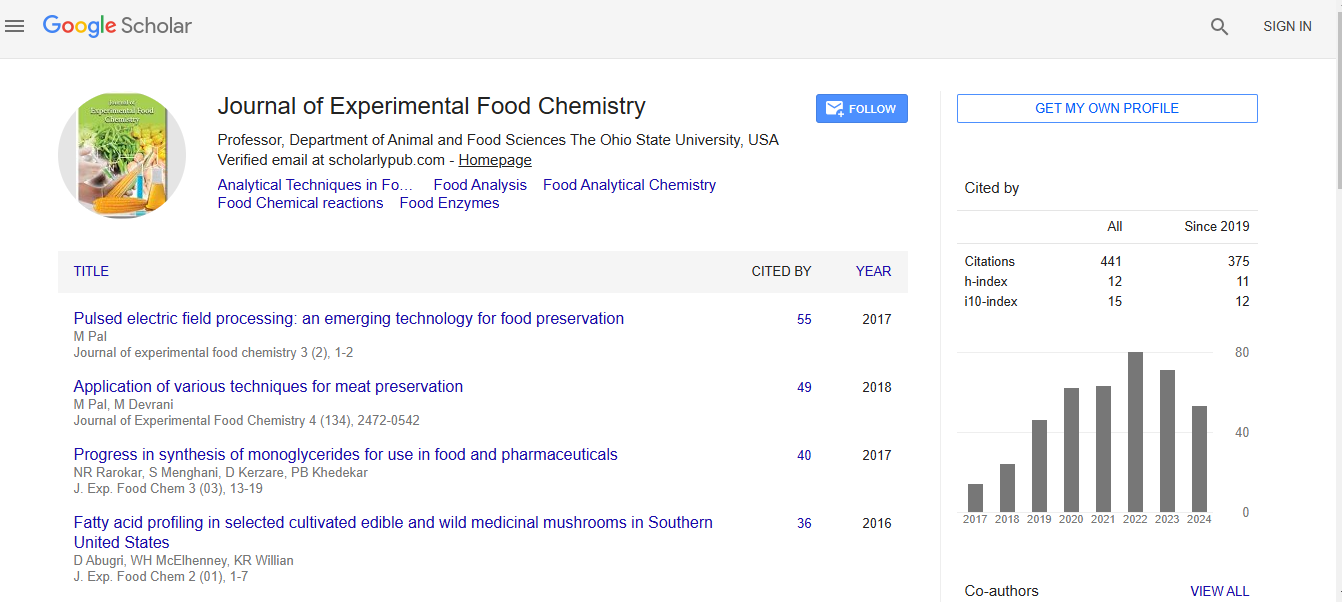
Journal of Experimental Food Chemistry received 389 citations as per Google Scholar report