Perspective - (2025) Volume 10, Issue 6
Received: 01-Dec-2025, Manuscript No. cgj-26-186554;
Editor assigned: 03-Dec-2025, Pre QC No. P-186554;
Reviewed: 17-Dec-2025, QC No. Q-186554;
Revised: 22-Dec-2025, Manuscript No. R-186554;
Published:
29-Dec-2025
, DOI: 10.37421/2952-8518.2025.10.347
Citation: Novak, Katarina. ”Long-Term Outcomes of Gastrointestinal Endoscopic and Surgical Therapies.” Clin Gastroenterol J 10 (2025):347.
Copyright: © 2025 Novak K. This is an open-access article distributed under the terms of the Creative Commons Attribution License, which permits unrestricted use, distribution and reproduction in any medium, provided the original author and source are credited.
The field of gastrointestinal (GI) therapies, encompassing both endoscopic and surgical modalities, is undergoing a significant evolution, with an increasing emphasis on long-term patient outcomes. This paradigm shift necessitates a comprehensive understanding of the durability and sustainability of various treatments for a range of gastrointestinal conditions. Minimally invasive techniques, in particular, are gaining prominence due to their potential for reduced morbidity and faster recovery, offering promising avenues for managing complex gastrointestinal issues. The judicious selection of patients for specific procedures is paramount to achieving optimal and lasting results, ensuring that the benefits of these interventions are maximized and tailored to individual needs. Within the realm of early gastrointestinal cancers, endoscopic interventions like endoscopic mucosal resection (EMR) and endoscopic submucosal dissection (ESD) have demonstrated considerable promise. These techniques allow for the en bloc removal of superficial malignancies, often preserving the integrity of the gastrointestinal tract. Their long-term efficacy in preventing recurrence and ensuring patient survival is a critical area of ongoing research and clinical evaluation. The durability of these endoscopic approaches is a key factor in their expanding role as alternatives to traditional surgery for carefully selected patients. Metabolic diseases, notably type 2 diabetes and severe obesity, are increasingly being addressed through bariatric surgery, with a growing body of evidence supporting its long-term benefits. Procedures such as laparoscopic sleeve gastrectomy (LSG) have shown sustained improvements in glycemic control and significant weight loss, leading to a reduction in the burden of associated comorbidities. The long-term impact on metabolic health and the potential for remission of chronic conditions underscore the transformative power of these surgical interventions. For gastroesophageal reflux disease (GERD), a chronic and often debilitating condition, both surgical and endoscopic treatments have been refined over time. While traditional surgical approaches like Nissen fundoplication have a long-standing track record of durable symptom control, newer endoscopic techniques are emerging. These less invasive methods are being developed to offer effective management, particularly in reducing medication dependence and improving the quality of life for patients with specific GERD profiles. Endoscopic submucosal dissection (ESD) has emerged as a powerful tool for the management of early esophageal cancers, offering a less invasive alternative to surgical resection. Studies investigating the long-term outcomes of ESD for these early-stage malignancies have reported high en bloc resection rates and encouragingly low recurrence rates. The long-term survival observed in patients treated with ESD, when appropriately adjusted for stage and patient comorbidities, often rivals that of surgical cohorts, highlighting its growing importance in oncological gastroenterology. Furthermore, the application of endoscopic mucosal resection (EMR) extends to colorectal neoplasia, including adenomas and early-stage cancers. Research focusing on the long-term outcomes of EMR in this context reveals high rates of recurrence-free survival, provided that appropriate patient selection criteria are met and meticulous technique is employed. This underscores the necessity of rigorous post-procedural surveillance to detect any residual or new neoplastic lesions, ensuring continued disease control. Laparoscopic sleeve gastrectomy (LSG) has also been a subject of extensive research regarding its long-term impact on severe obesity and type 2 diabetes. Ten-year outcome studies indicate not only sustained weight loss and glycemic control but also a significant reduction in cardiovascular events. However, these studies also highlight the importance of vigilant long-term follow-up to monitor for potential nutritional deficiencies, a crucial aspect of comprehensive post-operative care. Rectal cancer management has seen advancements with the adoption of laparoscopic and robotic surgery. Comparative studies evaluating the long-term oncological safety and functional outcomes of these minimally invasive approaches demonstrate comparable long-term oncological control. Robotic surgery, in particular, may offer advantages in achieving negative margins and preserving sphincter function, potentially leading to an improved quality of life for patients. Bariatric surgery's impact extends beyond weight loss and metabolic improvement to gastrointestinal symptoms and overall quality of life. Long-term studies show significant amelioration of GERD symptoms and enhanced quality of life post-surgery. Nevertheless, some patients may experience persistent or new GI complaints, emphasizing the need for individualized management strategies and ongoing support to address these potential challenges. Finally, the long-term outcomes of percutaneous endoscopic gastrostomy (PEG) tube placement, a common procedure for nutritional support, are also under scrutiny. While generally safe, long-term issues such as tube dislodgement, infection, and skin breakdown can occur. Careful patient selection and diligent ongoing care are essential to minimize these complications and ensure the continued efficacy and safety of PEG tubes for those requiring long-term enteral feeding.
The evolving landscape of gastrointestinal therapies, encompassing both endoscopic and surgical interventions, is increasingly focused on evaluating their long-term outcomes. A significant trend is the move towards minimally invasive techniques, which are demonstrating efficacy in managing complex conditions, with patient selection being a critical factor for optimal results. Key insights highlight the durability of endoscopic mucosal resection (EMR) and endoscopic submucosal dissection (ESD) for early gastrointestinal cancers, alongside the long-term benefits of bariatric surgery for metabolic diseases. Furthermore, anti-reflux procedures are undergoing continuous refinement, underscoring the necessity for ongoing research to standardize best practices and enhance patient-reported outcomes [1].
Endoscopic submucosal dissection (ESD) has been a focal point for its application in early esophageal cancer. Studies examining the long-term efficacy and safety of ESD have shown high rates of en bloc resection and low recurrence rates. This suggests ESD as a viable alternative to surgery for carefully selected patients, offering long-term survival comparable to surgical cohorts when adjusted for disease stage and patient comorbidities [2].
Laparoscopic sleeve gastrectomy (LSG) has been investigated for its long-term impact on type 2 diabetes remission and associated complications. Research indicates sustained improvements in glycemic control and significant weight loss over a decade, along with a reduction in cardiovascular events. However, vigilant long-term follow-up is crucial to manage potential nutritional deficiencies that may arise post-surgery [3].
For gastroesophageal reflux disease (GERD), comparative studies have assessed the long-term effectiveness of both endoscopic and surgical treatments. While surgical options like Nissen fundoplication generally provide more durable symptom control and medication-free survival, newer endoscopic techniques are showing promising outcomes for specific patient profiles, particularly in reducing reliance on medication [4].
The durability of endoscopic mucosal resection (EMR) for colorectal neoplasia is a critical area of investigation. A meta-analysis revealed high long-term recurrence-free survival rates for adenomas and early-stage cancers when appropriate patient selection and technique were utilized. This emphasizes the importance of thorough surveillance following EMR to detect any residual or new lesions [5].
Laparoscopic and robotic surgery for rectal cancer have also been evaluated for their long-term oncological safety and functional outcomes. Both approaches appear to offer comparable long-term oncological control. Robotic surgery may present advantages in achieving negative margins and preserving sphincter function, potentially contributing to a better quality of life in complex cases [6].
The long-term impact of bariatric surgery on gastrointestinal symptoms and quality of life is another area of significant interest. Studies indicate substantial improvements in GERD symptoms and overall quality of life after bariatric surgery. Nonetheless, some patients may experience persistent or new gastrointestinal complaints, necessitating tailored management strategies [7].
Endoscopic ultrasound-guided fine-needle aspiration (EUS-FNA) for pancreatic cystic lesions has been retrospectively studied for its long-term outcomes. While EUS-FNA proves safe and diagnostically valuable, its ability to predict long-term malignant transformation is limited, highlighting the need for serial imaging and clinical follow-up [8].
Laparoscopic Heller myotomy combined with Dor fundoplication for achalasia has demonstrated excellent and durable symptom relief and improved esophageal emptying in the majority of patients. This procedure is associated with a low rate of complications and infrequent need for reintervention over many years [9].
Lastly, the long-term outcomes and complications associated with percutaneous endoscopic gastrostomy (PEG) tube placement have been reviewed. Although generally safe, potential long-term issues include tube dislodgement, infection, and skin breakdown, underscoring the necessity of careful patient selection and ongoing care [10].
This collection of studies and reviews examines the long-term outcomes of various gastrointestinal endoscopic and surgical therapies. Key areas of focus include the durability of endoscopic resections for early cancers, the sustained benefits of bariatric surgery for metabolic diseases, and the comparative effectiveness of endoscopic versus surgical treatments for GERD. Advancements in minimally invasive techniques like ESD, EMR, laparoscopic, and robotic surgeries are showing promising results in oncological control and functional outcomes. While generally safe and effective, long-term monitoring for complications and individualized patient management are consistently highlighted as crucial for optimizing patient care and improving quality of life across these diverse gastrointestinal interventions.
None
None
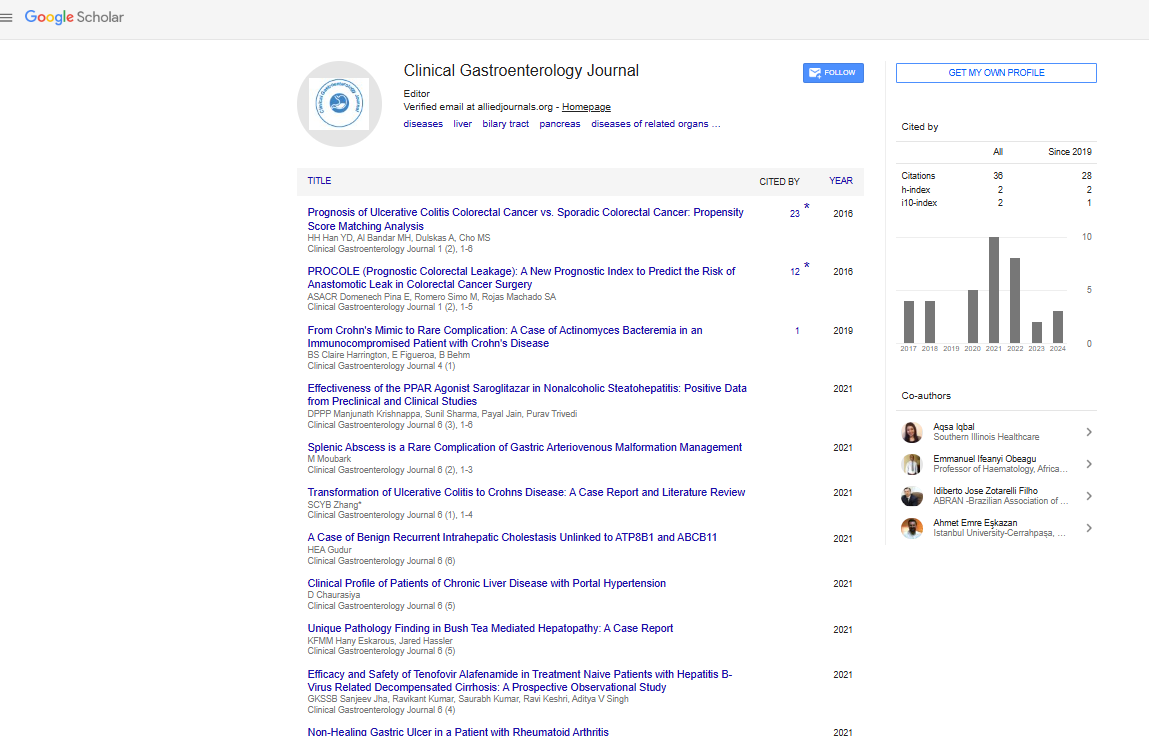
Clinical Gastroenterology Journal received 33 citations as per Google Scholar report