Brief Report - (2025) Volume 10, Issue 4
Received: 01-Dec-2025, Manuscript No. jib-25-175287;
Editor assigned: 03-Dec-2025, Pre QC No. P-175287;
Reviewed: 17-Dec-2025, QC No. Q-175287;
Revised: 22-Dec-2025, Manuscript No. R-175287;
Published:
29-Dec-2025
, DOI: 10.37421/2476-1966.2025.10.291
Citation: Marchand, Celine. ”Intestinal Mucosal Immunity: Health, Disease, Therapies.” J Immuno Biol 10 (2025):291.
Copyright: © 2025 Marchand C. This is an open-access article distributed under the terms of the Creative Commons Attribution License, which permits unrestricted use, distribution and reproduction in any medium, provided the original author and source are credited.
The intestinal mucosal immune system functions as a critical barrier, engaged in dynamic interactions with both the gut microbiota and dietary components to preserve host health. This system is indispensable for maintaining immune homeostasis and significantly contributes to the pathology of various diseases, thereby revealing its inherent complexity and considerable potential for therapeutic intervention [1].
This pivotal immune system also serves as the body's primary line of defense against a wide array of pathogens. Articles consistently highlight its crucial functions in successfully combating infectious diseases and explore how precisely targeted vaccine strategies can effectively harness mucosal immunity. Such approaches aim to deliver more potent and localized protective responses against threats [3].
Our evolving understanding of mucosal immunity now includes its intricate connection to neurodegenerative diseases. Contemporary reviews delve into the specific mechanisms by which immune dysregulation occurring at the mucosal interface can profoundly influence overall brain health. This line of inquiry suggests promising new therapeutic avenues that could specifically target the gut-brain axis for managing various neurological conditions [2].
Similarly, there is a current perspective on the essential role of mucosal immunity in inflammatory bowel diseases (IBD). This research distinctly emphasizes how disturbances and dysregulation within the mucosal immune system are direct contributors to IBD pathogenesis, thus paving the way for the discovery of novel diagnostic markers and innovative therapeutic interventions [4].
Beyond this, investigations meticulously examine the complex interplay between the mucosal immune system and the resident gut microbiome, particularly within the challenging context of colorectal cancer. Evidence suggests that dysregulation in these critical interactions can actively drive cancer progression, consequently presenting valuable potential targets for both disease prevention and effective therapy [8].
Adding to this intricate picture, research indicates that significant disruptions in gut mucosal homeostasis may be key contributors to the initial onset and subsequent progression of Type 1 Diabetes, thereby bringing the gut to the forefront as a crucial potential therapeutic target [10].
In the realm of vaccine development, the potential of specifically targeting intestinal mucosal immunity to engineer more effective vaccines is a major focus. Discussions center around advanced strategies designed to induce exceptionally robust immune responses precisely at mucosal surfaces. Such responses are deemed crucial not only for preventing common enteric infections but also for potentially mitigating systemic diseases [5].
Recent scientific advancements have greatly improved our understanding of mucosal immunity, especially in its application to COVID-19 vaccine development. This research distinctly emphasizes the paramount importance of inducing strong mucosal immune responses to effectively block viral entry and curtail transmission, thereby offering invaluable insights for the design of future vaccines [6].
Furthermore, the critical role of mucosal immunity in actively defending against SARS-CoV-2 is widely acknowledged, particularly its function within the upper respiratory tract. Detailed studies explain how localized immune responses can effectively prevent both infection and onward transmission, establishing a solid foundation for the development of highly effective mucosal vaccines [7].
Another area of significant study involves the female reproductive tract, where mucosal immunity is fundamental for achieving both robust pathogen protection and maintaining essential immune tolerance during reproduction. This intricate balance is thoroughly discussed, highlighting how it prevents infections while simultaneously avoiding detrimental immune responses, and importantly, how its dysregulation can precipitate a range of various pathologies [9].
The mucosal immune system, a complex and dynamic entity, serves as the body's primary interface with the external environment. Specifically, the intestinal mucosal immune system functions as a crucial barrier, engaged in continuous interaction with the gut microbiota and various dietary factors to ensure the maintenance of host health [1]. This interaction is not static; it is a dynamic interplay vital for immune homeostasis, influencing a broad spectrum of physiological processes and disease states. Its role in combating infectious diseases is paramount, acting as the first line of defense against a myriad of pathogens. By understanding its critical functions, researchers can develop advanced strategies for localized and effective protection [3]. The intricate nature of this system and its broad influence underscore its significant therapeutic potential across many medical disciplines.
Beyond its foundational role in protection, dysregulation of mucosal immunity is deeply implicated in several chronic and debilitating conditions. For instance, recent reviews have extensively explored the intricate connection between gut mucosal immunity and neurodegenerative diseases. These studies delve into how immune imbalances at the mucosal surface can profoundly impact brain health, suggesting innovative therapeutic pathways that specifically target the gut-brain axis for managing neurological conditions [2]. Similarly, a comprehensive perspective on inflammatory bowel diseases (IBD) highlights how dysregulation within the mucosal immune system is a direct contributor to the pathogenesis of these chronic inflammatory conditions. This insight is crucial for identifying novel diagnostic markers and developing more effective therapeutic interventions that aim to restore immune balance [4].
The scope of mucosal immunity's impact extends further into oncological and metabolic diseases. Research meticulously examines the complex interactions between the mucosal immune system and the gut microbiome in the context of colorectal cancer. Findings suggest that imbalances in these interactions can actively drive cancer progression, thereby presenting significant potential targets for both preventive strategies and therapeutic development [8]. Moreover, the involvement of mucosal immunity in the development of Type 1 Diabetes is gaining recognition. Studies propose that disruptions in gut mucosal homeostasis could contribute significantly to the onset and progression of this autoimmune disease, positioning the gut as a compelling new target for therapeutic development aimed at disease modification or prevention [10].
The strategic targeting of mucosal immunity holds immense promise for the development of more effective vaccines. Articles explore various strategies aimed at inducing robust immune responses precisely at mucosal surfaces. These responses are considered vital for preventing not only enteric infections but also potentially systemic diseases, offering a new frontier in vaccine science [5]. This principle is particularly evident in advancements related to COVID-19 vaccine development. Research emphasizes the critical importance of stimulating mucosal immune responses to effectively block viral entry and prevent viral transmission, providing invaluable insights for designing future generations of vaccines [6]. Furthermore, the crucial role of mucosal immunity in actively defending against SARS-CoV-2 is underscored, especially within the upper respiratory tract. Detailed analyses illustrate how localized immune responses are key to preventing both initial infection and subsequent transmission, laying a strong foundation for the creation of highly effective mucosal vaccines [7].
Finally, specialized mucosal immune systems are also critical for unique physiological contexts. The female reproductive tract's mucosal immunity, for example, is fundamental for both protecting against pathogens and maintaining essential immune tolerance during the reproductive process [9]. This system performs a delicate balancing act, preventing infections while simultaneously avoiding harmful immune responses that could impede reproduction. Understanding how its dysregulation can lead to various pathologies in this sensitive environment is essential for reproductive health and therapeutic strategies.
The intestinal mucosal immune system is a vital barrier, constantly interacting with the gut microbiota and dietary factors to ensure host health and immune balance. This intricate system is fundamental for maintaining homeostasis and plays a profound role in the development and progression of various diseases, underscoring its multifaceted nature and significant therapeutic promise. Serving as the body's primary defense, the mucosal immune system is critical in neutralizing pathogens and fighting infectious diseases. Research explores how specific vaccine strategies can leverage this mucosal immunity to achieve more potent and localized protection, particularly against common enteric infections and systemic illnesses. Recent breakthroughs have highlighted the importance of activating mucosal immune responses to effectively prevent viral entry and transmission. This is especially relevant for developing new COVID-19 vaccines and strengthening defenses in the upper respiratory tract against SARS-CoV-2. Beyond infection, dysregulation within the mucosal immune system is a key factor in the onset and severity of inflammatory bowel diseases, and it also impacts brain health, contributing to neurodegenerative conditions. The complex interplay between the mucosal immune system and the gut microbiome is deeply connected to the progression of colorectal cancer, offering promising avenues for both prevention and treatment. Moreover, imbalances in gut mucosal homeostasis are increasingly recognized as contributing to the genesis and advancement of Type 1 Diabetes, positioning the gut as a crucial area for future therapeutic interventions.
None
None
Hong-Wei Z, Jing-Yi G, Jing-Yan L. "The Intestinal Mucosal Immune System and Its Role in Immunity and Disease".Front Immunol 15 (2024):1391961.
Indexed at, Google Scholar, Crossref
Niamh F, Mark PC, Aisling MR. "Gut mucosal immunity and the brain in neurodegenerative diseases".Trends Mol Med 29 (2023):938-955.
Indexed at, Google Scholar, Crossref
Aashna D, Khushboo K, Archana S. "The mucosal immune system's pivotal role in infectious diseases and vaccination strategies".Int Rev Immunol 42 (2023):2200171.
Indexed at, Google Scholar, Crossref
Marta M, Ilaria G, Chiara P. "Mucosal immunity in health and disease: a new perspective on inflammatory bowel diseases".Immunol Rev 308 (2022):203-219.
Indexed at, Google Scholar, Crossref
Akiko TS, Takeshi K, Shohei K. "Intestinal mucosal immunity as a target for vaccine development".Semin Immunopathol 44 (2022):461-477.
Indexed at, Google Scholar, Crossref
Siyi L, Hongbo C, Dong-Guang X. "Advances in Understanding Mucosal Immunity for COVID-19 Vaccine Development".Vaccines (Basel) 9 (2021):1111.
Indexed at, Google Scholar, Crossref
M. BS, Andrew TCY, Katherine JS. "Mucosal Immunity against SARS-CoV-2: Key to Protecting the Upper Respiratory Tract".Viruses 13 (2021):1308.
Indexed at, Google Scholar, Crossref
Michael CZL, Michael JL, Emily FL. "The Interplay between the Mucosal Immune System and the Microbiome in Colorectal Cancer".Cancers (Basel) 13 (2021):2362.
Indexed at, Google Scholar, Crossref
Yanjie L, Ying F, Yiwen Z. "Mucosal Immunity in the Female Reproductive Tract: From Protection to Pathogenesis".Front Immunol 11 (2020):597258.
Indexed at, Google Scholar, Crossref
Emma MH, Laura HKPVDS, Andrew MKD. "The Role of Mucosal Immunity in Type 1 Diabetes Pathogenesis".Front Immunol 10 (2019):2289.
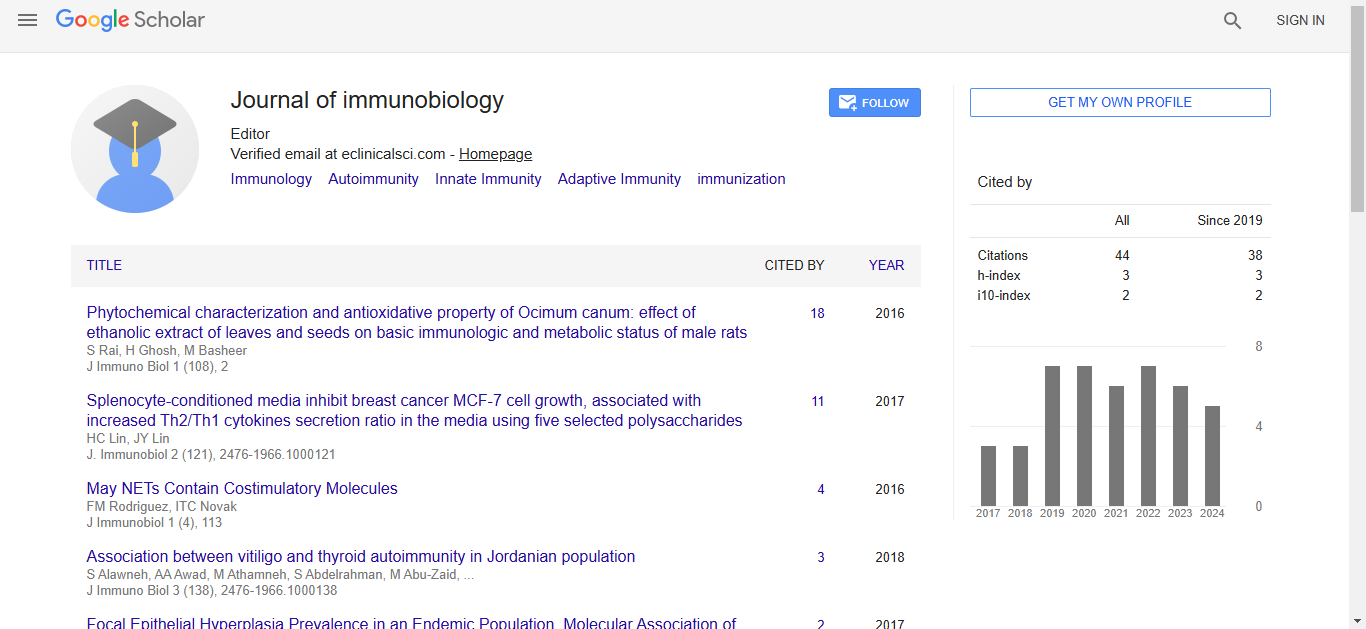
Journal of Immunobiology received 34 citations as per Google Scholar report