Short Communication - (2025) Volume 11, Issue 4
Received: 01-Jul-2025, Manuscript No. jefc-26-188274;
Editor assigned: 03-Jul-2025, Pre QC No. P-188274;
Reviewed: 17-Jul-2025, QC No. Q-188274;
Revised: 22-Jul-2025, Manuscript No. R-188274;
Published:
29-Jul-2025
, DOI: 10.37421/2472-0542.2025.11.554
Citation: Sharma, Rahul. ”Natural Compounds: Preserving Food Safely and Sustainably.” J Exp Food Chem 11 (2025):554.
Copyright: © 2025 Sharma R. This is an open-access article distributed under the terms of the Creative Commons Attribution License, which permits unrestricted use, distribution and reproduction in any medium, provided the original author and source are credited.
The growing consumer demand for minimally processed foods with extended shelf-lives has spurred significant research into natural alternatives to synthetic preservatives. These natural compounds offer a dual benefit of enhancing food safety and appealing to health-conscious consumers seeking cleaner labels. Essential oils, derived from various plant sources, have emerged as potent antimicrobial agents, demonstrating efficacy against a broad spectrum of foodborne pathogens and spoilage microorganisms. Their complex chemical compositions, often including phenolic compounds and terpenes, contribute to their diverse biological activities, making them valuable in food preservation strategies [1].
Beyond their antimicrobial properties, plant-derived compounds are also recognized for their antioxidant capabilities. These compounds, particularly polyphenols, can effectively scavenge free radicals, thereby inhibiting lipid oxidation, a primary cause of food spoilage and undesirable sensory changes in many food products [2].
The integration of natural preservatives into food systems is not limited to direct addition. Innovations in food packaging, such as active packaging films incorporating antimicrobial agents, offer a controlled release mechanism to continuously protect food products from microbial contamination and degradation, thereby extending their usability [3].
Fruit by-products, often considered waste streams, are a rich source of valuable bioactive compounds, including phenolic compounds. Research into utilizing these by-products for food preservation highlights a sustainable approach to valorize agricultural waste while developing natural preservative solutions for products like meat [4].
Ready-to-eat (RTE) foods, due to their minimal processing and lack of reheating steps, are particularly susceptible to microbial spoilage and quality deterioration. Natural essential oils have shown promise in preserving the microbial and physicochemical integrity of RTE salads, extending their shelf-life without compromising sensory attributes [5].
The exploration of synergistic effects between different classes of natural preservatives is a key area of research. Combining natural antioxidants with antimicrobial agents can lead to a more potent and comprehensive preservation strategy, offering enhanced protection against both microbial growth and oxidative processes than individual components alone [6].
Phenolic compounds, extracted from diverse plant sources like seeds and leaves, are continually being investigated for their antimicrobial potential. Specific phenolic acids and flavonoids have demonstrated significant inhibitory activity against common food spoilage bacteria, suggesting their suitability as natural replacements for synthetic preservatives [7].
In dairy products, the application of natural antimicrobial agents is crucial for controlling spoilage and pathogenic microorganisms. Extracts from spices like clove and cinnamon have shown notable efficacy in inhibiting the growth of undesirable microbes in products like yogurt, contributing to improved shelf-life and quality maintenance [8].
Edible coatings represent another promising avenue for incorporating natural preservatives. By incorporating essential oils into edible films, it is possible to create a protective layer for fresh-cut fruits that not only reduces microbial contamination but also mitigates enzymatic browning, thereby preserving quality and extending shelf-life [9].
The efficacy of natural preservatives in food systems has been a focal point of scientific inquiry, with extensive research demonstrating their multifaceted benefits. Essential oils, for instance, possess significant antimicrobial activity against a wide array of foodborne pathogens and spoilage organisms. This activity is attributed to their complex chemical structures, often containing compounds like phenols, aldehydes, and terpenes, which disrupt microbial cell membranes and inhibit vital metabolic processes [1].
Beyond their direct antimicrobial effects, plant-derived compounds, especially polyphenols, exhibit potent antioxidant properties. These compounds act as free radical scavengers, effectively delaying lipid oxidation. Lipid oxidation is a major contributor to the rancidity and off-flavors in many food products, and its inhibition by natural antioxidants helps maintain the sensory appeal and nutritional value of foods [2].
Advancements in food packaging technologies have opened new avenues for the application of natural preservatives. Active packaging systems, which incorporate antimicrobial or antioxidant agents into the packaging material, provide a means for controlled release of these protective compounds. This approach ensures sustained protection of the food product throughout its shelf-life, offering a significant advantage over traditional preservation methods [3].
Fruit by-products, often rich in bioactive phenolic compounds, are increasingly being explored as sustainable sources for natural food preservatives. Extracts from sources such as grape pomace and apple pomace have demonstrated significant antioxidant capabilities, making them valuable for preserving meat products by inhibiting oxidative rancidity and maintaining desirable color attributes [4].
Ready-to-eat (RTE) foods, such as salads, are particularly vulnerable to microbial spoilage due to their ready-to-consume nature. The application of essential oils, like lemon and rosemary, has proven effective in inhibiting spoilage microorganisms and reducing enzymatic browning in RTE salads. This leads to an extended shelf-life without negatively impacting the flavor or texture of the product [5].
The concept of synergistic action among natural preservatives is gaining traction, suggesting that combining different natural agents can yield superior preservation results. For example, the combination of a natural antioxidant, such as rosemary extract, with an antimicrobial agent like nisin, has shown significantly enhanced effectiveness in reducing microbial load and lipid oxidation compared to using each agent individually [6].
Phenolic compounds extracted from various plant sources, including grape seeds and green tea, have been investigated for their antimicrobial efficacy against common food spoilage bacteria. Compounds like gallic acid and epicatechin have shown particularly strong inhibitory effects, positioning them as viable natural alternatives to synthetic preservatives [7].
In the dairy industry, natural extracts play a crucial role in extending the shelf-life of products like yogurt. Clove and cinnamon extracts, for instance, have demonstrated antimicrobial activity against lactic acid bacteria and yeasts, thereby contributing to the preservation of yogurt quality and extending its usability. Clove extract, in particular, has shown superior inhibition against key spoilage microorganisms [8].
Edible coatings offer an innovative method for delivering natural preservatives to food surfaces. When infused with essential oils such as basil and oregano, these coatings can effectively reduce microbial contamination and inhibit enzymatic browning on fresh-cut fruits. This not only extends shelf-life but also maintains the visual appeal of the products, with the encapsulation method being crucial for controlled release [9].
The utilization of cultured mushroom extracts as natural preservatives in processed meat products is another area of active research. These extracts possess antioxidant and antimicrobial properties that contribute to reduced lipid oxidation and slower microbial growth. Importantly, their application has not led to significant adverse sensory changes in the meat products, indicating their potential for commercial use [10].
This collection of studies explores the diverse applications of natural compounds as preservatives in various food systems. Essential oils from plants like oregano and thyme demonstrate significant antimicrobial action against foodborne pathogens and spoilage microorganisms. Plant extracts rich in polyphenols exhibit potent antioxidant properties, delaying lipid oxidation and preserving sensory attributes in foods such as meat and emulsions. Chitosan in active packaging films effectively inhibits bacterial growth in dairy products. Fruit by-products and mushroom extracts are identified as valuable sources of antioxidants for meat preservation. Essential oils like lemon and rosemary extend the shelf-life of ready-to-eat salads by controlling microbial growth and reducing browning. Synergistic effects are observed when natural antioxidants like rosemary extract are combined with antimicrobials like nisin. Phenolic compounds from sources like grape seeds and green tea show broad-spectrum antimicrobial activity. Clove and cinnamon extracts are effective in preserving yogurt. Edible coatings incorporating essential oils protect fresh-cut fruits from microbial contamination and browning. Overall, these findings highlight the potential of natural preservatives to enhance food safety, extend shelf-life, and offer sustainable alternatives to synthetic additives.
None
None
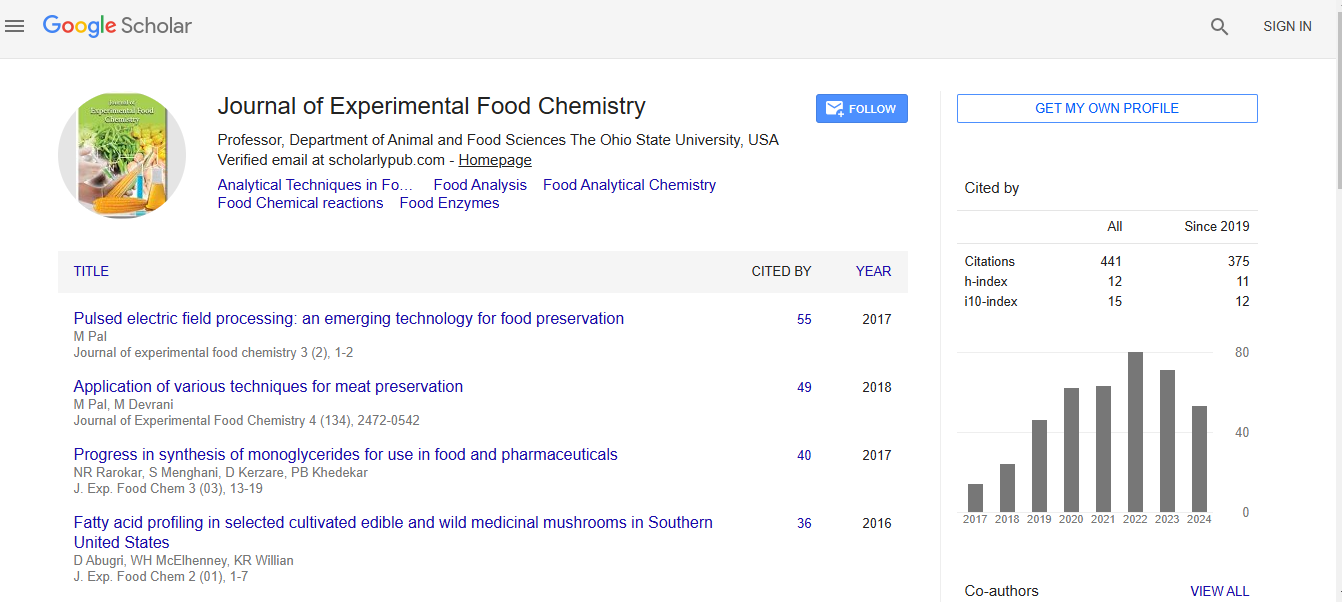
Journal of Experimental Food Chemistry received 389 citations as per Google Scholar report