Perspective - (2025) Volume 11, Issue 5
Received: 01-Sep-2025, Manuscript No. jfim-26-178584;
Editor assigned: 03-Sep-2025, Pre QC No. P-178584;
Reviewed: 17-Sep-2025, QC No. Q-178584;
Revised: 22-Sep-2025, Manuscript No. R-178584;
Published:
29-Sep-2025
, DOI: 10.37421/2572-4134.2025.11.370
Citation: Ali, Salma A. Ben. ”Innovations In Non-Thermal Food Processing For Safety.” J Food Ind Microbiol 11 (2025):370.
Copyright: © 2025 Ali B. A. Salma This is an open-access article distributed under the terms of the Creative Commons Attribution License, which permits unrestricted use, distribution and reproduction in any medium, provided the original author and source are credited.
The preservation of food safety and quality is a paramount concern in the modern food industry, driving continuous innovation in processing technologies. Among the most promising advancements are non-thermal processing (NTP) methods, which aim to inactivate microorganisms without relying on excessive heat, thereby preserving the nutritional and sensory attributes of food products. Non-thermal processing technologies have emerged as a significant area of research and development, offering compelling alternatives to conventional thermal methods. These innovative techniques leverage various physical principles to achieve microbial inactivation, minimizing detrimental effects on food matrices and their inherent qualities. High-pressure processing (HPP) is one such technology that utilizes mechanical pressure to disrupt microbial cell structures and functions, proving effective against a wide range of microorganisms. Its application in food preservation is gaining traction due to its ability to enhance food safety while maintaining product freshness [1].
Pulsed electric fields (PEF) represent another important NTP, employing short, high-voltage electrical pulses to create pores in microbial cell membranes, leading to cell death. PEF is particularly effective for liquid foods and has shown synergistic effects when combined with other treatments [2].
Ultrasound technology uses acoustic waves to induce cavitation and mechanical stress, which can damage microbial cells. Its application in food processing is versatile, ranging from microbial inactivation to extraction and enzymatic enhancement [6].
Cold atmospheric plasma (CAP) is an emerging NTP that generates reactive species, such as reactive oxygen and nitrogen species, which possess potent antimicrobial properties. CAP has demonstrated efficacy in decontaminating various food surfaces, including fresh produce [3].
High hydrostatic pressure (HHP) processing is increasingly recognized for its role in microbial inactivation within meat products. This method effectively targets microbial cells, offering a 'clean-label' preservation solution that maintains meat quality and extends shelf life [4].
Mild heat combined with pulsed electric fields (PEF) has shown synergistic effects in inactivating pathogens. This dual approach allows for microbial inactivation at lower temperatures than traditional pasteurization, preserving the quality of products like fruit juices [5].
Pulsed light (PL) technology utilizes short bursts of broad-spectrum light to inactivate microorganisms on food surfaces. It is particularly promising for decontaminating packaged leafy greens without compromising their quality attributes [7].
Supercritical carbon dioxide (SC-CO2) offers a unique non-thermal approach to microbial inactivation. By leveraging the antimicrobial properties of SC-CO2, such as cell membrane disruption, it provides a sustainable method for food preservation [8].
Electrochemical activation (ECA) technology generates antimicrobial agents through electrochemical processes. ECA water has demonstrated effectiveness in sanitization and washing applications, offering an environmentally friendly and cost-effective solution for microbial control in the food industry [10].
The landscape of food preservation is continually being reshaped by advancements in non-thermal processing (NTP) technologies. These innovative methods are designed to ensure microbial safety without the detrimental effects often associated with traditional thermal treatments, thus preserving the nutritional value and sensory appeal of food products. High-pressure processing (HPP) stands out as a key technology, employing elevated pressures to effectively inactivate a broad spectrum of microorganisms, thereby enhancing food safety and extending shelf life while maintaining product quality [1].
This review delves into the recent advancements in non-thermal processing technologies for microbial inactivation in food, highlighting methods such as high-pressure processing, pulsed electric fields, ultrasound, and cold plasma. These innovative techniques are discussed in terms of their mechanisms of action, effectiveness against various microorganisms, and impact on food quality attributes, emphasizing their potential for producing safer, higher-quality food products while preserving nutritional value and sensory characteristics. Challenges and future directions for industrial application are also addressed [1].
Pulsed electric fields (PEF) are a prominent non-thermal technology that utilizes electrical pulses to permeabilize microbial cell membranes, leading to inactivation. The efficacy of PEF is often enhanced when applied in combination with other techniques, as demonstrated in studies involving ultrasound-assisted PEF for inactivating Listeria monocytogenes in milk. This synergistic approach leads to significantly higher microbial inactivation rates compared to individual treatments, with minimal impact on the physicochemical properties of milk, suggesting a promising avenue for decontamination without compromising quality [2].
Ultrasound technology employs acoustic waves to create physical stress within microbial cells, leading to their inactivation. The principles of sonication, its effects on microbial cell membranes and internal structures, and its effectiveness against a broad spectrum of foodborne pathogens and spoilage organisms are covered. The review also discusses the optimization of sonication parameters and its integration with other technologies to achieve enhanced microbial decontamination while minimizing negative impacts on food quality, presenting it as a versatile tool in food microbiology [6].
Cold atmospheric plasma (CAP) is an emerging non-thermal technology that generates reactive species, including reactive oxygen and nitrogen species, which exhibit potent antimicrobial activity. CAP has shown significant promise for inactivating foodborne pathogens on fresh produce, effectively targeting microorganisms like E. coli and Salmonella while also being assessed for its impact on the sensory and nutritional quality of treated produce, indicating its potential for improving food safety [3].
High hydrostatic pressure (HHP) processing has been extensively studied for its application in microbial inactivation within meat products. This review summarizes the effects of HHP on the cell structures and metabolic functions of various bacteria, yeasts, and molds relevant to meat spoilage and safety. Furthermore, it examines how HHP influences meat quality attributes such as texture, color, and flavor, discussing its potential as a 'clean-label' preservation technology for extending shelf life while maintaining consumer acceptance [4].
The combination of mild heat and pulsed electric fields (PEF) has been evaluated for the inactivation of Staphylococcus aureus in fruit juices. This research demonstrates that PEF significantly enhances the inactivation of S. aureus at temperatures lower than those typically used in thermal pasteurization. The synergistic antimicrobial effect and the impact on juice quality suggest that this combined approach offers an effective and energy-efficient method for fruit juice preservation [5].
Pulsed light (PL) technology offers a non-thermal method for inactivating foodborne bacteria on the surface of packaged lettuce. Studies have investigated the impact of different PL parameters on microbial reduction and assessed the effect on lettuce quality attributes like color and vitamin C content. The findings indicate that PL is a promising non-thermal method for surface decontamination of packaged leafy greens, offering a potential alternative to conventional sanitization methods [7].
Supercritical carbon dioxide (SC-CO2) is another non-thermal technology being explored for microbial inactivation in food. This approach examines the mechanisms by which SC-CO2 exerts its antimicrobial effects, such as cell membrane damage and enzyme inactivation, and evaluates its efficacy against various foodborne pathogens. The article also considers the impact of SC-CO2 treatment on food quality and nutritional components, highlighting its potential as a sustainable and non-thermal processing method [8].
Electrochemical activation (ECA) technology provides a method for microbial inactivation through the generation of reactive species in ECA water. This review discusses the efficacy of ECA water against a wide range of foodborne pathogens and spoilage microorganisms, as well as its potential for use in sanitization, washing, and direct application in food products, emphasizing its environmental benefits and cost-effectiveness [10].
The field of non-thermal processing (NTP) in food is rapidly advancing, offering innovative solutions for microbial inactivation while preserving food quality. Technologies such as high-pressure processing (HPP), pulsed electric fields (PEF), ultrasound, cold atmospheric plasma (CAP), pulsed light (PL), supercritical carbon dioxide (SC-CO2), and electrochemical activation (ECA) are being explored. These methods work through various mechanisms, including cell membrane disruption and the generation of reactive species, to effectively eliminate pathogens and spoilage organisms. Often, synergistic effects are observed when combining different NTPs or when NTPs are used with mild heat, leading to enhanced microbial inactivation. Research also focuses on assessing the impact of these technologies on food's nutritional and sensory attributes, aiming for 'clean-label' preservation solutions and improved shelf life. Challenges related to industrial scalability and cost-effectiveness are being addressed to facilitate wider adoption of these promising food safety technologies.
None
None
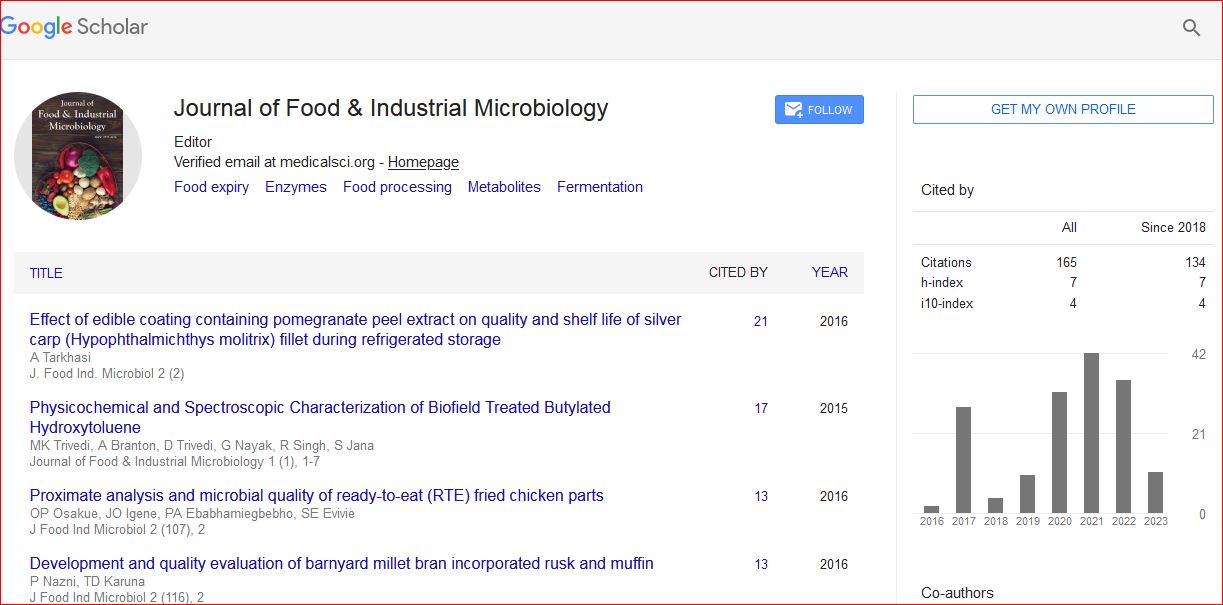
Journal of Food & Industrial Microbiology received 160 citations as per Google Scholar report