Short Communication - (2025) Volume 10, Issue 4
Received: 01-Dec-2025, Manuscript No. jib-25-175303;
Editor assigned: 03-Dec-2025, Pre QC No. P-175303;
Reviewed: 17-Dec-2025, QC No. Q-175303;
Revised: 22-Dec-2025, Manuscript No. R-175303;
Published:
29-Dec-2025
, DOI: 10.37421/2476-1966.2025.10.298
Citation: Järvinen, Evelina. ”Immune Checkpoint Inhibitors: Progress, Hurdles, Future.” J Immuno Biol 10 (2025):298.
Copyright: © 2025 Järvinen E. This is an open-access article distributed under the terms of the Creative Commons Attribution License, which permits unrestricted use, distribution and reproduction in any medium, provided the original author and source are credited.
Immune checkpoint inhibitors (ICIs) have profoundly transformed the landscape of cancer treatment by strategically unleashing the bodyâ??s own immune system to identify and eliminate tumor cells. These innovative therapies, primarily targeting immune pathways such as PD-1/PD-L1 and CTLA-4, function to lift the brakes off immune responses, allowing T-cells to attack malignant cells more effectively. This mechanism has led to a significant clinical impact, improving outcomes for many patients across various cancer types. However, despite their successes, the application of ICIs presents ongoing challenges, particularly concerning the development of treatment resistance and the complex management of immune-related adverse events [1].
A pressing issue in the real-world application of ICI therapy is that a subset of patients either do not respond to the initial treatment (primary resistance) or develop resistance over time after an initial period of benefit (acquired resistance). Understanding the intricate mechanisms by which tumors manage to evade these potent treatments is paramount for devising effective counter-strategies. This understanding extends to exploring both tumor-intrinsic factors and those residing within the patientâ??s unique immune system. Researchers are actively working to develop adaptive treatment approaches specifically designed to help these non-responding patients achieve a meaningful and sustained therapeutic response [2, 10]. Beyond the established and highly successful targets of PD-1 and CTLA-4, the field of cancer immunotherapy is in a state of rapid advancement, continually uncovering new immune checkpoints that hold immense promise as future therapeutic targets. Next-generation molecules such as LAG-3, TIM-3, TIGIT, and VISTA are currently under intense investigation. These novel targets are expected to significantly broaden the array of existing immunotherapy options, thereby extending the potential benefits of this treatment modality to a larger and more diverse patient population who might not respond to current therapies [3].
While the transformative impact of immune checkpoint inhibitors on cancer treatment is undeniable, their widespread use introduces a specific set of challenges in the form of immune-related adverse events (irAEs). These side effects can range in severity and affect multiple organ systems, necessitating careful clinical oversight. A comprehensive exploration of the underlying immunological mechanisms that drive these irAEs, coupled with detailed guidance on their recognition, diagnosis, and effective management strategies, is crucial for maintaining patient safety and ensuring optimal clinical care throughout the treatment journey [4, 9]. A critical and evolving area of research focuses on predicting which individual patients are most likely to respond favorably to immune checkpoint blockade. This involves a dedicated effort to identify and rigorously validate robust biomarkers that can guide patient selection more effectively. Established markers, such as PD-L1 expression, tumor mutational burden (TMB), and microsatellite instability (MSI), provide foundational insights. However, the search continues for newer, emerging genomic and immunological signatures that could further refine our ability to personalize immunotherapy approaches, ensuring treatments are precisely tailored to maximize efficacy for each patient [5].
To further enhance the efficacy and improve overall patient outcomes, the strategy of combining immune checkpoint inhibitors with other established or emerging cancer treatments has become a significant area of clinical and scientific focus. This involves a thorough examination of the scientific rationale and clinical results derived from various combination strategies. These approaches explore how pairing ICIs with conventional chemotherapy, targeted radiation therapy, specific targeted therapies, or even other forms of immunotherapy can synergistically boost the anti-tumor immune response, ultimately leading to superior patient outcomes and more durable remissions [6].
Clinical trials serve as the indispensable engine driving continuous progress in the field of oncology. This ongoing research provides timely summaries of the most recent breakthroughs and significant findings specifically evaluating immune checkpoint inhibitors across a broad spectrum of cancer types. Such trials are instrumental in highlighting new drug approvals, validating expanded indications for existing treatments, and pinpointing the exciting new directions that current research is pursuing. They offer a dynamic snapshot of the constantly evolving therapeutic landscape, guiding clinical practice and future drug development [8].
Looking ahead, the future trajectory of cancer immunotherapy extends strategically beyond the current generation of immune checkpoint inhibitors, envisioning a new era of even more sophisticated treatments. This forward-looking perspective explores cutting-edge therapies such as Chimeric Antigen Receptor (CAR)-T cell treatments, oncolytic viruses, and personalized cancer vaccines. The crucial discussion revolves around how these innovative, next-generation approaches might seamlessly integrate with, or even potentially surpass, existing ICI strategies to tackle cancer with unprecedented effectiveness and precision, representing a continuous leap forward in patient care [7].
Immune checkpoint inhibitors (ICIs) have emerged as a cornerstone of modern cancer treatment, fundamentally reshaping how we approach malignancy. These powerful immunotherapies operate by disinhibiting the body's natural immune responses, specifically by blocking pathways such as programmed cell death protein 1 (PD-1)/PD-ligand 1 (PD-L1) and cytotoxic T-lymphocyte-associated protein 4 (CTLA-4). This action allows T-cells to recognize and eliminate tumor cells, a mechanism that has yielded substantial clinical benefits across a wide array of cancer types [1]. However, this revolutionary treatment paradigm is not without its complexities; the widespread application of ICIs is frequently accompanied by a distinct spectrum of immune-related adverse events (irAEs), which necessitate precise and timely clinical management to ensure patient safety and optimize therapeutic outcomes [4].
Despite the remarkable successes of ICIs, a significant and persistent challenge remains: the phenomenon of resistance. A notable proportion of patients experience either primary resistance, meaning they derive no benefit from initial ICI treatment, or acquired resistance, where tumors develop mechanisms to evade therapy after an initial response [2]. Comprehending the multifaceted ways in which tumors circumvent these immune attacks is crucial. Research extensively explores both tumor-intrinsic factors, such as specific genomic alterations or characteristics of the tumor microenvironment, and host-related factors within the patient's immune system. Developing and implementing adaptive treatment strategies specifically tailored to overcome these resistance mechanisms and help non-responding patients achieve a meaningful and durable response represents a major focus for advancing personalized cancer care [2, 10].
The dynamic field of cancer immunotherapy is continuously expanding its horizons beyond the established PD-1 and CTLA-4 targets. A new wave of immune checkpoints is under vigorous investigation, including promising next-generation molecules like Lymphocyte-Activation Gene 3 (LAG-3), T-cell Immunoglobulin and Mucin-domain containing-3 (TIM-3), T-cell immunoreceptor with Ig and ITIM domains (TIGIT), and V-domain Ig suppressor of T-cell activation (VISTA). These novel targets are being explored for their potential to broaden current immunotherapy options and extend therapeutic benefits to a wider patient population [3]. Simultaneously, a critical research endeavor focuses on precisely predicting which patients will respond best to immune checkpoint blockade. This involves identifying and rigorously validating robust biomarkers, ranging from well-established markers like PD-L1 expression, tumor mutational burden (TMB), and microsatellite instability (MSI), to newer, emerging molecular signatures. These predictive tools are indispensable for refining patient selection and ushering in truly personalized immunotherapy approaches [5].
As immune checkpoint inhibitors become increasingly integral to standard oncological practice, the expert management of their distinctive side effects, known as immune-related adverse events (irAEs), is of paramount importance for ensuring patient safety and maintaining quality of life. Clinicians require comprehensive and practical guidance on the timely diagnosis and effective management of these events, which can manifest across virtually all organ systems [9]. In parallel with managing potential toxicities, a substantial effort is directed toward optimizing treatment efficacy through combination strategies. This involves meticulously examining the scientific rationale and evaluating the clinical outcomes of various approaches that pair ICIs with other therapeutic modalities, such as conventional chemotherapy, targeted radiation, other forms of targeted therapies, or even additional immunotherapies. The goal is to synergistically boost the anti-tumor immune response and achieve superior, more durable patient outcomes [6].
The relentless progress observed in oncology, particularly concerning immune checkpoint inhibitors, is fundamentally propelled by a robust pipeline of ongoing clinical trials. These trials serve as crucial platforms, providing timely summaries of recent breakthroughs and significant findings derived from evaluating ICIs across a diverse spectrum of cancer types. They play a vital role in highlighting new drug approvals, validating expanded indications for existing treatments, and illuminating the exciting new directions that cutting-edge research is actively exploring, thereby continually shaping the therapeutic landscape [8]. Looking further into the future, the evolution of cancer immunotherapy extends ambitiously beyond the current generation of ICIs. The exploration of advanced treatments such as Chimeric Antigen Receptor (CAR)-T cell therapies, oncolytic viruses, and personalized cancer vaccines represents a critical next step. These innovative approaches are being investigated for their potential to either seamlessly integrate with or even surpass existing ICI strategies, offering the promise of even more effective and precise ways to combat cancer in the long term [7].
Immune checkpoint inhibitors (ICIs) have reshaped cancer treatment by harnessing the body's immune system, targeting key pathways like PD-1/PD-L1 and CTLA-4. While demonstrating significant clinical success, these therapies face challenges including treatment resistance and the management of immune-related adverse events (irAEs). Research actively explores ways to overcome resistance, considering both tumor characteristics and patient immune factors, and develops adaptive strategies for non-responders. The field is also expanding beyond current targets, investigating novel immune checkpoints such as LAG-3, TIM-3, TIGIT, and VISTA, which promise to broaden immunotherapy options. Critical to personalized treatment is the identification and validation of biomarkers like PD-L1 expression and tumor mutational burden to predict patient response. To improve outcomes, combination therapies, pairing ICIs with chemotherapy, radiation, or other immunotherapies, are a major focus. Clinical trials continuously inform new approvals and expanded indications, pushing the therapeutic landscape forward. Looking to the future, advanced immunotherapies like CAR-T cells, oncolytic viruses, and personalized vaccines are being developed, exploring their integration with or potential to surpass existing ICI strategies for more effective cancer combat. Managing irAEs with practical guidance remains crucial for patient safety and care.
None
None
Kai Z, Zhijie C, Xin L. "Immune checkpoint inhibitors in oncology: From mechanisms to clinical application".Front. Oncol. 13 (2023):1251347.
Indexed at, Google Scholar, Crossref
Praneetha D, Ramasamy A, Jin-Kyung K. "Overcoming resistance to immune checkpoint blockade: a comprehensive review".Clin Exp Med 23 (2023):2039-2051.
Indexed at, Google Scholar, Crossref
Yu Z, Si C, Yang L. "New frontiers in immune checkpoint inhibitors: Novel targets and emerging therapeutic strategies".J. Clin. Med. 13 (2024):489.
Indexed at, Google Scholar, Crossref
Jun H, Chen M, Bo Z. "Immune checkpoint inhibitors: Mechanisms, current clinical applications, and adverse events".Front. Immunol. 13 (2022):1007788.
Indexed at, Google Scholar, Crossref
Geoffrey TG, Yousef Z, Neysa DM. "Biomarkers of response to immune checkpoint blockade".Oncogene 40 (2021):6479-6490.
Indexed at, Google Scholar, Crossref
Helen G, Theodoros K, Panagiotis K. "Combination Strategies for Immune Checkpoint Blockade: A Review of Emerging Therapies".Curr. Oncol. 30 (2023):5742-5762.
Indexed at, Google Scholar, Crossref
Shanshan M, Jin C, Yi L. "The future of cancer immunotherapy: Moving beyond immune checkpoint inhibitors".Chin J Cancer Res 36 (2024):1-13.
Indexed at, Google Scholar, Crossref
Yang Z, Qiong C, Pei L. "Recent advances in clinical trials of immune checkpoint inhibitors for cancer".Cancer Manag Res 15 (2023):111-125.
Indexed at, Google Scholar, Crossref
Ben JS, Mario EL, Jarushka N. "Management of immune checkpoint inhibitor-related adverse events: a review".JAMA Oncol. 7 (2021):1017-1027.
Indexed at, Google Scholar, Crossref
Xiaoming H, Zhenghui S, Qingyan G. "Strategies for non-responders to immune checkpoint blockade".J. Oncol. 2022 (2022):2320496.
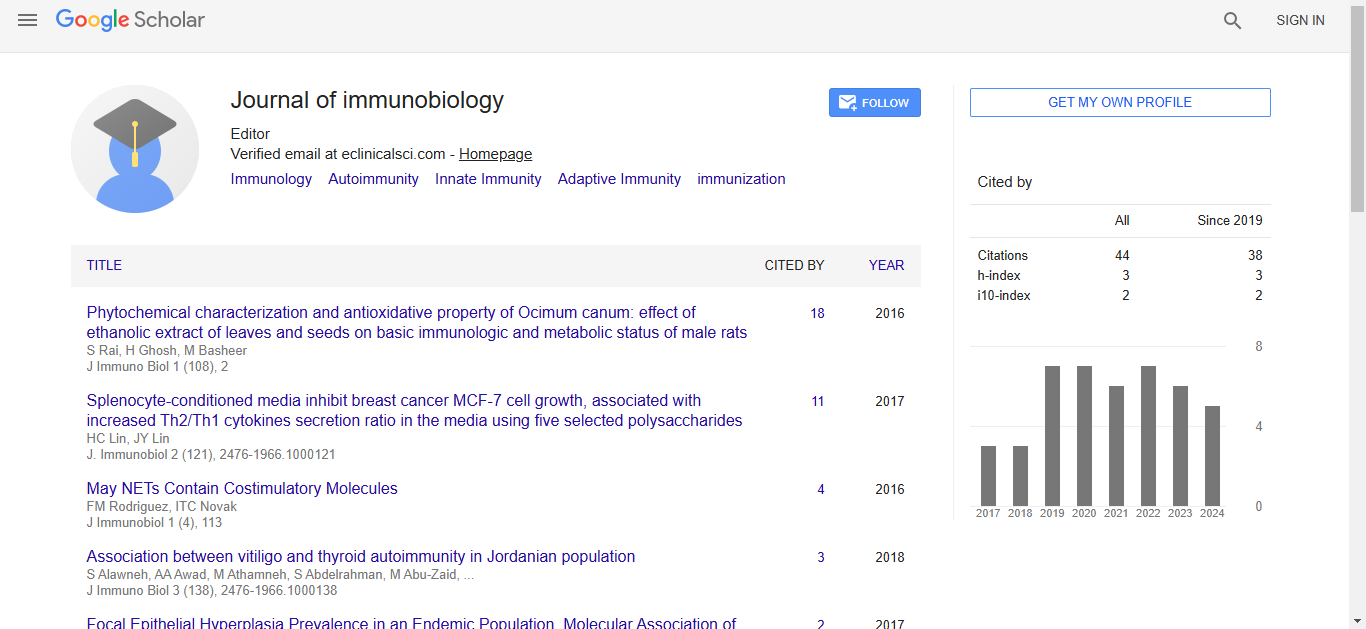
Journal of Immunobiology received 34 citations as per Google Scholar report