Commentary - (2025) Volume 10, Issue 5
Received: 01-Oct-2025, Manuscript No. cgj-26-186541;
Editor assigned: 03-Oct-2025, Pre QC No. P-186541;
Reviewed: 17-Oct-2025, QC No. Q-186541;
Revised: 22-Oct-2025, Manuscript No. R-186541;
Published:
29-Oct-2025
, DOI: 10.37421/2952-8518.2025.10.334
Citation: Rossi, Sofia M.. ”Endoscopic Resection: Revolutionizing Gastrointestinal Cancer Management.” Clin Gastroenterol J 10 (2025):334.
Copyright: © 2025 Rossi M. Sofia This is an open-access article distributed under the terms of the Creative Commons Attribution License, which permits unrestricted use, distribution and reproduction in any medium, provided the original author and source are credited.
Endoscopic resection has emerged as a transformative approach in the management of early gastrointestinal malignancies, offering a less invasive alternative to traditional surgical interventions. Techniques such as endoscopic mucosal resection (EMR) and endoscopic submucosal dissection (ESD) are now standard of care for selected superficial tumors, providing significant advantages including reduced patient morbidity, shorter hospital stays, and preservation of organ function [1].
The application of endoscopic resection is particularly well-established for early esophageal squamous cell carcinoma (ESCC), where it enables en bloc resection of lesions confined to the mucosa or submucosa. This facilitates accurate staging and minimizes the risk of lymph node metastasis, with careful patient selection being paramount [2].
For early colorectal cancers, endoscopic resection, encompassing polypectomy, EMR, and ESD, represents the standard of care for appropriately selected lesions. These minimally invasive techniques offer curative potential and excellent patient outcomes, with the choice of modality influenced by lesion size, morphology, and location [3].
Endoscopic resection also plays a critical role in managing early-stage biliary tract cancers, especially for tumors restricted to the biliary epithelium. Despite anatomical challenges, EMR and ESD can be utilized for select lesions, underscoring the importance of a multidisciplinary approach [4].
Advancements in endoscopic imaging technologies, including narrow-band imaging (NBI) and confocal laser endomicroscopy (CLE), have significantly enhanced the detection and characterization of early GI malignancies. These technologies aid in accurate decision-making for endoscopic resection by providing real-time visualization of mucosal and submucosal architecture, delineating tumor margins, and assessing invasion depth [5].
The evolution of endoscopic instruments, such as improved knives, snares, and retrieval devices, has been pivotal in expanding the scope of endoscopic resection for early GI cancers. ESD, in particular, relies on specialized, high-precision instruments that facilitate submucosal dissection with minimal collateral damage, thereby improving safety and efficacy [6].
Histopathological assessment of resected specimens is a cornerstone of endoscopic resection, verifying complete tumor removal and guiding subsequent management. Precise evaluation of resection margins, depth of invasion, and lymphovascular invasion is critical for determining recurrence risk and the need for adjuvant therapy [7].
The development of standardized training programs and competency assessments for endoscopic resection techniques is vital for ensuring patient safety and optimizing outcomes. Mastery of EMR and ESD necessitates extensive hands-on experience and a deep understanding of anatomy and pathology, with simulation-based training and mentorship playing crucial roles [8].
Cost-effectiveness is an important consideration when comparing endoscopic resection to surgical interventions for early GI malignancies. While complex ESD procedures may have higher initial costs, the overall economic benefits, including reduced hospital stays and faster recovery, often render it a more favorable option, though further research is ongoing to establish definitive data [9].
Long-term surveillance after endoscopic resection of early GI malignancies is indispensable for detecting metachronous lesions and monitoring for recurrence. Regular endoscopic follow-up, tailored to the specific cancer characteristics, is recommended to ensure optimal long-term patient outcomes [10].
Endoscopic resection has revolutionized the management of early gastrointestinal malignancies, offering a paradigm shift in treatment strategies. Techniques like endoscopic mucosal resection (EMR) and endoscopic submucosal dissection (ESD) enable the minimally invasive removal of superficial tumors, leading to reduced morbidity, shorter hospital stays, and preserved organ function compared to traditional surgical methods. The selection of appropriate candidates, precise endoscopic techniques, and thorough histopathological evaluation are paramount for successful outcomes and the prevention of recurrence. Continuous advancements in endoscopic imaging, instrumentation, and specialized training have expanded the indications for these procedures, solidifying their role in the multidisciplinary approach to early GI cancers [1].
For early esophageal squamous cell carcinoma (ESCC), endoscopic resection, specifically EMR and ESD, is well-established for lesions confined to the mucosa or submucosa. These techniques facilitate en bloc resection, which is crucial for accurate staging and reducing the risk of lymph node metastasis. Careful patient selection, based on tumor size, depth of invasion, and lymphovascular invasion, is essential. Ongoing research aims to refine these techniques and establish optimal criteria for endoscopic management to maximize cure rates while minimizing complications [2].
In the context of early colorectal cancers, endoscopic resection, including polypectomy, EMR, and ESD, is the standard of care for selected lesions, offering curative potential with excellent outcomes. The choice of technique is determined by factors such as lesion size, morphology, and location. The increasing sophistication of endoscopic equipment and the development of specialized tools have enabled complex resections, thereby broadening the therapeutic window for minimally invasive treatments [3].
Endoscopic resection also plays a crucial role in the management of early-stage biliary tract cancers, particularly for tumors confined to the biliary epithelium. Although challenging due to the anatomical location, EMR and ESD can be employed for selected lesions. Aggressive therapeutic strategies are often required, and a multidisciplinary approach involving gastroenterologists, surgeons, and oncologists is vital for optimizing patient outcomes [4].
Advancements in endoscopic imaging technologies, such as narrow-band imaging (NBI) and confocal laser endomicroscopy (CLE), have significantly improved the detection and characterization of early GI malignancies, facilitating more accurate decisions regarding endoscopic resection. These technologies allow for real-time visualization of mucosal and submucosal architecture, aiding in the delineation of tumor margins and assessment of invasion depth, which are critical for successful resection [5].
The technical evolution of endoscopic instruments, including improved knives, snares, and retrieval devices, has been instrumental in expanding the scope of endoscopic resection for early GI cancers. ESD, in particular, benefits from specialized, high-precision instruments that allow for submucosal dissection with minimal collateral damage. Continuous innovation in this area is crucial for enhancing safety and efficacy [6].
Histopathological assessment of resected specimens is fundamental for confirming complete tumor removal and guiding subsequent management decisions. Precise evaluation of resection margins, depth of invasion, and lymphovascular invasion is critical for determining the risk of recurrence and the necessity for adjuvant therapy. Advanced techniques in pathology are continuously being developed to improve the accuracy of these assessments [7].
The development of standardized training programs and competency assessments for endoscopic resection techniques is essential to ensure patient safety and optimize clinical outcomes. Mastery of EMR and ESD requires extensive hands-on experience and a thorough understanding of relevant anatomy and pathology. Simulation-based training and mentorship play vital roles in this educational process [8].
The cost-effectiveness of endoscopic resection compared to surgical interventions for early GI malignancies is an important consideration. Although initial procedural costs for complex ESD may be higher, the overall economic benefits, including reduced hospital stays, faster recovery, and fewer long-term complications, often make it a more favorable option. Further research is ongoing to establish definitive cost-effectiveness data [9].
Long-term surveillance after endoscopic resection of early GI malignancies is crucial for detecting metachronous lesions and monitoring for recurrence. Regular endoscopic follow-up, tailored to the specific type and location of the original cancer, is recommended. This vigilant follow-up strategy helps ensure optimal long-term outcomes for patients [10].
Endoscopic resection techniques like EMR and ESD have revolutionized the management of early gastrointestinal malignancies, offering minimally invasive options with reduced morbidity and shorter hospital stays. These procedures are effective for early-stage cancers of the stomach, esophagus, colorectum, and biliary tract. Advancements in endoscopic imaging and instrumentation enhance detection, characterization, and procedural precision. Accurate histopathological evaluation of resected specimens is critical for determining prognosis and guiding further treatment. Specialized training programs are essential for ensuring patient safety and optimal outcomes. While cost-effectiveness studies are ongoing, endoscopic resection often provides long-term economic benefits. Vigilant long-term surveillance is crucial for detecting recurrence and new lesions.
None
None
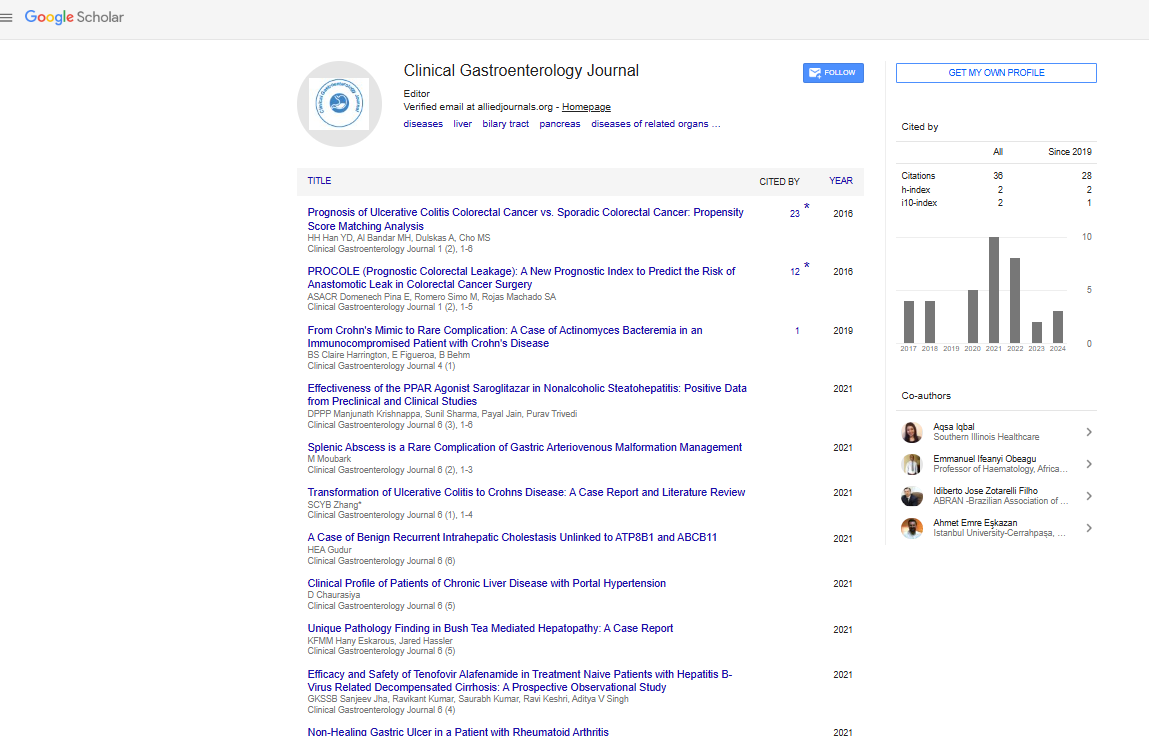
Clinical Gastroenterology Journal received 33 citations as per Google Scholar report