Opinion - (2025) Volume 14, Issue 4
Received: 02-Jul-2025, Manuscript No. jamk-25-177299;
Editor assigned: 04-Jul-2025, Pre QC No. P-177299;
Reviewed: 18-Jul-2025, QC No. Q-177299;
Revised: 23-Jul-2025, Manuscript No. R-177299;
Published:
30-Jul-2025
, DOI: 10.37421/2168-9601.2025.14.568
Citation: Kim, Daniel. ”Diverse Insights: Risk, Governance, and Firm Outcomes.” J Account Mark 14 (2025):568.
Copyright: © 2025 Kim D. This is an open-access article distributed under the terms of the Creative Commons Attribution License, which permits unrestricted use, distribution and reproduction in any medium, provided the original author and source are credited.
This research delves into the complex interplay between enterprise risk management (ERM) and the quality of internal audits, examining their combined impact on the fees companies pay for external auditing services. The study demonstrates that robust ERM practices, alongside a high-quality internal audit function, correlate with reduced external audit costs, signaling increased confidence in a firm's financial reporting and internal controls [1].
Another significant area of inquiry explores the relationship between accounting conservatism and the effectiveness of enterprise risk management within specific organizational contexts. Findings indicate that adopting a more conservative accounting approach can significantly bolster the efficacy of ERM practices. This suggests that prudent and careful accounting methodologies cultivate a more favorable environment for comprehensive organizational risk management [2].
A distinct investigation focuses on how enterprise risk management influences a firm's overall performance, particularly emphasizing the critical moderating role played by the characteristics of its audit committee. This research clearly establishes that audit committees possessing specific attributes, such as independence and expertise, substantially amplify the positive effects of ERM initiatives on a companyâ??s operational and financial outcomes [3].
Considering the dynamics of emerging markets, a study meticulously examines the intricate connections among corporate governance structures, prevalent political risks, and the fees companies ultimately incur for auditing services. The central insight gleaned is that the implementation of stronger corporate governance mechanisms can effectively mitigate the adverse impacts of political instability, leading to more predictable and potentially lower audit expenditures [4].
Anticipating future trends, an article outlines a crucial research agenda dedicated to understanding how artificial intelligence (AI) will fundamentally transform the auditing profession and, consequently, alter current approaches to risk assessment. This work underscores that AI represents more than merely a sophisticated tool; it is poised to redefine how auditors identify, evaluate, and manage various organizational risks, necessitating innovative methodologies and critical considerations [5].
Further analysis uncovers the relationship between integrated reporting practices and a company's intrinsic value, with a specific focus on the moderating influence of robust risk governance frameworks. The pivotal insight from this research highlights that integrated reporting genuinely enhances firm value when supported by effective risk governance, thereby seamlessly connecting financial and non-financial disclosures with comprehensive risk oversight [6].
In a regional context, research provides empirical insights from Nigerian financial institutions regarding the efficacy of forensic accounting techniques in detecting and preventing fraud. This investigation conclusively illustrates that specialized forensic accounting methodologies serve as indispensable tools for identifying and mitigating financial crimes within the often-complex structures of modern organizations [7].
Another study rigorously analyzes current cybersecurity risk management practices and their associated disclosure patterns, drawing evidence primarily from publicly available SEC filings. The core argument presented is that a firm's approach to managing and communicating its cybersecurity risks provides crucial signals to both investors and regulatory bodies, thereby shaping perceptions of its resilience and the overall quality of its governance [8].
Examining internal corporate dynamics, this study explores the intricate connection between managerial ability, the volume of corporate cash holdings, and the actual value derived from these cash reserves. The findings indicate that highly skilled and capable managers are more proficient at optimizing cash holdings, a factor that significantly influences both liquidity risk profiles and the overall financial health of an enterprise [9].
Finally, with a specific focus on an emerging market, an article meticulously analyzes how the adoption of sustainability reporting practices impacts a firm's risk profile and subsequent performance. The key insight derived is that transparent and comprehensive sustainability disclosures can demonstrably reduce perceived firm-specific risks, thereby contributing positively to overall financial outcomes and stakeholder confidence [10].
The initial study meticulously investigates the combined influence of enterprise risk management (ERM) and the inherent quality of internal audits on the fees firms are charged for external auditing. It clearly establishes that the presence of strong ERM frameworks, coupled with a highly effective internal audit function, leads to a noticeable reduction in external audit costs. This suggests that such firms inspire greater confidence in their financial reporting and internal control systems [1]. Subsequent research explores the direct relationship between accounting conservatism and the overall effectiveness of enterprise risk management practices within Egyptian firms. The core finding suggests that a prudent and cautious accounting methodology actively enhances the robustness of ERM. Essentially, maintaining a conservative accounting stance fosters an improved environment conducive to managing organizational risks comprehensively [2]. Further analysis delves into the impact of enterprise risk management on firm performance, particularly underscoring the vital role of audit committee characteristics. This study unequivocally reveals that audit committees endowed with critical attributes, such as independence and advanced expertise, significantly augment the positive contributions of ERM initiatives to the companyâ??s strategic and financial achievements [3]. In the context of an emerging economy, another investigation meticulously maps the linkages between corporate governance mechanisms, the pervasive influence of political risk, and the actual audit fees companies are obligated to pay. A primary conclusion drawn is that robust corporate governance structures are instrumental in mitigating the adverse effects of political risk, thereby promoting more stable and potentially lower audit costs [4]. Addressing future challenges, a seminal article proposes a comprehensive research agenda focused on anticipating how artificial intelligence will revolutionize auditing processes and, by extension, profoundly redefine the methodology for assessing risks. The crucial implication is that AI transcends a mere technological tool, fundamentally altering how auditors identify and evaluate risks, demanding new conceptual and practical approaches [5]. Moreover, the relationship between integrated reporting and firm value is thoroughly examined, specifically highlighting the pivotal moderating role played by effective risk governance. This research posits that integrated reporting genuinely unlocks and creates more value for a firm when it is firmly underpinned by strong risk governance, thus effectively connecting financial data with non-financial insights and robust risk oversight [6]. Empirical evidence from Nigerian financial institutions provides critical insights into the operational effectiveness of forensic accounting in the detection of fraud. This research unequivocally demonstrates that specialized forensic accounting techniques are essential and powerful instruments for identifying, investigating, and ultimately mitigating financial crimes within intricate corporate and institutional structures [7]. An insightful paper undertakes an in-depth analysis of cybersecurity risk management strategies and their public disclosure practices, primarily leveraging data from SEC filings. A key assertion is that the manner in which firms manage and articulate their cybersecurity risks conveys significant information to both investors and regulatory authorities, profoundly influencing perceptions of organizational resilience and governance quality [8]. Focusing on corporate financial management, this study investigates the intricate relationship between managerial ability and the level of corporate cash holdings, as well as the incremental value derived from these cash reserves. The findings consistently show that highly capable and skilled managers are more adept at optimizing cash balances, directly influencing both the firm's liquidity risk and its overall financial viability [9]. Lastly, a compelling study situated in an emerging market analyzes the profound effects of sustainability reporting on a firmâ??s risk profile and its subsequent performance trajectory. The central discovery indicates that transparent and comprehensive disclosures pertaining to sustainability issues can effectively diminish perceived organizational risk, which in turn contributes positively to financial performance and investor confidence [10].
This collection of studies provides diverse insights into risk management, corporate governance, and their impact on various organizational outcomes. Key themes include the role of enterprise risk management (ERM) and internal audit quality in reducing external audit fees, highlighting increased confidence in financial reporting. Accounting conservatism is shown to enhance ERM effectiveness, while robust audit committees amplify ERM's positive effects on firm performance. Corporate governance is also critical in mitigating political risk in emerging markets, influencing audit costs. The future impact of artificial intelligence on risk assessment in auditing is explored, alongside the value creation from integrated reporting when supported by strong risk governance. Specialized forensic accounting is vital for fraud detection, and cybersecurity risk disclosures provide crucial signals to stakeholders. Managerial ability influences cash holdings and value, while sustainability reporting positively affects firm risk and performance in emerging markets. Collectively, these papers underscore the interconnectedness of governance, risk practices, and corporate success.
None
None
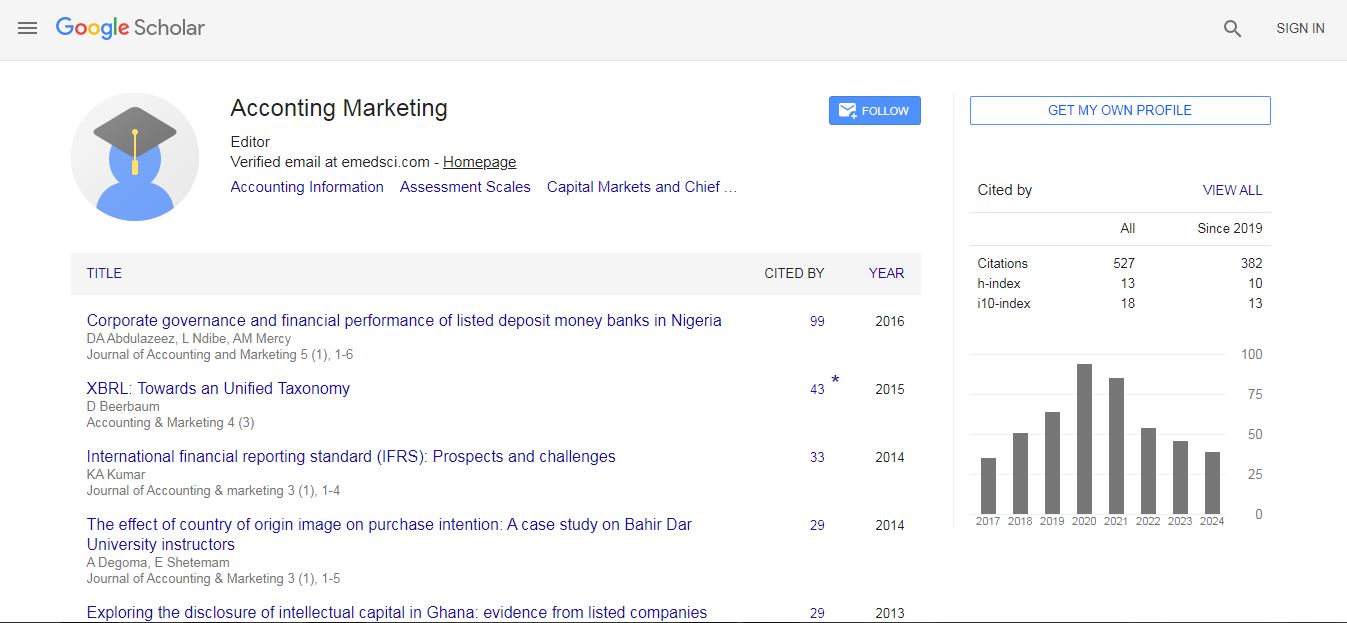
Accounting & Marketing received 487 citations as per Google Scholar report