Perspective - (2025) Volume 11, Issue 4
Received: 01-Jul-2025, Manuscript No. jefc-26-188268;
Editor assigned: 03-Jul-2025, Pre QC No. P-188268;
Reviewed: 17-Jul-2025, QC No. Q-188268;
Revised: 22-Jul-2025, Manuscript No. R-188268;
Published:
29-Jul-2025
, DOI: 10.37421/2472-0542.2025.11.551
Citation: El-Sayed, Ahmed. ”Factors Affecting Vitamin Stability In Foods.” J Exp Food Chem 11 (2025):551.
Copyright: © 2025 El-Sayed A. This is an open-access article distributed under the terms of the Creative Commons Attribution License, which permits unrestricted use, distribution and reproduction in any medium, provided the original author and source are credited.
The stability of vitamins in food products is a critical aspect of nutritional science, directly impacting the bioavailability and efficacy of essential nutrients. Various factors can influence vitamin degradation, including storage conditions, processing methods, packaging, and inherent properties of the food matrix. Understanding these influences is paramount for the food industry to develop products that retain their nutritional value throughout their shelf life. This review synthesizes recent research examining the complex interplay of factors affecting vitamin stability across a range of food categories. For instance, the impact of different storage conditions on vitamin stability in beverages has been a significant area of investigation. Studies have meticulously documented how elevated temperatures and prolonged storage periods can accelerate the degradation of vital nutrients like vitamin C and vitamin A. The findings underscore the necessity of optimized storage parameters, such as low temperatures and minimal light exposure, to preserve the vitamin content in products like orange juice [1].
Similarly, the choice of packaging materials plays a pivotal role in safeguarding vitamin integrity. Research focusing on fortified cereal products has demonstrated that the type of packaging can significantly influence the degradation rates of B vitamins. Opaque, high-barrier packaging has been shown to be more effective in retarding vitamin losses compared to transparent films, especially when subjected to fluctuating humidity levels [2].
Thermal processing, a cornerstone of food preservation, also presents challenges for vitamin retention. Investigations into the effects of pasteurization and UHT treatment on fat-soluble vitamins in milk have revealed that while both methods lead to some vitamin loss, UHT treatment can result in slightly higher degradation, particularly for vitamin E. This highlights the importance of considering milder processing conditions to maximize nutrient retention [3].
In the realm of specialized food products, such as plant-based meat alternatives, ensuring adequate vitamin fortification and stability is crucial. Research on vitamin B12 stability during refrigerated storage in these products has revealed significant variability. Factors like the food matrix and interactions with other components, including Maillard reaction products, can contribute to degradation, necessitating specific formulation adjustments for optimal bioavailability [4].
Baked goods, often fortified with essential vitamins, also require careful consideration of storage conditions. Studies on the degradation kinetics of folic acid in bread during storage have shown that prolonged storage and high humidity levels lead to more pronounced folic acid loss. Developing kinetic models to predict such degradation is vital for ensuring the nutritional quality of fortified baked goods [5].
The impact of common preservation techniques like freezing on vitamin content is another area of active research. Investigations into vitamin D retention in fortified dairy products have indicated that while freezing itself may have a minimal effect, repeated freeze-thaw cycles can lead to a notable decline in vitamin D levels. This suggests that stable storage temperatures are essential to prevent such losses [6].
For edible oils, which are significant sources of vitamin E, stability during storage is a key concern. Research examining alpha-tocopherol stability in vegetable oils under accelerated storage conditions has shown a high susceptibility to oxidation. Degradation rates are significantly influenced by oxygen levels and light exposure, emphasizing the role of the oil matrix's antioxidant capacity in maintaining vitamin stability [7].
Drying methods represent another significant processing step that can affect vitamin content. Studies evaluating the impact of different drying techniques on vitamin K1 retention in spinach powder have found that freeze-drying preserves higher levels of vitamin K1 compared to other methods like air-drying, which results in substantial losses. This indicates the superiority of gentle drying techniques for heat-sensitive vitamins [8].
Finally, the chemical environment within food systems can profoundly influence vitamin stability. Investigations into the degradation of vitamin A in model food systems have highlighted the detrimental effects of acidic pH and the presence of certain metal ions, such as iron and copper. Understanding these interactions is critical for formulating stable vitamin A-fortified foods [9].
The collective insights from these studies offer a comprehensive overview of the multifaceted challenges and solutions in maintaining vitamin integrity in the modern food supply.
The stability of vitamins within food matrices is a multifaceted scientific challenge, influenced by an array of extrinsic and intrinsic factors. Understanding and mitigating vitamin degradation is crucial for delivering nutritionally adequate food products to consumers. Recent research has shed light on several key areas, including the effects of storage conditions on nutrient retention. For example, studies on vitamin C and vitamin A in orange juice have demonstrated that elevated temperatures and extended storage times significantly accelerate their degradation. Conversely, maintaining low temperatures and minimizing light exposure are identified as critical strategies for preserving vitamin content in such beverages [1].
The role of packaging materials in vitamin preservation is another significant research focus. Investigations into B vitamins in fortified cereal products have revealed that the choice of packaging can substantially impact vitamin losses. Specifically, opaque packaging with high barrier properties has been found to be more effective in preventing vitamin degradation compared to transparent films, particularly under varying humidity conditions, emphasizing the importance of appropriate packaging selection for nutrient integrity [2].
Thermal processing, a common technique in food manufacturing, also has implications for vitamin stability. Research examining the impact of pasteurization and UHT treatment on fat-soluble vitamins in milk has shown that both processes can lead to vitamin loss, with UHT treatment sometimes causing greater degradation, especially for vitamin E. This suggests that adopting milder processing conditions might be beneficial for maximizing the retention of these vitamins [3].
For emerging food categories, such as plant-based meat alternatives, ensuring the stability of fortified vitamins is an ongoing area of investigation. Studies focusing on vitamin B12 in these products during refrigerated storage have indicated that its retention can vary significantly depending on the food matrix and fortification strategy. Interactions with other food components and the formation of degradation products, such as those from the Maillard reaction, can contribute to vitamin loss, underscoring the need for tailored formulation approaches [4].
In the context of baked goods, the stability of vitamins like folic acid is a critical consideration, especially for fortified products. Research on folic acid degradation in bread during storage has shown that longer storage periods and higher humidity levels exacerbate vitamin loss. The development of kinetic models to predict these degradation pathways is essential for optimizing storage and handling recommendations for fortified baked goods [5].
Freezing and thawing cycles, common preservation methods, can also impact vitamin content. Studies examining vitamin D retention in fortified dairy products have found that while the freezing process itself may have a limited effect, repeated freeze-thaw cycles can lead to a noticeable reduction in vitamin D levels. This is likely due to cellular damage and increased susceptibility to oxidative processes, highlighting the importance of maintaining stable storage temperatures [6].
For lipid-based foods, the stability of fat-soluble vitamins is of paramount importance. Research on vitamin E (alpha-tocopherol) in vegetable oils under accelerated storage conditions has indicated its high susceptibility to oxidation. Factors such as oxygen partial pressure and light exposure significantly increase degradation rates, emphasizing the critical role of the oil's intrinsic antioxidant capacity in preserving vitamin stability [7].
Drying is a widely used method for preserving food products, but it can also affect vitamin content. Studies comparing different drying methods for vitamin K1 retention in spinach powder have shown that freeze-drying results in the highest retention, whereas air-drying leads to the most substantial losses. This finding suggests that employing gentle drying techniques is advantageous for retaining heat-sensitive vitamins [8].
The chemical environment within a food system can also play a significant role in vitamin stability. Research on vitamin A degradation in model food systems has demonstrated that acidic pH conditions and the presence of certain transition metal ions, such as iron and copper, can accelerate its breakdown. Understanding these chemical interactions is crucial for formulating stable vitamin A-fortified foods [9].
Furthermore, the stability of vitamins in minimally processed foods is a growing concern. Studies investigating vitamin C in fruits and vegetables have highlighted the significant role of enzymatic activity, particularly ascorbate oxidase, in vitamin loss during storage, even under refrigerated conditions. Consequently, minimal processing techniques that effectively inactivate these enzymes are vital for preserving vitamin C content [10].
Recent research highlights the critical factors influencing vitamin stability in various food products. Storage conditions, including temperature, time, and light exposure, significantly impact the degradation of vitamins like C and A, with lower temperatures and minimal light being optimal. Packaging materials play a crucial role, with opaque, high-barrier options preserving B vitamins better than transparent films. Thermal processing methods such as pasteurization and UHT treatment can lead to vitamin loss, with milder conditions often preferred for fat-soluble vitamins. In plant-based alternatives, matrix interactions and fortification strategies affect vitamin B12 stability. Folic acid in bread is susceptible to degradation from prolonged storage and high humidity, necessitating predictive models. Freezing and thawing cycles can reduce vitamin D levels in dairy products, emphasizing stable storage. Vitamin E in vegetable oils degrades rapidly under oxidative and light stress, with antioxidant capacity being key. Drying methods influence vitamin K1 retention, favoring freeze-drying over air-drying. The chemical environment, including pH and metal ions, affects vitamin A stability, while enzymatic activity is a major cause of vitamin C loss in minimally processed produce.
None
None
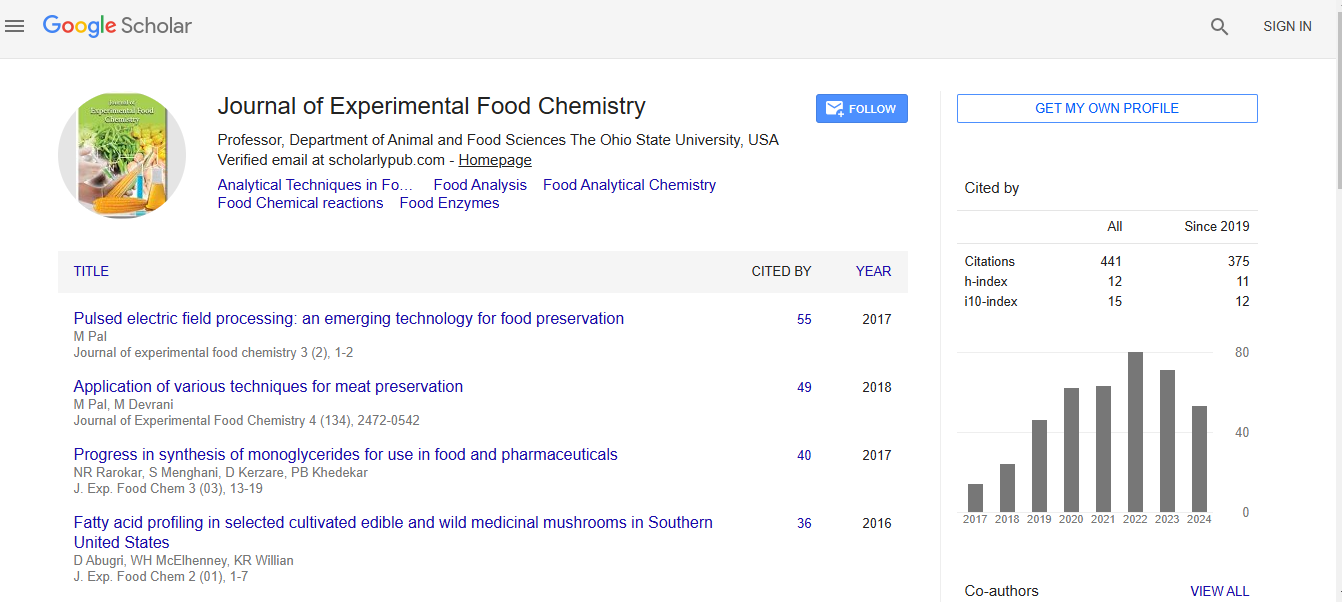
Journal of Experimental Food Chemistry received 389 citations as per Google Scholar report