Brief Report - (2025) Volume 11, Issue 5
Received: 01-Sep-2025, Manuscript No. jefc-26-188293;
Editor assigned: 03-Sep-2025, Pre QC No. P-188293;
Reviewed: 17-Sep-2025, QC No. Q-188293;
Revised: 22-Sep-2025, Manuscript No. R-188293;
Published:
29-Sep-2025
, DOI: 10.37421/2472-0542.2025.11.558
Citation: Johnson, Sarah. ”Starch Gelatinization and Retrogradation: Food Texture and Shelf-Life.” J Exp Food Chem 11 (2025):558.
Copyright: © 2025 Johnson S. This is an open-access article distributed under the terms of the Creative Commons Attribution License, which permits unrestricted use, distribution and reproduction in any medium, provided the original author and source are credited.
The intricate processes of starch gelatinization and retrogradation are fundamental to understanding the physical and chemical transformations that starch undergoes in various food systems. Gelatinization, the disruption of starch granules upon heating in the presence of water, leads to swelling and increased solubility, fundamentally altering its structure and functional properties. This initial phase is critical as it sets the stage for subsequent changes, including retrogradation [1].
Processing methods significantly influence the kinetics of these transformations. Techniques such as extrusion and baking can accelerate starch gelatinization, with parameters like temperature and shear playing crucial roles. The subsequent cooling rate then dictates the extent of retrogradation, influencing properties like water-holding capacity and digestibility, which are vital considerations in the design of processed foods [2].
The interaction of starch with other food components, such as proteins and hydrocolloids, can profoundly modify its behavior during gelatinization and retrogradation. These additives can either inhibit or promote gelatinization and significantly alter the rate and extent of retrogradation, thereby impacting the final texture and shelf-life of products like baked goods [3].
At a molecular level, advanced spectroscopic techniques have been instrumental in elucidating the structural changes that occur during starch gelatinization and retrogradation. These methods reveal alterations in crystalline structure, hydrogen bonding, and molecular arrangements, providing deep insights into the mechanisms driving texture development in food matrices [4].
Variations in starch types, such as corn, potato, or tapioca, lead to distinct behaviors during gelatinization and retrogradation. Differences in amylose content, chain length, and crystalline structure result in differing swelling power, solubility, and retrogradation rates, influencing their suitability for diverse food applications [5].
Enzymatic modification offers another avenue for controlling starch properties. Enzymes like amylases can alter starch structure, affecting gelatinization temperatures and the rate of retrogradation. This approach allows for tailored starch properties to meet specific processing requirements, such as reducing staling or improving digestibility [6].
The availability of water is a critical factor in starch transformations. Varying water content influences the degree of gelatinization and the subsequent rate of retrogradation. Lower water content generally results in less complete gelatinization and slower retrogradation, impacting texture and moisture migration in food systems [7].
Rheological measurements provide a powerful means to monitor starch gelatinization and retrogradation. By correlating dynamic viscoelastic properties with structural changes, this approach enables the assessment of textural development and the prediction of shelf-life in starch-based products like yogurts and sauces [8].
In baking, processing temperatures and times have a direct impact on starch behavior. Higher temperatures and longer baking durations promote more complete gelatinization but also accelerate retrogradation, which is a key factor in bread staling. Optimizing these parameters is essential for extending bread freshness [9].
Techniques like differential scanning calorimetry (DSC) and X-ray diffraction (XRD) are vital for quantitative analysis of starch transformations. They provide data on transition temperatures, enthalpy changes, and crystalline structure modifications, which are directly correlated with observed changes in texture and digestibility in food applications [10].
The study of starch gelatinization and retrogradation is central to food science, influencing the textural properties and shelf-life of a vast array of products. Gelatinization, the process where starch granules absorb water and swell upon heating, is a critical initial step. The extent of this swelling and subsequent enzyme accessibility are significantly influenced by the conditions of gelatinization, such as temperature and shear forces [1].
Different processing methods have a profound impact on the temporal progression of starch transformations. For instance, extrusion and baking techniques can accelerate the gelatinization process. The subsequent cooling rate, however, plays a pivotal role in determining the degree of retrogradation, a process where gelatinized starch molecules reassociate, thereby influencing crucial parameters like water-holding capacity and digestibility in processed foods [2].
Furthermore, the presence of specific additives, including proteins and hydrocolloids, can significantly modulate starch behavior during these phases. These interactions can either hinder or enhance gelatinization and considerably affect the speed and extent of retrogradation, ultimately impacting the texture and staling characteristics of food products, particularly baked goods [3].
At a more fundamental level, researchers have employed sophisticated spectroscopic techniques to meticulously examine the structural modifications occurring within starch molecules during gelatinization and retrogradation. These investigations have revealed specific changes in crystalline arrangements, hydrogen bonding networks, and helical structures, offering a deeper comprehension of the underlying mechanisms responsible for texture alteration in food systems [4].
It is also important to acknowledge that different types of starch, such as those derived from corn, potatoes, or tapioca, exhibit distinct behaviors. These variations in swelling power, solubility, and retrogradation rates are attributable to inherent differences in their amylose content, molecular chain lengths, and crystalline architectures, which collectively shape their functional attributes in diverse food applications [5].
Enzymatic modification presents a valuable strategy for altering starch properties. Treatments with specific enzymes, like amylases, can modify the starch structure, consequently influencing gelatinization temperatures and the pace of retrogradation. This enzymatic approach offers a controlled method for tailoring starch characteristics to meet specific food processing demands, such as delaying staling in bread or enhancing digestibility [6].
The environmental conditions during processing also play a significant role. Varying water content, for example, is a critical determinant of both gelatinization and retrogradation. Lower levels of water generally lead to less complete gelatinization and a slower rate of retrogradation, which in turn affects the final texture and the dynamics of moisture movement within the food matrix [7].
Rheological measurements have emerged as an indispensable tool for the real-time monitoring of starch gelatinization and retrogradation. By establishing correlations between dynamic viscoelastic properties and concurrent structural alterations, this methodology provides a robust framework for assessing textural development and predicting the shelf-life of various starch-based food items, including dairy products and sauces [8].
In the context of bread-making, processing parameters such as baking temperatures and durations exert a considerable influence on starch behavior. Elevated temperatures and extended baking times facilitate more comprehensive gelatinization but concurrently hasten retrogradation, a phenomenon directly linked to bread staling. A thorough understanding of these interrelationships is thus paramount for optimizing baking processes to ensure prolonged product freshness [9].
Advanced analytical techniques, specifically differential scanning calorimetry (DSC) and X-ray diffraction (XRD), are routinely utilized to investigate the thermal and structural aspects of starch gelatinization and retrogradation. These methods furnish quantitative data on transition temperatures, enthalpy changes, and modifications to crystalline structures, allowing for direct correlation with observed textural and digestibility changes in food systems [10].
Starch gelatinization and retrogradation are critical processes influencing food texture and shelf-life. Gelatinization, driven by heat and water, involves starch granule swelling and increased solubility. Processing methods like extrusion and baking accelerate gelatinization, with cooling rates affecting retrogradation. Additives such as proteins and hydrocolloids modify these behaviors. Molecular studies reveal structural changes during these phases. Different starch types exhibit varied properties due to their composition. Enzymatic modifications offer control over starch behavior. Water content significantly impacts gelatinization and retrogradation. Rheological measurements are key to monitoring these changes and predicting shelf-life. Baking conditions affect starch transformations and bread staling. Advanced techniques like DSC and XRD provide quantitative data on thermal and structural properties, linking them to food quality.
None
None
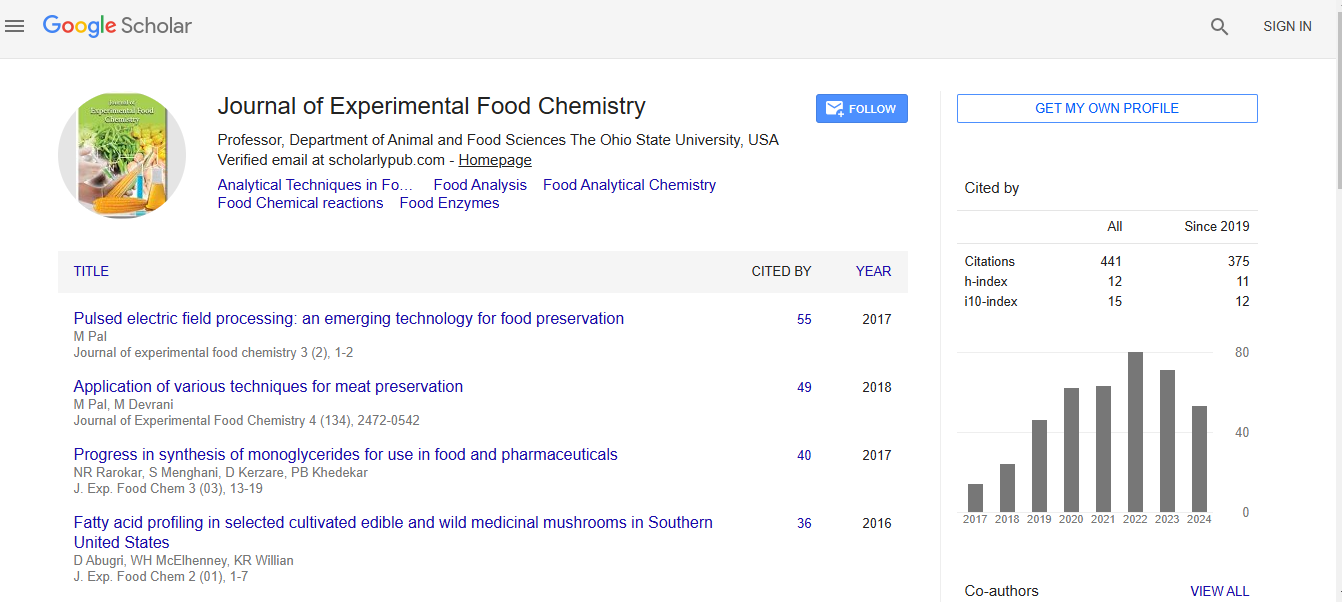
Journal of Experimental Food Chemistry received 389 citations as per Google Scholar report