Commentary - (2025) Volume 10, Issue 2
Received: 02-Jun-2025, Manuscript No. jib-25-175249;
Editor assigned: 04-Jun-2025, Pre QC No. P-175249;
Reviewed: 18-Jun-2025, QC No. Q-175249;
Revised: 23-Jun-2025, Manuscript No. R-175249;
Published:
30-Jun-2025
, DOI: 10.37421/2476-1966.2025.10.275
Citation: Senthil, Priya. ”B-cell Differentiation: Dynamic Process Shaping Immunity.” J Immuno Biol 10 (2025):275.
Copyright: © 2025 Senthil P. This is an open-access article distributed under the terms of the Creative Commons Attribution License, which permits unrestricted use, distribution and reproduction in any medium, provided the original author and source are credited.
The journey of B-cell differentiation represents a foundational aspect of adaptive immunity, encompassing a complex, multi-step process largely orchestrated within germinal centers. This intricate progression is vital for generating highly specialized plasma cells, which are the primary producers of antibodies, and long-lived memory B cells, indispensable for providing protective immunity against future encounters with pathogens [1].
Central to guiding B-cell differentiation, particularly within the dynamic environment of germinal centers, are T Follicular Helper (Tfh) cells. These cells play a pivotal role in influencing antibody affinity maturation and the successful generation of both memory and plasma cells. Importantly, dysregulation of Tfh cells is frequently implicated in the pathogenesis of various autoimmune diseases, underscoring their critical contribution to maintaining immune homeostasis [2].
At the earliest stages of development, the bone marrow stands as the primary anatomical site for early B-cell development. Here, a continuous and robust supply of progenitors is absolutely essential for ensuring sustained B-cell differentiation. A thorough understanding of these foundational early stages is crucial not only for comprehending the broader development of the immune system but also for devising potential therapeutic interventions aimed at immune disorders [3].
Interestingly, external environmental factors, such as the composition of the gut microbiota during early life, exert a significant influence on B-cell differentiation and maturation processes. This vital interaction actively shapes the immune response to infections, strongly suggesting that microbial exposures experienced early in life can profoundly impact an individual's long-term immune competency [4].
Within the diverse landscape of B-cell populations, atypical memory B cells emerge as a distinct subset characterized by unique differentiation pathways. These cells are frequently associated with chronic inflammatory and autoimmune conditions. Studying them offers crucial insights into the dysfunctional immune responses observed in complex diseases like lupus and HIV, thereby opening promising avenues for developing targeted therapies [5].
Underpinning the orchestration of B-cell differentiation and the shaping of their ultimate functional outcomes are critical epigenetic mechanisms. These include key processes such as DNA methylation and various histone modifications. When these sophisticated regulatory processes are disrupted, it can unfortunately lead to a spectrum of immune disorders, unequivocally highlighting epigenetics as a fundamental regulator of B-cell biology [6].
Furthermore, Marginal Zone B (MZB) cells, which predominantly reside in the spleen, are indispensable for mounting rapid, T-cell independent immune responses. Their differentiation and functional dynamics are meticulously regulated by a variety of signals, allowing them to effectively serve as a critical first line of defense against potentially life-threatening blood-borne pathogens [7].
The precise differentiation of B cells into plasmablasts and subsequently into fully mature plasma cells is a tightly controlled biological process. This intricate transformation involves specific signaling pathways and the coordinated action of various transcriptional factors. This sophisticated orchestration is absolutely essential for ensuring effective antibody production, which is a cornerstone of robust humoral immunity [8].
Another significant B-cell subset, Regulatory B cells (Bregs), are widely recognized for their potent immune suppressive functions. They play a crucial role in fostering immune tolerance and actively preventing autoimmunity. Gaining a deeper understanding of their intricate differentiation pathways and their diverse subsets is vital for effectively leveraging their therapeutic potential in the treatment of a wide array of autoimmune diseases [9].
Finally, B-cell memory differentiation is a cornerstone for establishing long-lasting protection against pathogens, forming the very basis of effective vaccination strategies. Recent research has considerably illuminated the complex mechanisms that govern the generation and meticulous maintenance of various memory B-cell subsets. This ongoing elucidation offers promising new strategies for advancing vaccine design and developing more effective treatments for various immune disorders [10].
B-cell differentiation is a cornerstone process within the adaptive immune system, orchestrating the development of diverse B-cell subsets, each endowed with specialized functions vital for host protection. This elaborate journey begins with early B-cell progenitors residing within the bone marrow, which are crucial for maintaining a continuous supply essential for sustained B-cell differentiation throughout an organism's life [3]. These nascent B cells then embark on a maturation pathway that prepares them to play their critical role in humoral immunity. A pivotal stage for advanced B-cell differentiation occurs within the highly organized microenvironments of germinal centers. Here, B cells undergo intensive selection and modification, including crucial processes like somatic hypermutation and class-switch recombination. This complex maturation is finely tuned and guided by the crucial interactions with T Follicular Helper (Tfh) cells. Tfh cells are indispensable in shaping high-affinity antibody responses and facilitating the effective generation of both long-lived memory and plasma cells. Disruption in the intricate regulatory balance of Tfh cells is a recognized factor in the pathology of various autoimmune conditions, underscoring their profound importance in maintaining immune homeostasis [2]. The ultimate outcomes of B-cell differentiation are the production of highly specialized cells that underpin protective immunity: antibody-secreting plasma cells and immunological memory. Plasma cells act as dedicated factories for antibody synthesis, providing immediate defense against pathogens, while long-lived memory B cells form the basis of durable immunological memory, enabling swift and potent responses upon subsequent pathogen encounters [1]. The precise transition of B cells into plasmablasts and their subsequent maturation into fully functional plasma cells is an exquisitely controlled biological process. This transformation relies on specific, intricate signaling pathways and the coordinated action of various transcriptional factors. Such meticulous orchestration is absolutely vital for ensuring efficient and effective antibody production, which is the very foundation of robust humoral immunity [8]. Furthermore, the mechanisms governing B-cell memory differentiation are fundamental for establishing long-lasting protection against a broad spectrum of pathogens, forming the immunological basis for the success of vaccination strategies. Contemporary research continues to illuminate the complex and dynamic processes that regulate the generation and meticulous maintenance of diverse memory B-cell subsets. This expanding knowledge not only enhances our understanding of immune system function but also provides new avenues for advancing vaccine design and developing more targeted therapies for a range of immune disorders [10]. Beyond cellular interactions, intrinsic regulatory mechanisms play a profound role in B-cell fate. Epigenetic mechanisms, encompassing critical processes like DNA methylation and various histone modifications, serve as master orchestrators of B-cell differentiation and significantly shape their ultimate functional attributes. Perturbations or dysregulations within these intricate epigenetic controls can unfortunately lead to a wide array of immune disorders, unequivocally highlighting their indispensable role as key regulators in B-cell biology [6]. Interestingly, external environmental factors also exert significant influence. The composition of the gut microbiota during early life, for instance, significantly impacts B-cell differentiation and maturation processes. This crucial interaction actively shapes the host's immune response to various infections, strongly suggesting that early microbial exposures can profoundly determine an individual's long-term immune competency and susceptibility to disease [4]. Among the diverse B-cell populations, Marginal Zone B (MZB) cells stand out. Primarily located in the spleen, these cells are renowned for their ability to mount rapid, T-cell independent immune responses, effectively serving as a critical first line of defense against blood-borne pathogens. Their differentiation and functional dynamics are intricately regulated by a complex interplay of various signals [7]. The B-cell lineage also includes specialized subsets with distinct roles, some of which are implicated in disease. Atypical memory B cells represent a unique B-cell subset characterized by differentiation pathways that are often associated with chronic inflammatory and autoimmune conditions. Delving into the study of these distinct pathways provides crucial insights into the dysfunctional immune responses observed in complex human diseases such as systemic lupus erythematosus and HIV infection, thereby opening promising new avenues for the development of highly targeted therapeutic strategies [5]. Conversely, Regulatory B cells (Bregs) constitute another vital B-cell subset, particularly recognized for their potent immune suppressive functions. These cells are instrumental in fostering immune tolerance, actively preventing the onset and progression of autoimmunity. A comprehensive understanding of their complex differentiation pathways and the inherent diversity of their subsets is critically important for effectively harnessing their significant therapeutic potential, especially in the context of treating various autoimmune diseases [9].
B-cell differentiation is a crucial, multi-step immunological process fundamental to adaptive immunity. This journey begins with early B-cell progenitors in the bone marrow, providing a continuous supply for subsequent maturation. Within germinal centers, B cells undergo complex differentiation pathways, guided by T Follicular Helper (Tfh) cells, leading to the generation of highly specialized plasma cells for antibody production and long-lived memory B cells, which are essential for sustained protection against pathogens. The gut microbiota in early life significantly influences these differentiation and maturation processes, shaping immune responses to infections. Beyond conventional pathways, specific B-cell subsets like atypical memory B cells are linked to chronic inflammatory and autoimmune conditions, offering insights into dysfunctional immune responses. Marginal Zone B (MZB) cells, found in the spleen, are vital for rapid, T-cell independent responses against blood-borne pathogens. The broader differentiation into plasmablasts and plasma cells is meticulously controlled by specific signaling pathways and transcriptional factors, ensuring effective humoral immunity. Epigenetic mechanisms, including DNA methylation and histone modifications, play a critical role in orchestrating these differentiation steps and their functional outcomes. Furthermore, Regulatory B cells (Bregs) represent a key subset with immune suppressive functions, crucial for maintaining immune tolerance and preventing autoimmunity. Understanding the generation and maintenance of memory B-cell subsets is also central to vaccine development and treating various immune disorders. Overall, B-cell differentiation is a dynamic, highly regulated process with profound implications for both immune health and disease.
None
None
Jesus LDLC, Erika KB, Francisco JC. "The journey of B cell differentiation: From germinal center to plasma cells and memory B cells".Front Immunol 13 (2022):1049756.
Indexed at, Google Scholar, Crossref
Haiyan M, Sha L, Chao H. "T follicular helper cells and their roles in B cell differentiation and autoimmune diseases".Front Immunol 14 (2023):1107530.
Indexed at, Google Scholar, Crossref
Hongtao Z, Wenkai C, Tao M. "Early B-cell progenitors in the bone marrow are critical for sustained B-cell differentiation".Cell Immunol 386 (2023):104712.
Indexed at, Google Scholar, Crossref
Marina BCG, Ana GM, Sarah MFL. "The Gut Microbiota in Early Life Impacts B Cell Differentiation and Maturation in Response to Infection".Front Cell Infect Microbiol 11 (2021):794380.
Indexed at, Google Scholar, Crossref
Catarina ACF, Bruna TMHG, Sarah OAMS. "Atypical Memory B Cells and Their Differentiation: Insights into Inflammatory and Autoimmune Disorders".Int J Mol Sci 25 (2024):986.
Indexed at, Google Scholar, Crossref
Jose LV, Cinthya RV, Andrea LB. "Epigenetic Regulation of B Cell Differentiation and Function in Health and Disease".Int J Mol Sci 24 (2023):14051.
Indexed at, Google Scholar, Crossref
Hyo GP, Jung HL, Ji IK. "Dynamic regulation of marginal zone B cell differentiation and function".Exp Mol Med 53 (2021):1365-1375.
Indexed at, Google Scholar, Crossref
Hanna GPLdO, Giulia CL, Flavio BLCM. "Signaling Pathways and Transcriptional Factors Orchestrating Human Plasmablast Differentiation".Int J Mol Sci 24 (2023):4818.
Indexed at, Google Scholar, Crossref
Daniely SR, Eliza BBSS, Thais PCDP. "Regulatory B cells (Bregs): differentiation, subsets, and their therapeutic role in autoimmune disease".Front Immunol 14 (2023):1222409.
Indexed at, Google Scholar, Crossref
Xiang H, Mengke Z, Hongyan Z. "Recent advances in B cell memory differentiation in health and disease".Cell Mol Immunol 19 (2022):801-812.
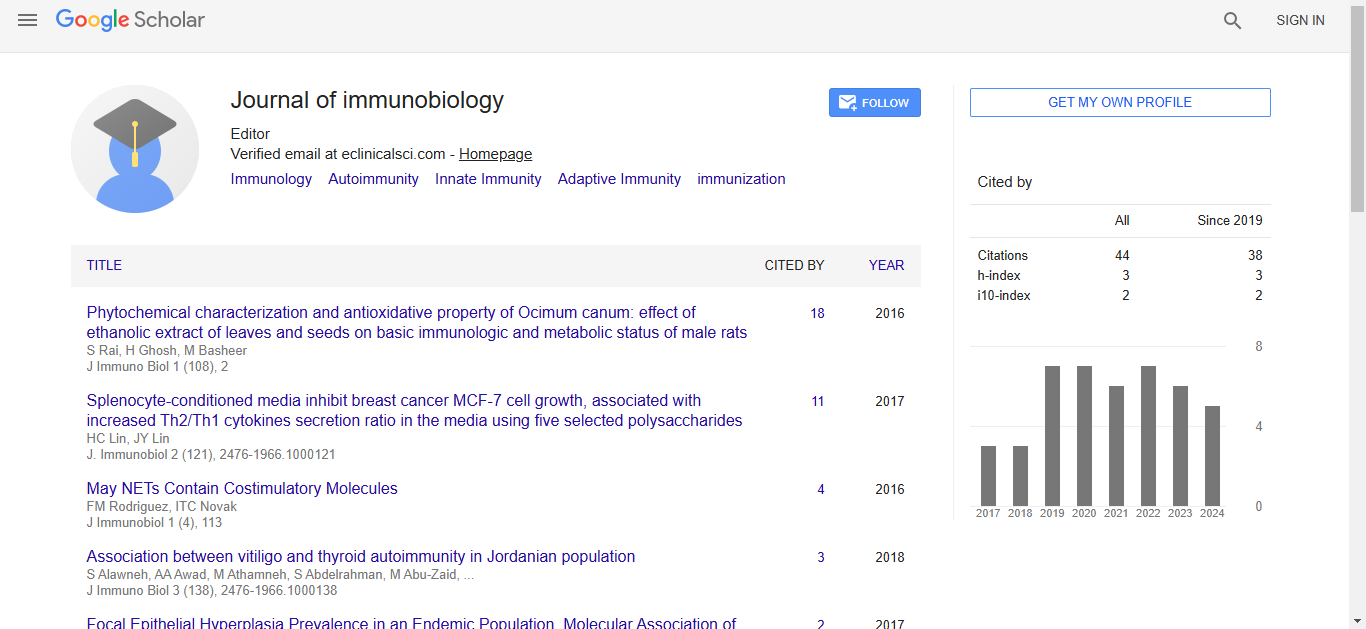
Journal of Immunobiology received 34 citations as per Google Scholar report