Commentary - (2025) Volume 11, Issue 2
Received: 01-Mar-2025, Manuscript No. jfim-26-178548;
Editor assigned: 03-Mar-2025, Pre QC No. P-178548;
Reviewed: 17-Mar-2025, QC No. Q-178548;
Revised: 24-Mar-2025, Manuscript No. R-178548;
Published:
31-Mar-2025
, DOI: 10.37421/2572-4134.2025.11.334
Citation: Al‑Hassan, Ahmed S.. ”Advancing Food Fermentation: Efficiency, Sustainability, Innovation.” J Food Ind Microbiol 11 (2025):334.
Copyright: © 2025 Al‑Hassan S. Ahmed This is an open-access article distributed under the terms of the Creative Commons Attribution License, which permits unrestricted use, distribution and reproduction in any medium, provided the original author and source are credited.
Industrial fermentation for food production is currently undergoing a period of significant advancement, marked by a strong emphasis on enhancing both the efficiency and sustainability of the processes involved. The integration of novel technologies is playing a pivotal role in enabling finer control over complex microbial activities, which in turn leads to demonstrably improved product yields and the successful development of entirely new food products. These innovations span a wide spectrum, encompassing the sophisticated development of microbial strains, the engineering of advanced bioreactor designs, and the optimization of intricate downstream processing techniques. Precision fermentation has emerged as a particularly dynamic area of growth within the food industry. This specialized approach allows for the highly targeted production of specific food ingredients, such as proteins and flavor compounds, with remarkable precision. The inherent advantages of this method lie in its capacity to offer superior control over the production process and ensure a high degree of consistency, characteristics that are often challenging to achieve with more traditional fermentation techniques. This paves the way for the creation of innovative new food formulations and the exploration of novel applications for fermented ingredients. Bioreactor technology, a cornerstone of industrial fermentation, is undergoing continuous evolution to effectively meet the escalating demands of modern food production. Current research and development efforts are intensely focused on designing bioreactors that optimize critical operational parameters. These include enhancing mass transfer for better nutrient delivery and waste removal, improving heat removal capabilities to maintain optimal temperatures, and ensuring robust microbial containment to prevent contamination and ensure product safety. All these improvements are absolutely crucial for achieving scalable and highly efficient food production operations. Sustainability is no longer an afterthought but a fundamental principle increasingly integrated into the fabric of industrial fermentation practices. This commitment to environmental responsibility manifests in several key areas, such as the strategic utilization of renewable feedstocks, which reduces reliance on finite resources. Furthermore, the valorization of waste streams, transforming by-products into valuable materials, and the implementation of energy-efficient processes are all vital components in minimizing the overall environmental footprint associated with food production. Metabolic engineering and synthetic biology stand out as exceptionally powerful tools for the precise optimization of microbial strains employed in various food fermentation processes. These advanced biotechnological techniques empower researchers and developers to design and engineer microorganisms with significantly enhanced production capabilities for desired compounds. Moreover, they enable the introduction of novel functionalities into these microbial workhorses, expanding the possibilities for ingredient development and product innovation in the food sector. Downstream processing, a critical and often resource-intensive phase, represents a significant bottleneck in the overall efficiency of industrial fermentation processes. To address this challenge, considerable advancements are being made in separation and purification technologies. Innovations in techniques such as membrane filtration, which allows for selective separation of components, and advanced chromatography methods, which can isolate compounds based on their properties, are crucial for improving both the recovery rates and the final purity of the desired food ingredients. The application of artificial intelligence (AI) and machine learning (ML) in the realm of industrial fermentation is a rapidly growing trend with immense potential to revolutionize the field. These sophisticated technologies are being effectively employed for real-time process monitoring, enabling early detection of deviations and facilitating prompt adjustments. They are also instrumental in process optimization, identifying the ideal conditions for maximum yield and quality, and in predictive modeling, allowing for better forecasting of fermentation outcomes and enhancing overall control. Beyond the technical aspects, consumer acceptance and the establishment of clear regulatory frameworks are paramount for the widespread adoption and success of novel fermentation-derived food products. Building and maintaining consumer trust is a key objective, and this is largely achieved through transparency in production methods and the provision of clear, informative labeling regarding the origin and composition of these innovative food items. The development of starter cultures that are not only robust but also scalable is absolutely fundamental to the success of any industrial fermentation endeavor. Ongoing research efforts are intensely focused on enhancing the performance characteristics of these essential microbial populations. This includes improving their viability, productivity, and genetic stability, ensuring they consistently perform as expected under demanding industrial conditions and across multiple production cycles. Finally, the valorization of by-products generated during fermentation processes is increasingly recognized as a cornerstone of circular economy principles within the food production sector. Innovative and economically viable methods are actively being explored and developed to effectively convert these often-discarded waste streams into valuable co-products, thereby reducing waste and creating additional revenue streams.
Industrial fermentation for food production is witnessing considerable progress, focusing on enhancing both efficiency and sustainability. New technologies are facilitating improved control over microbial processes, leading to better yields and novel food products through innovations in strain development, bioreactor design, and downstream processing [1].
Precision fermentation is a rapidly expanding area, enabling the targeted production of specific ingredients such as proteins and flavors. This approach offers enhanced control and consistency over traditional methods, paving the way for new food formulations and applications [2].
Bioreactor technology is continuously evolving to meet the demands of industrial fermentation. New designs prioritize optimizing mass transfer, heat removal, and microbial containment, all vital for scalable and efficient food production [3].
Sustainable practices are being increasingly integrated into industrial fermentation. This involves the use of renewable feedstocks, waste valorization, and energy-efficient processes to minimize the environmental impact of food production [4].
Metabolic engineering and synthetic biology are potent tools for optimizing microbial strains in food fermentation. These techniques allow for the design of microorganisms with enhanced production capabilities and novel functionalities for food applications [5].
Downstream processing remains a critical bottleneck in industrial fermentation. Advances in separation and purification technologies, including membrane filtration and chromatography, are improving product recovery and purity [6].
The application of artificial intelligence (AI) and machine learning (ML) in industrial fermentation is a growing trend. These technologies are used for process monitoring, optimization, and predictive modeling, leading to more efficient and controlled fermentation runs [7].
Consumer acceptance and regulatory considerations are crucial for the widespread adoption of novel fermentation-derived foods. Transparency and clear labeling are essential for fostering consumer trust and ensuring market entry [8].
The development of robust and scalable starter cultures is fundamental to successful industrial fermentation. Research is focused on improving the performance and genetic stability of these essential microbial workhorses [9].
The valorization of by-products from fermentation processes is a key aspect of circular economy principles in food production. Innovative methods are being explored to convert waste streams into valuable products, contributing to a more sustainable food system [10].
Industrial fermentation for food production is experiencing significant advancements, driven by innovations in efficiency and sustainability. Key developments include precision fermentation for targeted ingredient production, advanced bioreactor designs for optimized processes, and the use of metabolic engineering and synthetic biology to improve microbial strains. Sustainable practices, such as renewable feedstocks and waste valorization, are increasingly integrated. Downstream processing bottlenecks are being addressed with new separation technologies. Artificial intelligence and machine learning are enhancing process control and optimization. The success of novel fermentation-derived foods also depends on consumer acceptance, regulatory frameworks, and the development of robust starter cultures. The valorization of fermentation by-products is a growing focus for circular economy principles.
None
None
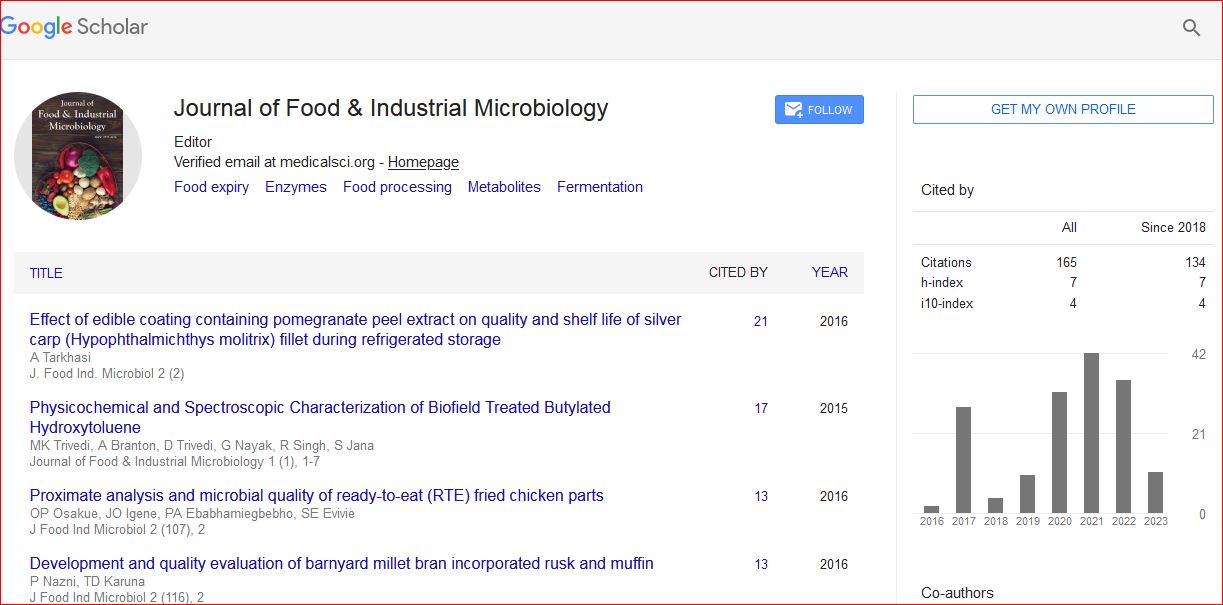
Journal of Food & Industrial Microbiology received 160 citations as per Google Scholar report