Brief Report - (2025) Volume 10, Issue 2
Received: 02-Jun-2025, Manuscript No. jib-25-175242;
Editor assigned: 04-Jun-2025, Pre QC No. P-175242;
Reviewed: 18-Jun-2025, QC No. Q-175242;
Revised: 23-Jun-2025, Manuscript No. R-175242;
Published:
30-Jun-2025
, DOI: 10.37421/2476-1966.2025.10.271
Citation: Al-Kareem, Farid. ”Adaptive Immunity: Memory, Dysfunctions, Therapeutics.” J Immuno Biol 10 (2025):271.
Copyright: © 2025 Al-Kareem F. This is an open-access article distributed under the terms of the Creative Commons Attribution License, which permits unrestricted use, distribution and reproduction in any medium, provided the original author and source are credited.
This article explains how T-cell memory forms and sustains long-term protection against pathogens. It delves into the molecular and cellular mechanisms that dictate T-cell fate decisions, showing how memory T cells retain their ability to respond effectively upon re-encountering an antigen, a cornerstone of adaptive immunity[1].
This study examines the intricate dynamics of B cell responses following SARS-CoV-2 infection and mRNA vaccination. It highlights the development of neutralizing antibodies and memory B cells, emphasizing how these adaptive immune components contribute to protection against the virus and the longevity of vaccine-induced immunity[2].
This research illustrates the crucial cross-talk between the innate and adaptive immune systems, particularly focusing on the role of cytokines. It reveals how innate immune signals, often mediated by various cytokines, actively instruct and fine-tune the subsequent adaptive T and B cell responses, thereby influencing the specificity and potency of long-term immunity[3].
This review highlights the indispensable role of long-lived plasma cells in maintaining sustained humoral immunity. It discusses their unique survival niches, transcriptional programs, and how they continuously produce antibodies, providing essential, rapid protection against re-infection, forming a key pillar of adaptive immunological memory[4].
This paper explores the intricate relationship between the adaptive immune system and the clinical success of PD-1/PD-L1 immune checkpoint blockade in cancer therapy. It highlights how these therapies reactivate tumor-specific T cells, illustrating the critical role of adaptive immunity in mediating anti-tumor responses and overcoming immune evasion mechanisms in various cancers[5].
This review details the mechanisms underlying CD8+ T cell exhaustion, a state of T cell dysfunction characterized by impaired effector functions during chronic infections and cancer. It discusses the molecular pathways involved and explores therapeutic strategies aimed at reversing exhaustion to restore effective adaptive immune responses, a crucial aspect of overcoming persistent immunological challenges[6].
This article explores the bidirectional relationship between the gut microbiome and the adaptive immune system. It elucidates how microbial metabolites and signals profoundly influence the development and function of T and B cells in the gut and systemic circulation, showcasing the microbiome's critical role in shaping adaptive immune responses and maintaining immune homeostasis[7].
This piece discusses how the adaptive immune system, when regulatory mechanisms fail, can turn against self-antigens, leading to autoimmune diseases. It touches upon the failure of self-tolerance, emphasizing the critical balance required for T and B cells to distinguish between self and non-self, and the consequences when this balance is lost[8].
This review highlights contemporary strategies in vaccine and immunotherapy development that aim to precisely engineer adaptive immune responses. It covers novel approaches for antigen presentation, adjuvant design, and T and B cell activation, illustrating how a deeper understanding of adaptive immunity can lead to more effective and durable protective interventions against diverse pathogens and diseases[9].
This article examines the profound impact of aging on the adaptive immune system, a phenomenon known as immunosenescence. It details the structural and functional changes in T and B cell compartments, leading to diminished vaccine efficacy, increased susceptibility to infections, and impaired responses to novel pathogens, providing insights into maintaining immune competence in older populations[10].
The adaptive immune system is fundamental for developing specific and long-lasting protection against pathogens. For instance, T-cell memory formation involves intricate molecular and cellular mechanisms that enable T cells to respond effectively upon re-encountering an antigen, serving as a cornerstone of adaptive immunity[1]. Concurrently, B cell responses, characterized by the development of neutralizing antibodies and memory B cells, are crucial following infections like SARS-CoV-2 or after mRNA vaccination. These components contribute significantly to protection against viruses and ensure the longevity of vaccine-induced immunity[2]. The sustained production of antibodies, a critical aspect of humoral immunity, is maintained by long-lived plasma cells. These cells reside in unique survival niches and employ specific transcriptional programs to continuously produce antibodies, offering essential, rapid protection against re-infection and thus forming a key pillar of adaptive immunological memory[4].
The adaptive immune system does not function in isolation; it engages in crucial cross-talk with the innate immune system. Innate immune signals, frequently mediated by various cytokines, actively instruct and fine-tune subsequent adaptive T and B cell responses. This interaction profoundly influences the specificity and potency of long-term immunity[3]. Beyond endogenous immune interactions, the gut microbiome also plays a critical, bidirectional role. Microbial metabolites and signals significantly influence the development and function of both T and B cells, not just in the gut but also in systemic circulation. This highlights the microbiome's essential contribution to shaping adaptive immune responses and maintaining overall immune homeostasis[7].
Despite its sophisticated mechanisms, the adaptive immune system faces various challenges that can compromise its effectiveness. One significant issue is CD8+ T cell exhaustion, a state of T cell dysfunction marked by impaired effector functions, which commonly occurs during chronic infections and cancer. Understanding the molecular pathways involved in this exhaustion is vital for developing therapeutic strategies aimed at reversing this state and restoring effective adaptive immune responses to overcome persistent immunological challenges[6]. Another critical failure arises when regulatory mechanisms falter, causing the adaptive immune system to mistakenly target self-antigens, leading to autoimmune diseases. This underscores the delicate balance required for T and B cells to differentiate between self and non-self, and the severe consequences when this balance is lost[8].
Aging represents another profound challenge to the adaptive immune system, a phenomenon termed immunosenescence. This process involves structural and functional changes within both T and B cell compartments in older adults. These alterations lead to diminished vaccine efficacy, increased susceptibility to infections, and impaired responses to newly encountered pathogens. Insights into immunosenescence are crucial for developing strategies to maintain immune competence and resilience in aging populations[10].
The advanced understanding of the adaptive immune system has paved the way for significant therapeutic innovations. In cancer therapy, for example, the clinical success of PD-1/PD-L1 immune checkpoint blockade demonstrates the systemâ??s critical role. These therapies reactivate tumor-specific T cells, mediating potent anti-tumor responses and effectively overcoming immune evasion mechanisms in various cancers[5]. Furthermore, contemporary strategies in vaccine and immunotherapy development are focused on precisely engineering adaptive immune responses. This involves novel approaches for antigen presentation, refined adjuvant design, and optimized T and B cell activation, illustrating how a deeper understanding of adaptive immunity can lead to more effective and durable protective interventions against diverse pathogens and diseases[9].
The adaptive immune system forms the basis of long-term protection against pathogens. T-cell memory develops through specific molecular and cellular mechanisms, ensuring T cells can respond effectively upon re-encountering an antigen. This memory is a cornerstone of adaptive immunity. Similarly, B cell responses, including the development of neutralizing antibodies and memory B cells, are crucial for protection after infections like SARS-CoV-2 or following mRNA vaccination, contributing to sustained immunity. An indispensable component of this humoral immunity is the long-lived plasma cell, which continuously produces antibodies, offering rapid protection against re-infection and forming a key pillar of immunological memory. The system doesn't operate in isolation; there's a crucial cross-talk with the innate immune system. Innate immune signals, often mediated by cytokines, actively instruct and fine-tune subsequent adaptive T and B cell responses, influencing their specificity and potency. Furthermore, the gut microbiome profoundly influences T and B cell development and function, both locally and systemically, playing a critical role in shaping adaptive immune responses and maintaining immune homeostasis. However, adaptive immunity faces significant challenges. CD8+ T cell exhaustion, a state of dysfunction with impaired effector functions, can occur during chronic infections and cancer. Understanding these molecular pathways is key to developing therapeutic strategies to restore effective immune responses. Moreover, when regulatory mechanisms fail, the adaptive immune system can mistakenly target self-antigens, leading to autoimmune diseases due to a loss of self-tolerance. The impact of aging, known as immunosenescence, also presents a challenge, causing structural and functional changes in T and B cell compartments, which leads to reduced vaccine efficacy and increased susceptibility to infections. Despite these complexities, a deeper understanding of the adaptive immune system enables powerful therapeutic applications. Immune checkpoint blockade, specifically targeting PD-1/PD-L1, reactivates tumor-specific T cells, proving critical in cancer therapy by overcoming immune evasion. Advanced strategies in vaccine and immunotherapy development aim to precisely engineer adaptive immune responses, focusing on novel antigen presentation, adjuvant design, and optimized T and B cell activation. This comprehensive knowledge paves the way for more effective and durable protective interventions against a wide range of pathogens and diseases.
None
None
Amy MI, J VA, Steven LR. "T-cell memory and host protection.".Immunity 50 (2019):561-572.
Indexed at, Google Scholar, Crossref
Lindsey BR, Jonas N, Risa L. "Dynamics of B cell immunity after SARS-CoV-2 infection or mRNA vaccination.".Cell 184 (2021):373-389.e19.
Indexed at, Google Scholar, Crossref
Georg G, Diana D, Roxanne G. "The innate immune system shapes the adaptive immune response through cytokines.".J Exp Med 218 (2021):e20210745.
Indexed at, Google Scholar, Crossref
Andreas R, Gerhard M, Valerie T. "Long-lived plasma cells: drivers of humoral immunity.".Nat Rev Immunol 23 (2023):483-497.
Indexed at, Google Scholar, Crossref
Xi W, Hao W, Jing G. "Adaptive immune system and the clinical efficacy of PD-1/PD-L1 blockade in cancer.".Front Immunol 14 (2023):1229712.
Indexed at, Google Scholar, Crossref
Mansour K, Shoaib K, Haroon K. "CD8+ T cell exhaustion: mechanisms and therapeutic implications.".Cell Mol Immunol 20 (2023):727-738.
Indexed at, Google Scholar, Crossref
Christoph AT, Mor L, Elad B. "The gut microbiome and adaptive immunity: reciprocal regulation.".Cell Host Microbe 27 (2020):15-27.
Indexed at, Google Scholar, Crossref
Shimon S, Makoto M, Claudia C. "Autoimmunity: Adaptive Immune Responses Out of Control.".Curr Biol 30 (2020):R304-R306.
Indexed at, Google Scholar, Crossref
James JM, Hung-Hsueh C, Lihong JM. "Engineering adaptive immunity for next-generation vaccines and immunotherapies.".Nat Rev Immunol 20 (2020):152-168.
Indexed at, Google Scholar, Crossref
Emilia M, Bruria B, Kenneth D. "Immunosenescence and adaptive immunity: remodeling the immune system in older adults.".Semin Immunol 43 (2019):101318.
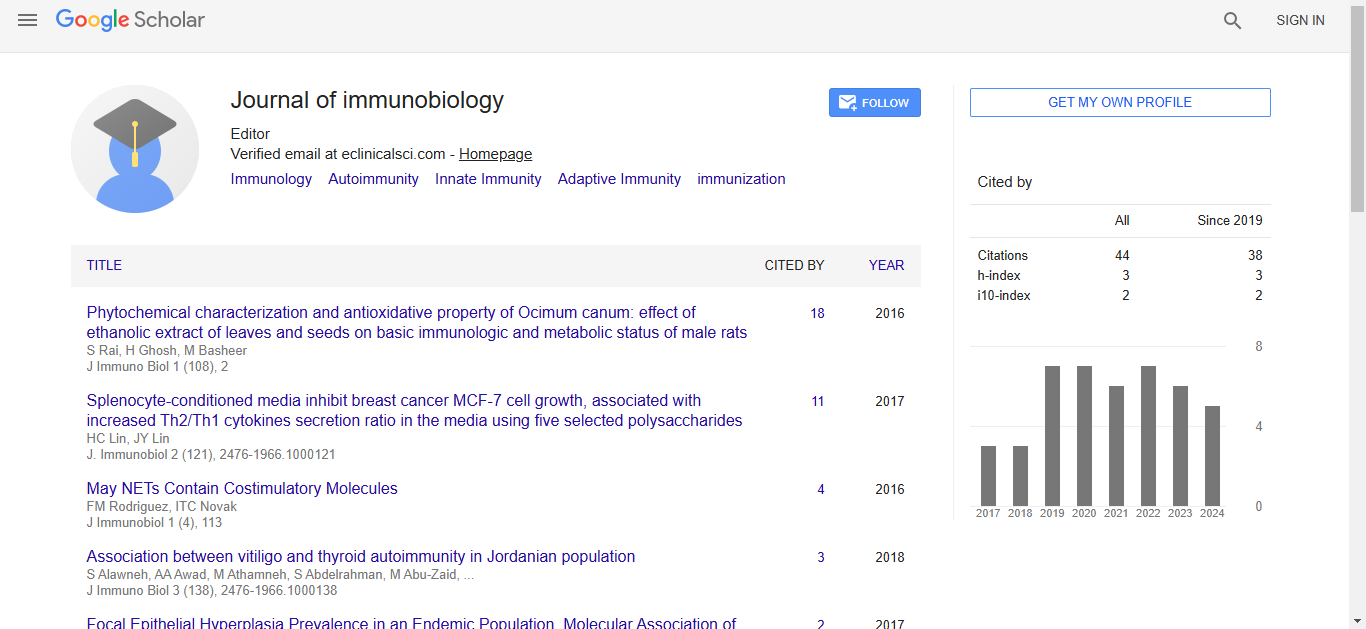
Journal of Immunobiology received 34 citations as per Google Scholar report