DOI: 10.37421/2157-7579.2025.16.287
DOI: 10.37421/2157-7579.2025.16.286
Canine Osteoarthritis (OA) is a prevalent and debilitating condition affecting dogs worldwide. This research explores recent advancements in diagnostic imaging techniques aimed at early detection of OA in canines. We compare the efficacy of traditional radiography with emerging modalities such as Magnetic Resonance Imaging (MRI) and Computed Tomography (CT) in identifying early structural changes associated with OA. Our findings highlight the potential of these advanced imaging techniques in enhancing early diagnosis and paving the way for timely intervention, ultimately improving the quality of life for affected animals.
Mamoudou Abdoulmoumini, Ngah Osoe Bouli Freddy Patrick*, Aliou Mohamadou, Adamou Moise, Moffo Frederic, Hamidou liman and Wafo Fokam Agnes Jorelle
DOI: 10.37421/2157-7579.2025.16.283
From January to December 2022, a study was carried out in Cameroon in order to assess the pesticide honey contamination and presence of other toxic compounds and the related public health significance. In order to achieve these objectives, 150 samples were collected from the three much honey productive areas respectively at the hive, extraction and market levels and analysed. The pesticide and others compound determination was done through the QuEChERS coupled with the gas chromatography-mass spectrometry, while the health risk assessment was done by the calculation of the Hazard Index (HI) associated with each compound. A total of thirteen samples (prevalence=8.69%) were positive to four toxic compounds (satratoxin-h, methyl-diclofop, fumaronitrile and propiolonitrile) respectively in the bimodal forest (prevalence: 6.67) and western highlands (23.37%). No health risk was associated with the presence of these compounds and no significant difference was found either between the areas than between the different technological levels. These results prove that honey contamination is present in Cameroon and can be possibly higher than the results found in this study and should also be assessed by the liquid chromatography-mass spectrometry to have a complete view of the situation.
Temesgen Sendekie* and Habtamu Tassew
DOI: 10.37421/2157-7579.2025.16.252
Increased seafood consumption in general, and fish consumption in particular, has sparked some interest in food safety, despite a lack of understanding of the precautions that must be taken to avoid dangers. Physical contact with fish, as well as eating it, might expose the people to bacterial pathogens that are harmful to health. The goal of this review study is to provide a broad overview of the four bacterial infections that affect both fish and humans. When handling infected fish water, bacterial infection is most commonly obtained by abrasions, cuts, or deep lesions in the skin. Mycobacterium species, Streptococcus iniae, Aeromonas specieces, and Vibrio vulnificus are among the most well-known zoonotic bacteria acquired from fish. Consumption of raw infected fish and fish products, and contact with contaminated water or infected fish, the existence of zoonotic bacteria in fish in Ethiopia could provide a potential risk to human health. Despite the fact that fish pathogens receive less attention, zoonotic bacteria are found all across the world, including Ethiopia. The main prophylactic methods for minimizing the risk of exposure are basic hygiene and complete hand washing promptly after handling seafood. Veterinarians, their employees, and their clients should always take precautions to avoid exposing open cuts and abrasions to water. Most of the reviewed articles are done by taking tissue samples, including skins, gills, intestines, swim bladders, kidneys, and livers. Biochemical tests are the most widely used technique to identify pathogens. Both natural water bodies and aquaculture are covered by the studies, unlike studies done in Ethiopia, which are entirely on lakes and rivers. Their findings also varied across species, countries, diagnostic techniques, etc. More research is needed to demonstrate the presence of risk factors as well as the method of transfer from the aquatic environment (fish) to humans.
DOI: 10.37421/2157-7579.2025.16.287
DOI: 10.37421/2157-7579.2025.16.295
DOI: 10.37421/2157-7579.2025.16.294
DOI: 10.37421/2157-7579.2025.16.293
DOI: 10.37421/2157-7579.2025.16.292
DOI: 10.37421/2157-7579.2025.16.291
DOI: 10.37421/2157-7579.2025.16.290
DOI: 10.37421/2157-7579.2025.16.289
DOI: 10.37421/2157-7579.2025.16.288
Leta Muleta Kisi*, Amana Feyisa Ammesa, Getachew Gugsa Amede and Beksisa Urge Hurisa
A cross-sectional study was conducted in Holeta town and Adea Berga district on model dairy farms from November 2020 to April 2021 with the aims of determining the prevalence of calf scour and its associated risk factors and identification of helminth parasites (Ostertagia and Cooperia) and E. coli. Descriptive statistics were used to determine the prevalence and Pearson’s Chi-square (χ2) test was applied to assess the association between the prevalence of calf scour and different risk factors. The overall prevalence of calf scour was found to be 57 (48.7%). Of the total positive samples 29.8%, 35.1%, 22.8, and 12.3% were found to be positive for E. coli, Ostertagia, Cooperia and mixed (Ostertagia and Cooperia), respectively. The results of Chi-square (χ2) analysis revealed that among the different risk factors associated with the occurrence of calf scour only colostrum feeding (P=0.001; χ2=10.191), breed (P=0.001; χ2=10.191), body condition (P=0.00; χ2=21.680) and hygiene (P=0.037; χ2=6.594) had significant difference in the prevalence of calf scour. Of the total 117 examined calves 17 (14.5%) were positive for E. coli. Among the different risk factors associated with the occurrence of colibacillosis age (P=0.000; χ2=23.576), colostrum feeding (P=0.002; χ2=9.199), breed (P=0.002; χ2=9.199), and hygiene (P=0.000; χ2=16.453) had significant difference in the prevalence of colibacillosis. Of the total 117 examined calves 40 (34.2%) were positive for helminth parasites. Of the helminth positive samples 50%, 32.5%, and 17.5% were positive for Ostertagia, Cooperia, and mixed (Ostertagia and Cooperia), respectively. Among the different risk factors associated with the occurrence of helminthiais age (P=0.012; χ2=6.307), and body condition (P=0.00; χ2=22.756) had significant difference in the prevalence of helminthiais. In general, the current study revealed that there is alarmingly high prevalence of calf scour in the study areas. Hence, improved calf management practices should be implemented so as to minimize the occurrence of calf scour in the study areas.
DOI: 10.37421/2157-7579.2025.16.286
Growth performance, a critical parameter for assessing cattle productivity, is influenced by genetic, nutritional, and environmental factors. This study systematically analyzed data on the growth traits of Ethiopian cattle breeds, including Birth Weight (BW), Weaning Weight (WW), Yearling Weight (YW), and Pre-Weaning Average Daily Gain (PrWADG). The analysis utilized 213 records from diverse secondary sources, encompassing local and crossbred genetic groups using SAS software. The mean BW was 24.31 ± 3.61 kg, with crossbreds, particularly Simmental crosses, outperforming indigenous breeds due to their dual-purpose characteristics. The mean WW and YW were 90.84 ± 19.97 kg and 134.97 ± 20.50 kg, respectively, with crossbreds again demonstrating superior performance. The PrWADG averaged 405.29 ± 45.00 gram, highlighting the heterosis effect in crossbreeds. Local breeds exhibited lower growth performance but demonstrated resilience to environmental stressors, making them well-suited for harsh conditions. Variations in performance across genetic groups were attributed to differences in management practices, nutrition, and the genetic potential of breeds. This study underscores the importance of crossbreeding as a viable strategy for genetic improvement while emphasizing the need for improved management and feeding practices. Findings provide valuable insights for developing a sustainable national breeding strategy that balances productivity with adaptability in Ethiopian cattle breeds.
Betelihem Yirdaw*, Dessie Abera, Habtamu Alebachew and Bekisisa Urga
Vaccine is one of the major ways of preventing and controlling infectious diseases in livestock. The aim of the study was to evaluate and know available vaccines, to identify and characterize factors responsible for vaccine failures in order to support improvement against disease, to understand the vaccine management and vaccine delivery system. A cross-sectional semi structural questionnaire survey was developed. A total of 86 farm owners from three districts Assosa, Bambasi, and Homosha, there were 52, 18 and 16 participants, respectively. In this study three species of animals, six farmers who have goat, 76 farmers who have cattle and 4 farmers who have poultry were included in the survey. All most all respondents in Bambasi (100%), Assosa (88.5%), and Homosha (87.5%) can use and were known about vaccines but not about all type of vaccines. In other study vaccination was the most widely known preventive measure (68.9%). There is no significant difference (P=0.3) and (p=0.06) between districts in terms of farmers' knowledge of vaccines and their use respectively. Most respondents had heard of vaccines prior to 11 years ago. The majority of respondents (66.3%) learned about the vaccine from animal health workers, followed by locals (18.6%) and elders (6.9%). Most respondent’s 62.8% starting use of vaccine above nine (9) years. Pasturolosis, LSD, Anthrax, black leg, CBPP, PPR, CCPP, pox and NCD was available in the study area. In addition, in commercial poultry farms fowl typhoid, fowl pox, and mareks was found. 65.1% of the respondents were practiced vaccinating of their livestock against the most common diseases. Sick animals (88.4%) were excluded from vaccination. Vaccination mostly provided by the government (94.2%), with only a few cases (5.8%) performed by private owners. Vaccination was carried out by professionals (95.3%), SC administration and liquid preparation was applied. Commercial dairy and poultry farms have better use and adapt vaccine technology than small holder farm owners. Most respondents explained that the reason of diseases encountered after vaccination was due to poor vaccine handling and management (60.5%) followed by poor response from the host (26.7%). The factors tackle vaccine efficacy and vaccine delivery system was vaccination condition, frequency of vaccination, vaccine value channels, supply chain, access points and vaccine delivery system.
Ramisetty Naga Sai Sravya*, N. Arul Jothi, S. Tina Roshini, N. Gurunathan, M. Vigneswari, Saurav K, Vasanthanathan D and Dayana Priyadarshini B
DOI: 10.37421/2157-7579.2025.15.294
A comprehensive ultrasonographic examination of the normal pelvic girdle in 24 mature crossbred Jersey cows, aged 3 to 8 years, calved once and above were taken for this present study. The ultrasonographic evaluation focused on various pelvic girdle components, including the coxofemoral joint and its anterior and posterior capsules, both externally and internally. Key findings include the observation of pelvic tuberosities (sacral, coxal, and ischial) as convex arches with surface irregularities. The bony external surfaces of the iliac wing, body, and ischium appeared as thin, hyperechoic concave arches, while the internal surfaces of the ischium’s tabula and the medial aspect of the acetabulum were seen as thin, hyperechoic convex arches. Pelvic articulations, including the hip joint, were visualized as anechoic bands bordered by hyperechoic arches. The mean distance from sacral tubers to the skin is 0.721 ± 0.011 cm. The mean thickness of the dorsal aspect of the dorsal sacroiliac ligament-thoracolumbar fascia fusion is 3.4167 ± 0.061 cm, while the mean thickness of the dorsal sacroiliac ligament is 2.300 ± 0.0326 cm. Additionally, the mean distance from the skin surface to the joint measures 65.732 ± 2.585 cm. The mean thickness of the articular cartilage is reported as 2.35 ± 0.042 cm, and the mean distance between the sacral tubers and the first sacral spinous process is 1.947 ± 0.084 cm. These results provide a detailed ultrasonographic description of the pelvic girdle in mature cows and serve as a valuable guide for pelvic examinations.
Million Admasu* and Shemsia Mohammed
DOI: 10.37421/2157-7579.2025.16.290
A survey was conducted on ixodid ticks infesting cattle at Chagni cattle and Forage multiplication and distribution center formerly known as Metekele Ranch with the objective of identifying important tick species and to assess some possible risk factors for tick infestation on cattle. Ticks were collected from 384 cattle of different breeds, age, and sex. During the study period, 1884 adult ixodid ticks were collected, out of which, 602 were male and 1281 were female tickes. The ticks were collect from nine different body regions of cattle, including, head, dewlap, neck/briskets, foreleg, belly, rear leg, escutcheon, tail, and shoulder/back/side. The species of ticks identified were Ambylomma varigatum (41.03%) Ambylomma lepidum (0.11%), Rhipicephalus evertsi evertsi (39.38%), Boophilus decoloratus (16.93) and Hyalomma marginatum rufipes (2.55%). From all the 384 cattle, haematocrite value was determined and 179 animals were found with below the normal value for all cattle. All the blood samples from the study cattle were thoroughly checked for the presence of tick born haemoparasites using thin blood film and were found negative.
Addis Asegid Admasu* and Ashenafi Mengistu
DOI: 10.37421/2157-7579.2025.16.287
This study was undertaken to determine the proximate composition and variations of nutrient in commercial layer’s feeds produced and sold in Addis Ababa and Bishoftu. A total of 438 feed samples classified into two sampling categories were collected in 2022. The first category referred as premarket feed and comprises 240 samples collected from 12 licensed commercial feed producers, while the second referred as post market feed sample consist of 198 samples collected from 198 commercial layer farms who use feed produced by commercial feed producers. The samples were subjected to proximate analysis using non distractive method.
This research suggests that the nutrient composition of layers feed is highly variable among manufacturers to the extent that contain nutrients below or above the national feed quality standard. The noncompliance frequencies in crude protein and metabolizable energy varied between 39.3% to 43.8%, 33.8% to 48.3%, of the total sample population, with average total deficiency of 1.3% and 1.7%, 62.5 and 112.4 kcal/kg respectively.
The moisture and crude fiber contents in 5% to 10% and 2% to 7% of the total feed samples surpass the maximum limit respectively, while all crude fat all values were higher than the maximum recommended requirement. This may expose birds fed with feeds to under or over-feeding of essential nutrients and hence reduced bird performance, added input costs and increased environmental pollution. Statically significant (P<0.05) association between out of compliance frequencies and feed sample categories or study locations were apparent, which in part attributed to differences in ingredient source, quality and feed compounding practices across the study locations. To ensure quality and standardization of feeds, frequent monitoring and enforcement of standards in the preparation of feed is cardinal, this will ensure that nutritional feeds are formulated to meet production needs of poultry birds.
DOI: 10.37421/2157-7579.2025.16.286
A cross sectional study was conducted on 384 small ruminants kept in Damot Sore district of Wolaita zone from November 2021 to May 2022 to determine the prevalence of gastrointestinal nematodes and to see the association with age, sex, body condition and species of small ruminants. For the purpose of this study, 384 faecal samples were collected from (289 sheep and 95 goats) and examined using standard parasitological procedure for screening gastrointestinal tract nematodes. The faecal samples examined revealed an overall prevalence of 200 (52.1%) in small ruminants with 152 (52.6%) in sheep and 48 (50.5%) in goats. The study revealed that a statistically significant difference (p<0.05) was observed in prevalence between age and body condition. The prevalence of nematodes with other risk factors (sex and species of the study animals) was not statistically significant difference (p>0.05). The sex wise prevalence was 53.6% and 48.1% in female and male animals respectively while that of age was 69.3%, 43.0% and 55.1% in young, adult and old animals respectively. Infection was 71.4%, 51.5% and 43.5% in poor, medium and good body conditioned animals respectively. The present study revealed that gastrointestinal nematodes are major parasitic infection problems of small ruminants in the study area and the study area was conducive for the successive maintenance and subsequent transmission of nematodes to susceptible animals. Therefore, effective strategic treatments and control measures should be instituted in the study area. During the treatment and control of small ruminant nematodes, age and body condition should be considered as potential risk factors for the occurrence of the disease. In this study the nematode eggs detected were strongyle type, hence, further laboratory examination is recommended to identify nematodes in to the genus and species level in order to design appropriate control measures.
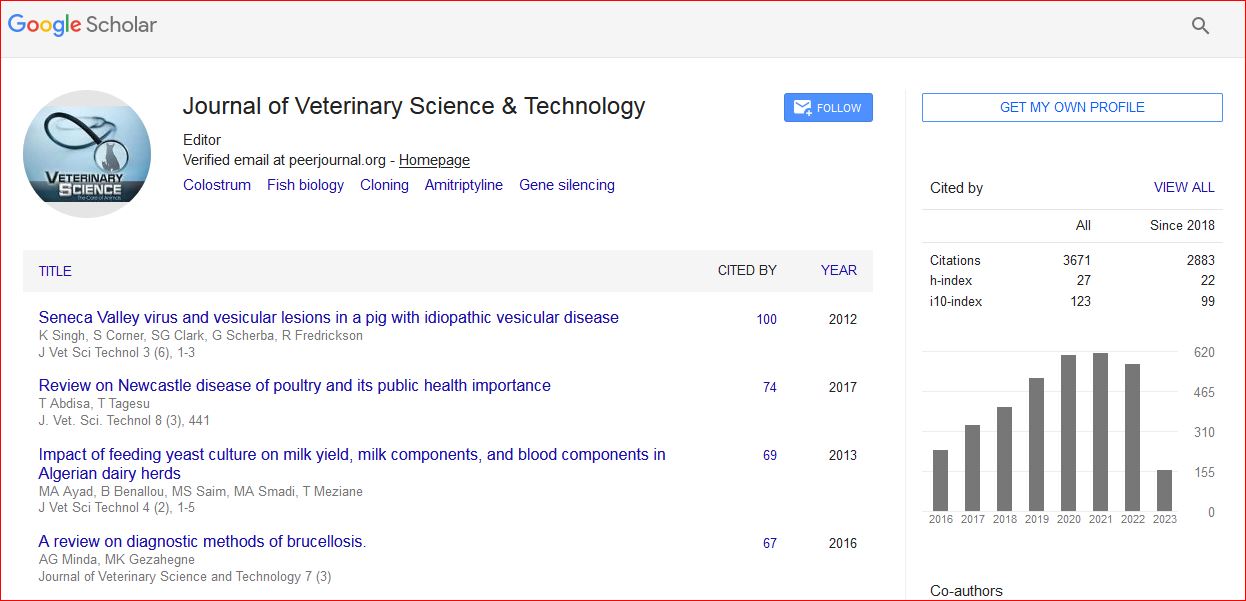
Veterinary Science & Technology received 4472 citations as per Google Scholar report
 Spanish
  Chinese
  Russian
  German
  French
  Japanese
  Portuguese
  Hindi
Hindi 