Perspective - (2025) Volume 16, Issue 2
Received: 01-Apr-2025, Manuscript No. jvst-26-187992;
Editor assigned: 03-Apr-2025, Pre QC No. P-187992;
Reviewed: 17-Apr-2025, QC No. Q-187992;
Revised: 22-Apr-2025, Manuscript No. R-187992;
Published:
29-Apr-2025
, DOI: 10.37421/2157-7579.2025.16.290
Citation: Yamamoto, Hiroshi. ”Veterinary Diagnostics: Technological
Transformation Enhances Animal Health.” J Vet Sci Techno 16 (2025):290.
Copyright: © 2025 Yamamoto H. This is an open-access article distributed under the terms of the Creative Commons Attribution License, which permits unrestricted use,
distribution and reproduction in any medium, provided the original author and source are credited.
Recent advancements in veterinary diagnostic techniques have significantly improved the early detection, accurate diagnosis, and effective management of animal diseases. These include the expanded use of next-generation sequencing for pathogen identification and antimicrobial resistance profiling, the integration of artificial intelligence and machine learning for image analysis and predictive diagnostics, and the development of novel point-of-care diagnostic platforms for rapid on-site testing. These innovations are crucial for addressing emerging infectious diseases, improving animal welfare, and ensuring food safety.[1]
Next-generation sequencing (NGS) is revolutionizing veterinary diagnostics by enabling high-throughput and comprehensive analysis of pathogen genomes. This technology allows for rapid identification of novel and known pathogens, characterization of virulence factors, and detection of antimicrobial resistance genes directly from clinical samples. Its application is vital for outbreak investigations, understanding disease transmission, and developing targeted therapeutic strategies in veterinary medicine.[2] The integration of artificial intelligence (AI) and machine learning (ML) into veterinary diagnostic imaging offers unprecedented capabilities. AI algorithms can assist in the automated detection and characterization of abnormalities in radiographs, CT scans, and ultrasound images, improving diagnostic accuracy and reducing interpretation time. This technology holds promise for enhancing the early diagnosis of conditions like neoplastic diseases and orthopedic disorders.[3] Point-of-care (POC) diagnostic devices are transforming veterinary practice by enabling rapid, on-farm or in-clinic testing. Innovations in biosensor technology and microfluidics have led to the development of portable kits for detecting infectious agents, biomarkers, and metabolic abnormalities. These POC tests are critical for timely treatment decisions, disease surveillance, and reducing the turnaround time associated with traditional laboratory diagnostics.[4] Genomic and transcriptomic analyses are becoming increasingly important for understanding the complex interactions between pathogens and their hosts, as well as for identifying genetic predispositions to diseases in animals. These molecular techniques provide a deeper insight into disease pathogenesis and can aid in the development of novel diagnostic markers and targeted therapies.[5] The development of liquid biopsy techniques in veterinary medicine, analogous to human applications, offers a non-invasive approach to cancer diagnosis and monitoring. Circulating tumor DNA (ctDNA) and other biomarkers in blood or other body fluids can provide early detection of malignancy, assess treatment response, and detect recurrence. This represents a significant advancement in veterinary oncology.[6] Advanced imaging modalities such as magnetic resonance imaging (MRI) and positron emission tomography (PET) are increasingly accessible and utilized in veterinary diagnostics. These techniques provide superior soft tissue contrast and functional information, aiding in the diagnosis of complex neurological, oncological, and metabolic diseases, especially in companion animals.[7] The application of multiplex assays in veterinary diagnostics allows for the simultaneous detection of multiple analytes from a single sample. This approach is highly efficient for diagnosing complex diseases involving several pathogens or for monitoring immune responses, offering a comprehensive diagnostic picture with reduced sample volume and cost.[8] CRISPR-based diagnostic tools are emerging as highly sensitive and specific platforms for pathogen detection. These technologies leverage the precise gene-editing capabilities of CRISPR to identify specific nucleic acid sequences of viruses, bacteria, and other pathogens, offering rapid and field-deployable diagnostic solutions for veterinary epidemiology.[9] The application of Raman spectroscopy in veterinary diagnostics provides a non-destructive method for analyzing biological samples. Its ability to detect molecular vibrations allows for the identification of various compounds and can be used for the rapid screening of diseases, detection of adulterants in feed, and characterization of tissue types.[10]The landscape of veterinary diagnostics is being rapidly reshaped by technological innovations, enhancing the ability to identify and manage animal health issues. Next-generation sequencing (NGS) stands out as a transformative technology, enabling high-throughput analysis of pathogen genomes for accurate identification, virulence factor characterization, and antimicrobial resistance profiling directly from clinical specimens. This is indispensable for effective outbreak investigation and strategic therapeutic development in veterinary medicine.[1]
Artificial intelligence (AI) and machine learning (ML) are increasingly integrated into veterinary diagnostic imaging, providing powerful tools for analyzing radiographic, CT, and ultrasound images. These algorithms excel at detecting and characterizing abnormalities, thereby improving diagnostic accuracy and reducing interpretation times, which is especially beneficial for early detection of neoplastic and orthopedic conditions.[2] Point-of-care (POC) diagnostic devices are revolutionizing veterinary practice by enabling immediate testing directly on farms or in clinics. Driven by advances in biosensor and microfluidics technology, these portable kits can rapidly detect infectious agents, biomarkers, and metabolic disturbances, facilitating prompt treatment decisions and disease surveillance.[3] Genomic and transcriptomic analyses are fundamental to understanding the intricate relationships between pathogens and hosts, as well as for identifying genetic predispositions to diseases in animals. These molecular approaches offer profound insights into disease pathogenesis and contribute to the development of novel diagnostic markers and targeted treatment strategies.[4] Liquid biopsy techniques are emerging as a non-invasive method in veterinary oncology for cancer diagnosis and monitoring. By analyzing circulating tumor DNA and other biomarkers in bodily fluids, these techniques can facilitate early detection of malignancy, evaluate treatment efficacy, and identify recurrence, marking a significant step forward in veterinary cancer care.[5] Advanced imaging modalities, including magnetic resonance imaging (MRI) and positron emission tomography (PET), are becoming more prevalent in veterinary diagnostics. These methods provide superior soft tissue contrast and functional data, crucial for diagnosing complex conditions affecting the nervous system, as well as oncological and metabolic disorders, particularly in companion animals.[6] Multiplex assays offer a highly efficient approach to veterinary diagnostics by allowing the simultaneous detection of multiple targets from a single sample. This is particularly valuable for diagnosing complex diseases involving multiple pathogens or for assessing immune responses, providing a comprehensive diagnostic overview while minimizing sample requirements and costs.[7] CRISPR-based diagnostic tools are emerging as highly sensitive and specific platforms for pathogen detection. Their ability to precisely target and identify specific nucleic acid sequences of various pathogens offers rapid and field-deployable solutions essential for veterinary epidemiology and disease control.[8] Raman spectroscopy presents a non-destructive method for analyzing biological samples in veterinary diagnostics. By identifying molecular vibrations, this technique can be employed for rapid disease screening, detecting feed adulterants, and characterizing different tissue types, thus broadening the diagnostic toolkit.[9] The broader application of molecular techniques, such as genomic and transcriptomic analyses, is crucial for a deeper understanding of disease mechanisms in animals. By elucidating the complex interactions at the molecular level, these methods pave the way for the discovery of new diagnostic biomarkers and the development of more effective, targeted therapeutic interventions.[10]Veterinary diagnostics are undergoing a significant transformation driven by advancements in various technological fields. Next-generation sequencing enables comprehensive pathogen analysis, while AI and machine learning enhance diagnostic imaging accuracy. Point-of-care devices offer rapid on-site testing, and molecular techniques like genomics and transcriptomics provide deeper insights into disease mechanisms. Liquid biopsies offer non-invasive cancer detection, and advanced imaging modalities like MRI and PET improve diagnosis of complex conditions. Multiplex assays allow for simultaneous detection of multiple analytes, and CRISPR-based tools provide highly sensitive pathogen identification. Raman spectroscopy offers a non-destructive analytical method for biological samples. These innovations collectively improve disease detection, management, animal welfare, and food safety.
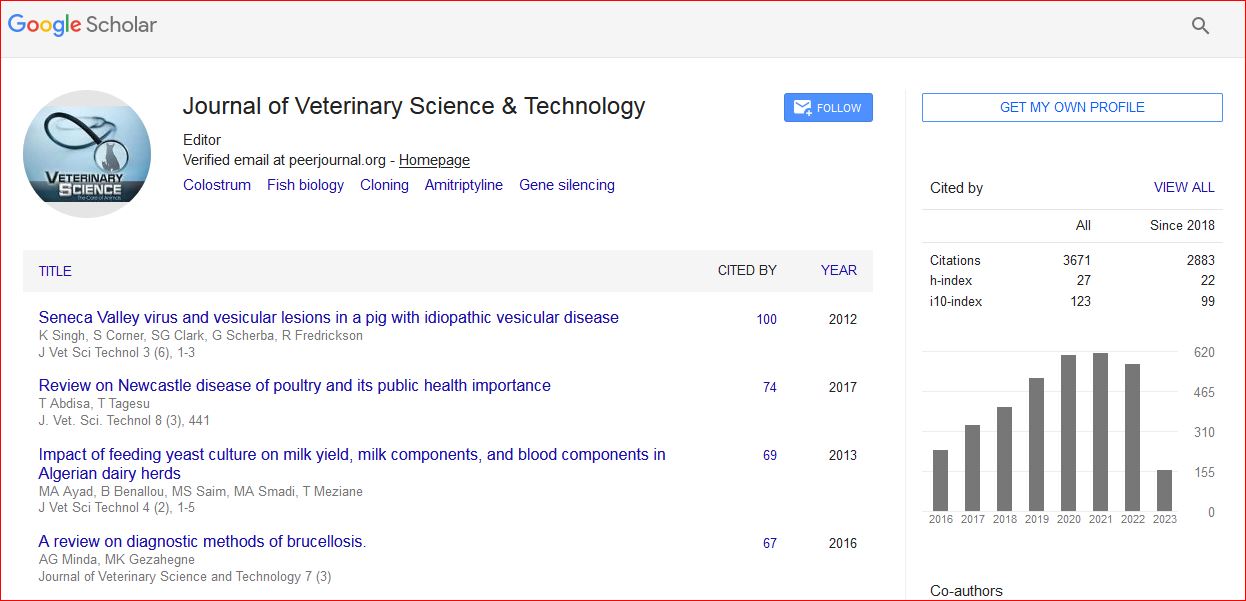
Veterinary Science & Technology received 4472 citations as per Google Scholar report