Short Communication - (2025) Volume 16, Issue 2
Received: 01-Apr-2025, Manuscript No. jvst-26-188000;
Editor assigned: 03-Apr-2025, Pre QC No. P-188000;
Reviewed: 17-Apr-2025, QC No. Q-188000;
Revised: 22-Apr-2025, Manuscript No. R-188000;
Published:
29-Apr-2025
, DOI: 10.37421/2157-7579.2025.16.294
Citation: Wei, Chen. ”Bacterial Livestock Diseases: Control,
Resistance, and Future Strategies.” J Vet Sci Techno 16 (2025):294.
Copyright: © 2025 Wei C. This is an open-access article distributed under the terms of the Creative Commons Attribution License, which permits unrestricted use, distribution
and reproduction in any medium, provided the original author and source are credited.
Bacterial diseases pose a significant threat to the global livestock industry, impacting animal health, welfare, and the economic viability of farming operations. These infections can lead to reduced productivity, increased mortality rates, and substantial economic losses due to decreased yields and the costs associated with treatment and control measures. A comprehensive understanding of these diseases is crucial for developing effective management strategies. This review aims to provide an overview of common bacterial diseases affecting farm animals, highlighting their pathogenesis, diagnostic approaches, and control strategies. It also emphasizes the critical role of antimicrobial resistance in treatment strategies and the economic impact of these diseases in livestock production.
Bovine Mastitis, a widespread and economically damaging disease in dairy cattle, is caused by various bacterial pathogens. Staphylococcus aureus and Streptococcus agalactiae are among the most prevalent culprits, leading to significant reductions in milk yield and quality. The study of their epidemiology and the development of antimicrobial resistance patterns are essential for effective management in dairy herds. Early detection and targeted interventions are underscored as vital for mitigating the impact of this disease. Bovine Respiratory Disease (BRD) is another major concern in cattle, with Mannheimia haemolytica identified as a primary bacterial pathogen responsible for significant morbidity and mortality. Understanding the molecular mechanisms of virulence, including the role of specific toxins and adhesins in bacterial colonization and tissue damage, is key to developing novel control strategies against BRD. This area of research offers promising avenues for improved disease prevention. The poultry industry faces its own set of challenges from bacterial infections, notably Salmonella species, which not only affect bird health but also pose a food safety risk. Studies on the prevalence and antibiotic susceptibility patterns of Salmonella in poultry farms are critical. Identifying risk factors and evaluating biosecurity measures and vaccination programs are essential for reducing Salmonella shedding and minimizing carcass contamination, thereby enhancing food safety. In swine production, while viral diseases like Porcine Epidemic Diarrhea Virus (PEDv) are prominent, secondary bacterial infections frequently complicate outbreaks, exacerbating clinical signs and mortality. The management of these co-infections, where bacterial pathogens opportunistically thrive in compromised hosts, presents a significant challenge. Research into the role of these dual-pathogen challenges is vital for comprehensive disease control in swine. Mycoplasma infections represent a considerable threat to poultry health, causing significant respiratory disease and impacting productivity. These infections necessitate a thorough understanding of their pathogenesis, diagnostic methods, and the development of effective therapeutic and preventative strategies. The persistent challenge of antimicrobial resistance in treating Mycoplasma infections requires continuous research and innovation. Calf diarrhea, a common ailment in young cattle, can be caused by a range of bacterial agents, with Escherichia coli being a frequent offender. Research into the genetic diversity and antimicrobial resistance profiles of diarrheagenic E. coli strains is crucial. Identifying specific virulence factors associated with severe disease and assessing antibiotic susceptibility informs targeted treatment and prevention approaches for calf scours. Brucellosis, a zoonotic bacterial disease, remains a significant concern in small ruminants, including sheep and goats. Effective control and eradication programs require robust diagnostic techniques, encompassing both serological and molecular methods. The zoonotic nature of Brucellosis presents unique challenges in its management, emphasizing the need for integrated surveillance and control measures. Foot and Mouth Disease (FMD), though viral, is often compounded by secondary bacterial infections that worsen the clinical outcome for affected livestock. Advances in controlling FMD rely on a multi-faceted approach, including effective vaccination strategies, stringent biosecurity protocols, and the continuous monitoring and control of emerging viral strains. Addressing secondary bacterial complications is an integral part of comprehensive FMD management. Clostridium perfringens infections, particularly necrotic enteritis, are a major cause of economic loss in the poultry industry. Investigating the pathogenicity of different toxin types and evaluating alternative control measures, such as probiotics and organic acids, are essential. These strategies aim to improve gut health and reduce reliance on antibiotic growth promoters, thereby mitigating disease incidence and promoting animal welfare.The content delves into a broad spectrum of bacterial diseases affecting various farm animal species, offering a comprehensive overview of their characteristics and management. It initiates with a general review of common bacterial diseases in livestock, encompassing Bovine Mastitis, Swine Dysentery, Avian Colibacillosis, and Sheep and Goat Pneumonia. This foundational paper details causative agents, clinical signs, diagnostic methods, and critically, the influence of antimicrobial resistance on treatment effectiveness, underscoring the economic implications and the necessity of robust disease prevention and control measures in livestock production [1].
Subsequently, the focus narrows to a specific and impactful disease: Bovine Mastitis. This study meticulously investigates the prevalence of key bacterial pathogens like Staphylococcus aureus and Streptococcus agalactiae within dairy herds. It quantifies their detrimental effects on milk yield and quality and critically evaluates the efficacy of various antibiotic treatments, alongside the escalating issue of antibiotic resistance. The research highlights the paramount importance of early detection and precisely targeted interventions in managing this pervasive condition [2].
Moving to respiratory ailments in cattle, a research paper addresses Bovine Respiratory Disease (BRD), specifically examining the virulence factors of Mannheimia haemolytica, a primary etiologic agent. The study undertakes a detailed analysis of specific toxins and adhesins that facilitate bacterial colonization and subsequent tissue damage. The insights gained from this molecular perspective are intended to inform the development of innovative control strategies against BRD [3].
Within the avian sector, significant attention is given to the prevalence and antibiotic susceptibility patterns of Salmonella species. This research identifies critical risk factors contributing to infection and assesses the effectiveness of implemented biosecurity measures and vaccination programs in curtailing Salmonella shedding. The ultimate goal is to enhance food safety by minimizing carcass contamination and protecting public health [4].
The realm of swine health is explored through an article that addresses the challenges and advancements in controlling Porcine Epidemic Diarrhea Virus (PEDv). While primarily viral, the paper acknowledges that secondary bacterial infections frequently complicate PEDv outbreaks. It specifically discusses the role of these co-infections and the complexities involved in managing challenges arising from dual-pathogen threats in swine populations [5].
Another critical concern in poultry is Mycoplasma infections, which are identified as significant contributors to respiratory disease and diminished productivity. This review provides an in-depth outline of their pathogenesis, diagnostic methodologies, and current therapeutic and preventative strategies. Crucially, it also addresses the persistent challenges posed by the growing issue of antimicrobial resistance in treating these infections [6].
Focusing on calf health, a study investigates the genetic diversity and antimicrobial resistance profiles of Escherichia coli strains isolated from cases of calf diarrhea. This research identifies specific virulence factors linked to severe disease and evaluates the susceptibility of these E. coli strains to commonly used veterinary antibiotics. Such characterization is vital for guiding targeted treatment and effective prevention strategies [7].
In small ruminants, the epidemiology and control of Brucellosis are examined. This review details essential diagnostic techniques, including both serological and molecular methods, and discusses the inherent difficulties in eradicating the disease, particularly due to its zoonotic nature. The study emphasizes the critical importance of implementing integrated surveillance systems for effective Brucellosis management [8].
Foot and Mouth Disease (FMD), a highly contagious viral disease, is addressed from the perspective of managing secondary bacterial infections that complicate its clinical course. The article reviews current vaccination strategies, the implementation of stringent biosecurity protocols, and the crucial task of controlling emerging viral strains, acknowledging the role of bacterial co-infections in disease severity [9].
Finally, the review of Clostridium perfringens infections in poultry, specifically necrotic enteritis, highlights the pathogenicity of various toxin types. It evaluates the efficacy of alternative control measures, such as probiotics and organic acids, as potential replacements for antibiotic growth promoters. The overarching aim is to enhance gut health and reduce the incidence of this disease in poultry flocks [10].
This collection of research and reviews covers a wide array of bacterial diseases affecting farm animals, including Bovine Mastitis, Bovine Respiratory Disease, Salmonella in poultry, Mycoplasma in poultry, Clostridium perfringens in poultry, calf diarrhea caused by E. coli, and Brucellosis in small ruminants. It also touches upon the impact of secondary bacterial infections in viral diseases like PEDv in swine and Foot and Mouth Disease. Key themes include the identification of causative agents, diagnostic approaches, virulence factors, and the significant challenge posed by antimicrobial resistance. The economic impact of these diseases and the importance of prevention, control, and biosecurity measures are consistently emphasized throughout the content. Strategies for managing these diseases range from traditional antimicrobial treatments to exploring alternative approaches like probiotics and organic acids, alongside the development of improved vaccination and surveillance programs. The research underscores the need for continued investigation into bacterial pathogenesis and resistance mechanisms to safeguard animal health and ensure sustainable livestock production.
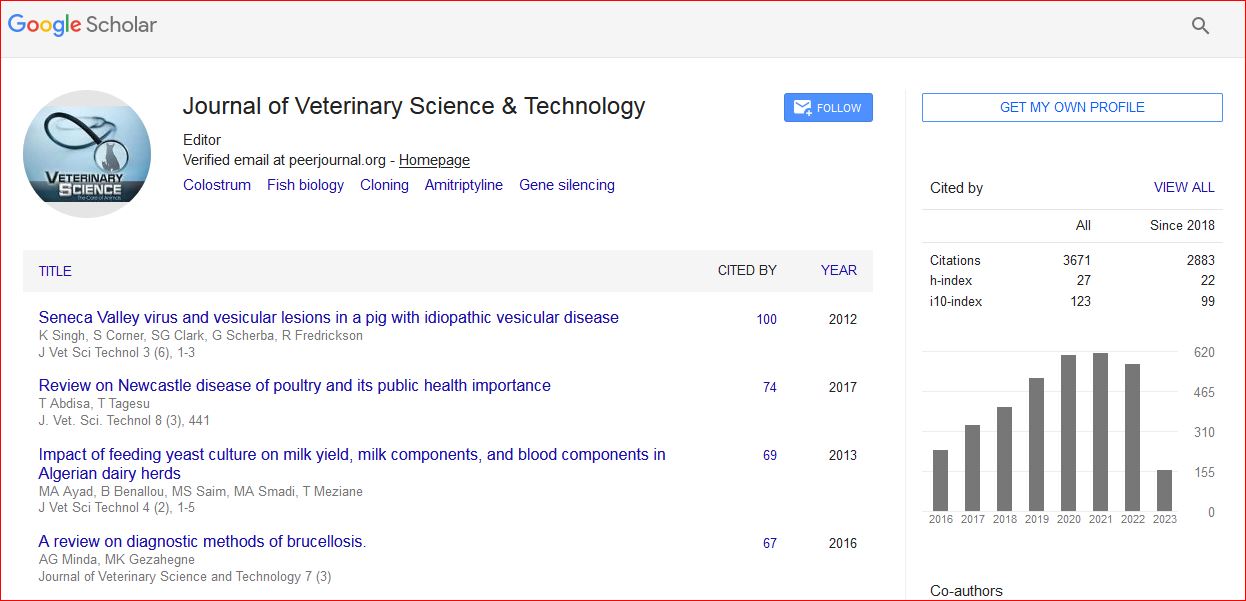
Veterinary Science & Technology received 4472 citations as per Google Scholar report