Commentary - (2025) Volume 16, Issue 2
Received: 01-Apr-2025, Manuscript No. jvst-26-187998;
Editor assigned: 03-Apr-2025, Pre QC No. P-187998;
Reviewed: 17-Apr-2025, QC No. Q-187998;
Revised: 22-Apr-2025, Manuscript No. R-187998;
Published:
29-Apr-2025
, DOI: 10.37421/2157-7579.2025.16.293
Citation: Thompson, David. ”Veterinary Public Health: Securing
Safe Food Systems.” J Vet Sci Techno 16 (2025):293.
Copyright: © 2025 Thompson D. This is an open-access article distributed under the terms of the Creative Commons Attribution License, which permits unrestricted use,
distribution and reproduction in any medium, provided the original author and source are credited.
The intricate relationship between animal health, human well-being, and the environment forms the bedrock of veterinary public health, an essential discipline for safeguarding global food safety. This field champions a proactive stance, employing rigorous risk assessment and robust surveillance systems to intercept the transmission of zoonotic diseases within the food chain, thereby fortifying public health and economic resilience. This comprehensive approach is critical in modern food systems. [1]
Antimicrobial resistance (AMR) originating from food-producing animals presents a formidable challenge to public health, underscoring the imperative for judicious antimicrobial use in veterinary medicine. The continuous monitoring of AMR trends and the exploration of alternative therapeutic strategies are paramount in mitigating this escalating global threat. Veterinary public health plays a pivotal role in this endeavor. [2] Ensuring the safety of meat products relies heavily on the systematic application of risk assessment methodologies. These strategies involve identifying, evaluating, and managing potential hazards at every stage of the meat production process, from farm to fork, to guarantee adherence to stringent food safety regulations and consumer protection. This systematic approach is vital. [3] The emergence of novel pathogens poses significant challenges to food safety and the efficacy of existing veterinary public health systems. Enhanced surveillance, rapid diagnostic capabilities, and strengthened international collaboration are indispensable for effectively controlling the dissemination of new foodborne diseases. Such measures are crucial. [4] The 'One Health' paradigm offers a powerful framework for combating foodborne zoonoses. By integrating perspectives from veterinary, human, and environmental health, this collaborative approach enhances the prevention and control of diseases transmissible from animals to humans via food. This interdisciplinary approach is key. [5] Global food safety is governed by a complex tapestry of regulatory frameworks and international standards, within which veterinary public health operates. Harmonizing these standards and ensuring their consistent implementation across diverse global food supply chains remains a significant undertaking. This effort is ongoing. [6] Laboratory diagnostics are fundamental to both food safety and veterinary public health. The development and deployment of accurate and rapid diagnostic tools are essential for identifying foodborne pathogens, monitoring animal health status, and ultimately preventing disease outbreaks, thereby safeguarding consumers. Accuracy is paramount. [7] Climate change exerts a discernible impact on food safety and veterinary public health. Altered environmental conditions can profoundly influence the prevalence and distribution of foodborne pathogens and zoonotic diseases, necessitating adaptive strategies in surveillance and disease control measures. Adaptation is essential. [8] Modern technologies, including genomics and bioinformatics, are revolutionizing food safety surveillance and veterinary public health initiatives. These advanced tools significantly improve pathogen identification, enable the tracing of contamination sources, and deepen our understanding of disease transmission dynamics. Innovation is driving progress. [9] Effective veterinary public health and food safety hinge on robust education and continuous training for professionals. Equipping individuals with evolving knowledge and skills is crucial for addressing the dynamic challenges inherent in protecting public health through secure and safe food systems. Lifelong learning is vital. [10]Veterinary public health is instrumental in guaranteeing food safety through a holistic approach that recognizes the interconnectedness of animal health, human health, and the environment. It champions proactive strategies, meticulous risk assessment, and comprehensive surveillance systems designed to thwart the transmission of zoonotic diseases throughout the food chain, thereby safeguarding public health and fostering economic stability. This multifaceted strategy is essential for modern food security. [1]
The pervasive issue of antimicrobial resistance (AMR) in food-producing animals presents a critical public health concern. This necessitates a focus on the judicious application of antimicrobials within veterinary practices, coupled with vigilant monitoring of AMR trends and the proactive development of alternative strategies to combat this escalating global threat, a central tenet of veterinary public health. Responsible use is key. [2] Risk assessment methodologies are pivotal in ensuring the safety of meat products. The application of these methods involves identifying, evaluating, and meticulously managing potential hazards across the entire meat production continuum, from initial farming practices to final consumption, ensuring strict adherence to food safety regulations and robust consumer protection. Thorough assessment is paramount. [3] The study of emerging pathogens and their influence on food safety highlights significant challenges for veterinary public health systems. There is a pressing need for intensified surveillance efforts, the development of rapid detection techniques, and enhanced international cooperation to effectively control the spread of novel foodborne diseases. Collaboration is crucial. [4] The 'One Health' approach provides a comprehensive paradigm for addressing foodborne zoonoses. By fostering integration between veterinary, human, and environmental health perspectives, this strategy significantly enhances the effectiveness of disease prevention and control measures for ailments that can transmit from animals to humans via food. Integrated efforts yield better results. [5] Navigating the landscape of global food safety requires an understanding of the intricate regulatory frameworks and international standards that guide veterinary public health practices. The ongoing efforts towards harmonization and the challenges associated with ensuring uniform application of these standards across complex global food supply chains are significant considerations. Global cooperation is vital. [6] Laboratory diagnostics play a critical role in advancing food safety and bolstering veterinary public health initiatives. Accurate and rapid diagnostic tools are indispensable for identifying foodborne pathogens and effectively monitoring the health of animal populations, which are fundamental for preventing outbreaks and ensuring consumer confidence and protection. Diagnostic accuracy is essential. [7] The impact of climate change on food safety and veterinary public health is a growing area of concern. Shifts in environmental conditions can alter the prevalence of foodborne pathogens and zoonotic diseases, thereby demanding adaptive strategies for surveillance and disease management in response to evolving ecological factors. Environmental awareness is growing. [8] The application of advanced technologies, such as genomics and bioinformatics, is transforming food safety surveillance and strengthening veterinary public health capabilities. These sophisticated tools offer enhanced pathogen identification, facilitate the tracking of contamination sources, and provide deeper insights into the complex dynamics of disease spread. Technological advancement is key. [9] The critical importance of education and training for professionals in veterinary public health and food safety cannot be overstated. Continuous learning and skill enhancement are essential to effectively confront the ever-evolving challenges associated with safeguarding public health through the provision of safe and secure food systems. Professional development is ongoing. [10]This collection of research underscores the vital role of veterinary public health in ensuring food safety. It highlights the interconnectedness of animal, human, and environmental health in preventing zoonotic diseases and managing antimicrobial resistance in food animals. The importance of risk assessment, advanced diagnostics, and international collaboration is emphasized for controlling emerging pathogens. The 'One Health' approach and the impact of climate change are also discussed, alongside the need for modern technologies like genomics and continuous professional education to maintain safe food systems.
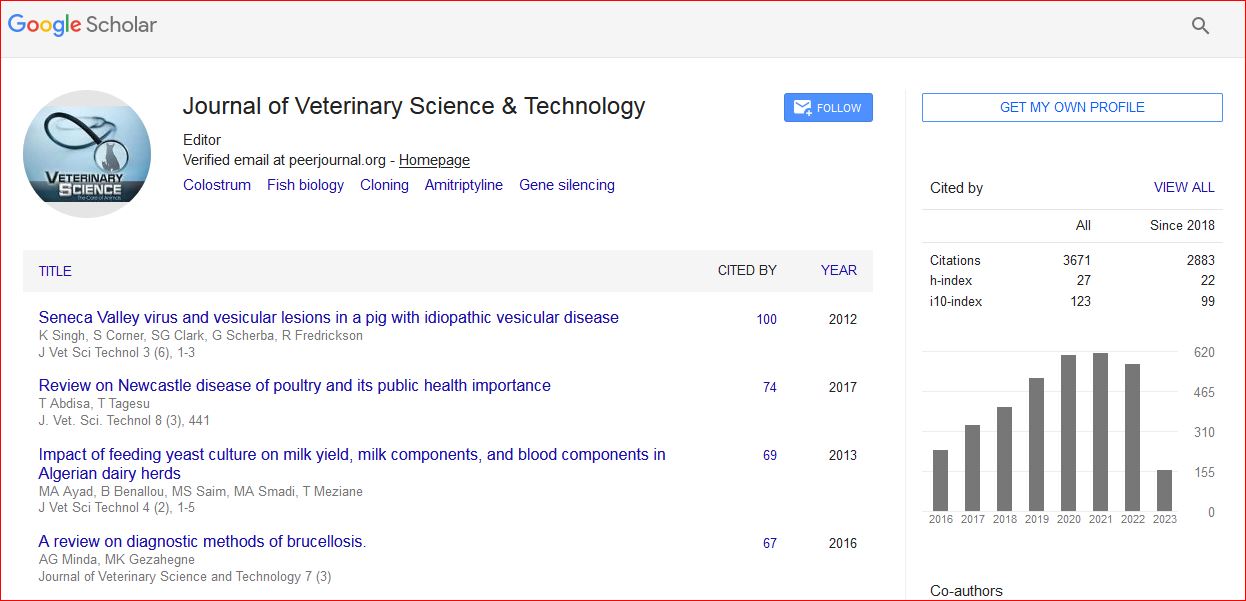
Veterinary Science & Technology received 4472 citations as per Google Scholar report