DOI: 10.37421/2329-9126.2025.13.609
Stephen Kellett1,2*, Melanie Simmonds-Buckley1,2, Mike Seneviratne1, Katherine Morgan2, Mark Boon3 and Ian Seymour4
Objective: The accurate prescription of antidepressants is technically complex and difficult to achieve. This project therefore sought to evaluate the feasibility of integrating an evidence-based decision support tool (Predictix) into General Practice. Methods: This was a real-world mixed methods evaluation in N=2 General Practices of the experiences of patients (n=24), General Practitioners (GPs; n=4) and Predictix administrators (n=2). Suitable patients were assessed using Predictix and this produced a recommendation for the likely most efficacious anti-depressant. Two patient study groups were created (a) antidepressant recommended by Predictix and (b) a GP clinical opinion override group. Both groups of patients were followed up at 12-weeks. The PHQ-9 was embedded in the Predictix assessment, and the measure was recompleted at 12-weeks follow-up. Qualitative interviews were conducted with GPs, patients and administrators and a reflexive thematic analysis (RTA) conducted. Results: It took 20-minutes to administer Predictix and then 3-days for the prescription to be issued. N=19 (88%) received a Predictix selected antidepressant (2 participants dropped out during the Predictix assessment), of whom 8/19 recovered. The N=3 (14%) in the GP override group all recovered. The common qualitative themes across GPs, patients and administrators were managing expectations, individualized care and burden. Conclusion: Whilst decision support tools have the potential for increasing prescribing accuracy for antidepressants, practical and psychological barriers to implementation need to be identified and resolved.
Noura Brahem*, Kaouther Bouzid and Haifa Taher
DOI: 10.37421/2329-9126.2025.13.607
Background: Human beings are worthy of psychological well-being to live in perfect health. Unfortunately, the complexity of modern life could cause psycho-mental disorders that destabilize the state of health of citizens. These disorders range from psychosomatic manifestations to proven psychoses. Faced with this situation, an ambitious National Mental Health Program (PNSM) was launched in Tunisia in 1990. A better understanding of the current practices of patients on psychotropic drugs and the monitoring carried out by family doctors will make it possible to provide practical responses to the expectations of all stakeholders (patients, parents and doctors).
Objective: The study focuses on the identification and classification of psycho-mental patients in the Bembla delegation, the analysis of the components of their medication prescriptions, as well as their possible associated pathologies, which will make it possible to propose practical solutions for the best application of the national mental health program.
Method: This is a statistical study carried out throughout 2023, including 197 participants of all ages who constitute all patients on psychotropic drugs treated in the seven health establishments. The data were collected from the care registers of psycho-mental patients treated on an outpatient basis and more particularly, the patients' medical files. Data analysis was performed using SPSS Version 29.0. Qualitative variables were expressed as numbers and percentages.
Results: Of the 197 patients studied, whose ages ranged from 3 to 82, the age group under 30 only represents a quarter and the population most exposed to psychological disorders is those between 30 and 60 years old or 57.4%. It is essentially antiepileptics (33.33%) and neuroleptics (27.94%) that are most often prescribed. Nearly 50% of patients take a single medication and only 14.2% take three or more products. 22% of patients have at least one associated pathology.
In terms of respecting psychiatric and neurological consultation appointments and the regularity of the supply of medications, the study shows that half of the patients are either irregular in the supply of treatment and appointments or completely lost of sight. Hence, there is a need for specific, individualized and personalized medical monitoring at the level of health establishments in the delegation through better application of the National Mental Health Program.
Conclusion: This contribution to a better understanding of the current practices of patients on psychotropic drugs and the monitoring currently carried out by family doctors will make it possible to provide practical responses to failures in the care of patients on psychotropic drugs at the delegation level and to the expectations of all stakeholders.
DOI: 10.37421/2329-9126.2025.13.605
DOI: 10.37421/2329-9126.2025.13.606
DOI: 10.37421/2329-9126.2025.13.607
DOI: 10.37421/2329-9126.2025.13.608
DOI: 10.37421/2329-9126.2025.13.610
DOI: 10.37421/2329-9126.2025.13.611
DOI: 10.37421/2329-9126.2025.13.612
DOI: 10.37421/2329-9126.2025.13.613
DOI: 10.37421/2329-9126.2025.13.614
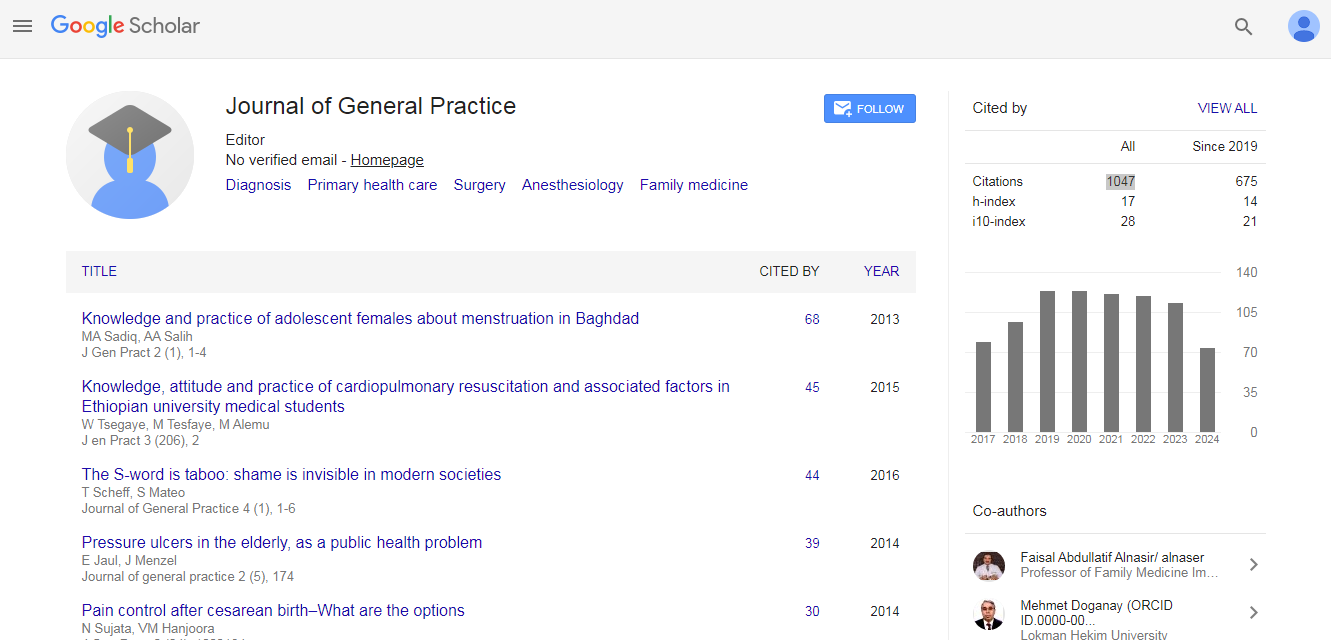
Journal of General Practice received 1047 citations as per Google Scholar report

 Spanish
  Chinese
  Russian
  German
  French
  Japanese
  Portuguese
  Hindi
Hindi 