Brief Report - (2025) Volume 13, Issue 2
Received: 01-Apr-2025, Manuscript No. JGPR-26-187997;
Editor assigned: 03-Apr-2025, Pre QC No. P-187997;
Reviewed: 17-Apr-2025, QC No. Q-187997;
Revised: 22-Apr-2025, Manuscript No. R-187997;
Published:
29-Apr-2025
, DOI: 10.37421/2329-9126.2025.13.605
Citation: Petrova, Elena. ”GPs: The Gatekeepers of Early Disease Detection.” J Gen Pract 13 (2025):605.
Copyright: © 2025 Petrova E. This is an open-access article distributed under the terms of the Creative Commons Attribution License, which permits unrestricted use, distribution and reproduction in any medium, provided the original author and source are credited.
General practitioners (GPs) are pivotal in early disease detection, acting as the first point of contact for most patients. Their role involves vigilant observation, comprehensive history taking, and targeted physical examinations to identify subtle signs of illness. GPs are adept at recognizing deviations from normal health patterns and initiating timely investigations, thereby preventing disease progression and improving patient outcomes. Their continuous care relationship allows for the longitudinal assessment of patient health, making them uniquely positioned to detect changes indicative of early-stage diseases. [1] Effectively leveraging patient history and symptom patterns is a core GP skill for early diagnosis. GPs are trained to connect seemingly unrelated symptoms and risk factors, painting a comprehensive picture of a patient's health status. This nuanced approach, often missed in episodic care settings, allows for the identification of potential serious conditions before they become symptomatic or advanced. [2] GPs play a critical role in screening for common cancers and other preventable diseases. They guide patients on appropriate screening schedules based on age, gender, and risk factors, ensuring early detection through methods like mammography, colonoscopies, and blood tests. This proactive approach significantly reduces morbidity and mortality from these conditions. [3] The continuous relationship between a GP and their patient fosters trust and open communication, which are essential for early disease reporting. Patients are more likely to confide in their GP about subtle symptoms or concerns they might otherwise dismiss, knowing they have a trusted medical advisor. [4] GPs are instrumental in the early detection of mental health conditions. They are often the first professionals to recognize signs of depression, anxiety, and other psychiatric disorders, initiating appropriate management or referral. Their holistic approach considers the interplay between physical and mental well-being. [5] The implementation of advanced diagnostic tools and point-of-care testing in primary care settings empowers GPs to detect diseases earlier. These technologies, when integrated effectively, allow for rapid identification of infections, metabolic disorders, and other conditions directly in the GP's office. [6] GPs are crucial in recognizing the early signs of cardiovascular diseases. Through regular health checks, risk factor assessment, and prompt investigation of symptoms like chest pain or shortness of breath, they can intervene early to prevent major cardiac events. [7] The role of GPs extends to the early identification of neurological disorders. Subtle changes in gait, cognition, or motor function, often overlooked by patients, can be detected by a skilled GP, leading to timely diagnosis and management of conditions like Parkinson's or early-stage dementia. [8] GPs are vital in orchestrating the referral process for further diagnostic workup or specialist care when early signs of disease are detected. Their ability to judiciously refer patients ensures that those who need advanced diagnostics or treatments receive them without undue delay. [9] The general practitioner's role in educating patients about health maintenance and early symptom recognition is fundamental to disease prevention and early detection. Empowering patients with knowledge about their bodies and potential warning signs encourages proactive engagement with their health. [10]
General practitioners (GPs) serve as the cornerstone of early disease detection, acting as the initial point of contact for the majority of individuals seeking medical attention. Their responsibilities encompass meticulous observation, thorough history-taking, and precise physical examinations aimed at identifying subtle indicators of illness. GPs possess a refined ability to discern deviations from established health norms and to initiate prompt diagnostic investigations, thereby mitigating disease progression and enhancing patient prognoses. The enduring nature of their care relationship enables a longitudinal evaluation of patient well-being, positioning them uniquely to identify changes that may signify the nascent stages of various diseases. [1] A fundamental skill for GPs in achieving early diagnoses lies in their adeptness at utilizing patient histories and recognizing symptom constellations. These practitioners are trained to discern connections between seemingly disparate symptoms and risk factors, constructing a holistic health profile for each patient. This sophisticated approach, which may be less emphasized in more episodic care models, is crucial for identifying potentially serious conditions before they manifest clinically or advance significantly. [2] Furthermore, GPs play an indispensable part in the screening protocols for prevalent cancers and other conditions amenable to prevention. They provide essential guidance to patients regarding appropriate screening timelines, tailored to individual age, gender, and specific risk factors. This ensures timely detection through modalities such as mammography, colonoscopies, and biochemical assays, ultimately contributing to a substantial reduction in the morbidity and mortality associated with these diseases. [3] The sustained engagement between a GP and their patient cultivates an environment of trust and facilitates open communication, both of which are paramount for the timely reporting of symptoms suggestive of disease. When patients feel they have a dependable medical advisor, they are more inclined to share subtle symptoms or concerns that they might otherwise disregard. [4] GPs are also instrumental in the early identification of mental health challenges. They frequently emerge as the first healthcare professionals to recognize the manifestations of depression, anxiety, and other psychiatric disorders, thereby initiating suitable management strategies or facilitating necessary referrals. Their commitment to a holistic approach acknowledges the intricate interplay between an individual's physical and mental health status. [5] The integration of sophisticated diagnostic technologies and point-of-care testing within primary care settings significantly enhances the capacity of GPs to detect diseases at an earlier stage. When these technological advancements are effectively incorporated into clinical practice, they enable the swift diagnosis of infections, metabolic disturbances, and a spectrum of other conditions directly within the GP's practice. [6] Crucially, GPs are vital for the early recognition of cardiovascular diseases. Through routine health assessments, comprehensive risk factor evaluations, and prompt investigation of symptoms like chest discomfort or dyspnea, they can implement early interventions designed to avert serious cardiac events. [7] The diagnostic purview of GPs extends to the early identification of neurological disorders. Subtle alterations in gait, cognitive function, or motor skills, which might be imperceptible to the patient, can be detected by an experienced GP, paving the way for the timely diagnosis and management of conditions such as Parkinson's disease or early-onset dementia. [8] Moreover, GPs play a pivotal role in coordinating the referral pathways for patients who require further diagnostic evaluation or specialized medical care following the detection of early disease indicators. Their judicious decision-making in referring patients ensures that those in need of advanced diagnostic procedures or therapeutic interventions access them without undue delay. [9] Finally, the role of general practitioners in patient education concerning health maintenance and the recognition of early symptoms is fundamental to both disease prevention and timely detection. By equipping patients with knowledge about their bodies and potential warning signs, GPs foster a more proactive approach to personal health management. [10]
General practitioners (GPs) are essential for early disease detection, serving as the first point of contact for patients. They utilize observation, history-taking, and examinations to identify subtle illness signs, preventing disease progression. GPs excel at recognizing symptom patterns and risk factors for early diagnosis, and play a key role in screening for cancers and other preventable diseases. Their continuous care builds trust, encouraging patients to report early symptoms. GPs also detect mental health and neurological conditions, and recognize early signs of cardiovascular diseases. The use of advanced diagnostic tools in primary care further aids early detection. Furthermore, GPs coordinate referrals to specialists and educate patients on health maintenance and symptom recognition, empowering proactive health management.
None
None
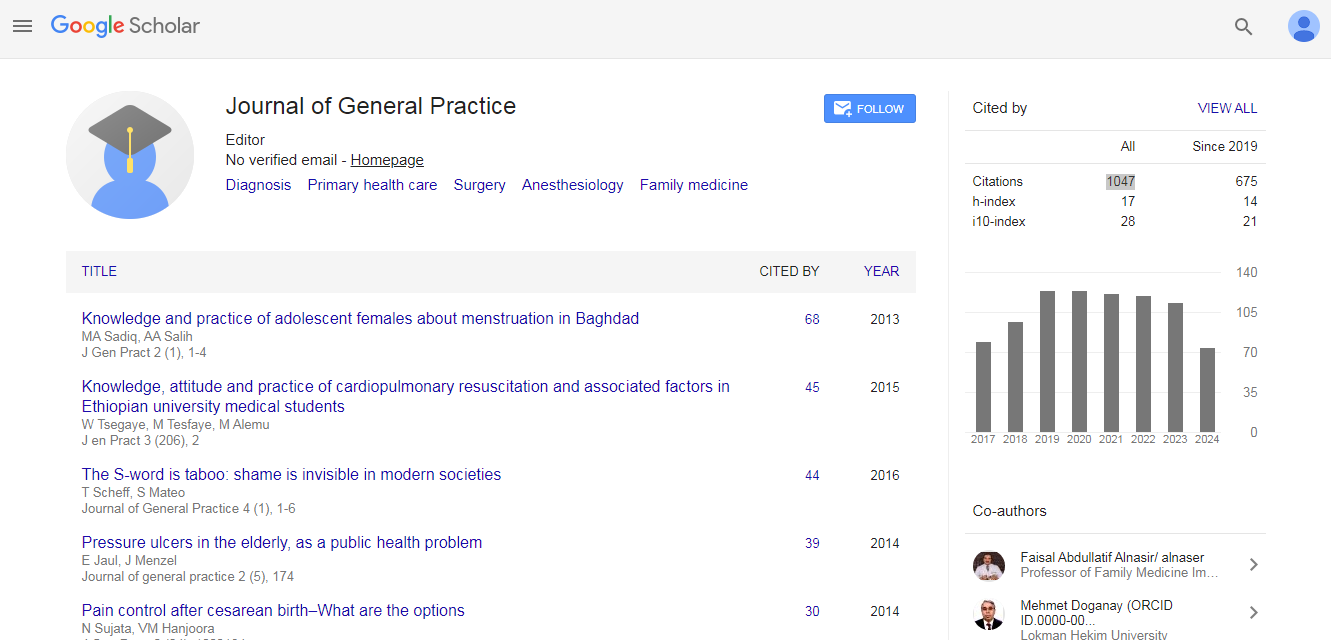
Journal of General Practice received 1047 citations as per Google Scholar report