Short Communication - (127) Volume 13, Issue 2
Received: 01-Apr-2025, Manuscript No. JGPR-26-188003;
Editor assigned: 03-Apr-2025, Pre QC No. P-188003;
Reviewed: 17-Apr-2025, QC No. Q-188003;
Revised: 22-Apr-2025, Manuscript No. R-188003;
Published:
29-Apr-2025
, DOI: 10.37421/2329-9126.2025.13.608
Citation: Rodriguez, Camila. ”General Practitioner Decision- Making: Challenges and Solutions.” J Gen Pract 13 (2025):608.
Copyright: © 2025 Rodriguez C. This is an open-access article distributed under the terms of the Creative Commons Attribution License, which permits unrestricted use, distribution and reproduction in any medium, provided the original author and source are credited.
General practitioners navigate a complex landscape of clinical decision-making, intricately influenced by a myriad of factors that shape diagnostic and treatment pathways, particularly in resource-constrained environments like rural settings. The inherent variability in patient demographics, coupled with the availability of resources and the cumulative experience of the physician, creates a unique set of challenges that necessitate adaptable frameworks and enhanced support systems to optimize patient outcomes. This dynamic interplay of variables underscores the critical need for continuous evaluation and refinement of decision-making processes within primary care [1].
Diagnostic uncertainty is a pervasive challenge encountered by general practitioners in their daily practice. The ambiguity surrounding diagnoses can lead to potential risks for patients and place considerable strain on clinicians. To effectively mitigate these risks and enhance diagnostic accuracy, it is imperative to implement strategic approaches. These strategies often involve leveraging advanced clinical decision support systems and fostering robust communication channels with specialist colleagues to ensure timely and precise diagnostic conclusions [2].
Patient-centered communication plays a pivotal role in shaping the efficacy of clinical decision-making within general practice. Models that prioritize shared decision-making, actively involving patients in the diagnostic and treatment planning process, have demonstrated a significant positive impact. This collaborative approach not only fosters greater adherence to prescribed treatment plans but also contributes to a marked improvement in overall patient satisfaction, reinforcing the importance of a patient-engaged healthcare paradigm [3].
The practice of general medicine is replete with ethical considerations that deeply influence clinical decision-making. Dilemmas frequently arise concerning the equitable allocation of limited resources, the sensitive management of end-of-life care, and the assertion of professional autonomy within evolving healthcare systems. Addressing these complex ethical challenges necessitates dedicated robust ethical training programs and the cultivation of strong collegial support networks to guide practitioners through difficult choices [4].
The integration of digital health tools represents a significant advancement in modern general practice, offering novel avenues to support clinical decision-making. Electronic health records, telemedicine platforms, and artificial intelligence-powered diagnostic aids are increasingly being assessed for their effectiveness in augmenting clinician capabilities. These technologies hold the potential to streamline workflows, improve access to information, and ultimately enhance the quality and efficiency of patient care [5].
Cognitive biases, often operating subconsciously, can subtly yet significantly impact the clinical judgments made by general practitioners. Common biases such as confirmation bias, where evidence is favored that confirms pre-existing beliefs, and the availability heuristic, relying on easily recalled information, can lead to suboptimal decision-making. Implementing practical strategies to recognize and mitigate these biases is crucial for fostering more objective and accurate clinical assessments [6].
The management of chronic diseases presents a unique set of challenges within the general practice setting, demanding sophisticated clinical decision-making. Adopting evidence-based approaches, empowering patients with self-management support, and adeptly coordinating care across diverse multidisciplinary teams are essential components. Successfully navigating these complexities requires a holistic and integrated approach to patient care [7].
Interprofessional collaboration is increasingly recognized as a cornerstone for enhancing clinical decision-making within general practice teams. When healthcare professionals from different disciplines work together, sharing knowledge, respecting diverse perspectives, and engaging in mutual support, it leads to demonstrably better patient care outcomes. This collaborative environment can significantly reduce the incidence of medical errors and improve the overall quality of healthcare delivery [8].
Clinical decision support systems (CDSS) have emerged as valuable tools in general practice, with a growing body of evidence supporting their effectiveness. A systematic review of these systems indicates a positive impact on diagnostic accuracy, the appropriateness of treatment decisions, and overall patient safety. When well-designed and effectively implemented, CDSS can substantially assist practitioners in making more informed and effective clinical choices [9].
The adoption of evidence-based practice (EBP) within general practice is a continuous pursuit, influenced by various facilitators and barriers. Effectively translating research findings into actionable clinical decision-making is paramount. General practitioners often encounter obstacles in this process, including time constraints, lack of access to research, and resistance to change, highlighting the ongoing need to address these barriers to promote the consistent application of the latest evidence in patient care [10].
The intricate process of clinical decision-making for general practitioners is profoundly shaped by contextual elements, especially in rural settings where resource constraints are often pronounced. Patient demographics, the availability of medical resources, and the accumulated experience of the physician collectively influence the diagnostic and therapeutic trajectories pursued. Recognizing this multifaceted reality, there is a clear imperative to develop and implement adaptable decision-making frameworks, complemented by enhanced diagnostic support mechanisms, with the ultimate goal of elevating patient outcomes. The inherent variability and complexity demand continuous adaptation and innovation in primary care practice [1].
Within the demanding environment of primary care, general practitioners frequently grapple with diagnostic uncertainty, a challenge that carries significant implications for patient safety and clinician confidence. Proactive strategies aimed at mitigating these uncertainties are essential for improving the precision of diagnoses. Key among these strategies are the judicious use of clinical decision support systems, which provide evidence-based guidance, and the cultivation of effective communication with specialist physicians, ensuring seamless referral pathways and collaborative diagnostic efforts when needed [2].
The influence of patient-centered communication on clinical decision-making in general practice cannot be overstated. Embracing shared decision-making models, where patients are active participants in their healthcare journey, leads to demonstrable improvements. This collaborative approach fosters a greater sense of ownership and commitment from patients, resulting in enhanced adherence to treatment plans and a palpable increase in patient satisfaction. Such models underscore the ethical and practical benefits of empowering patients in their medical care [3].
Ethical considerations are intrinsically woven into the fabric of clinical decision-making for general practitioners, presenting a constant source of deliberation. Clinicians frequently encounter ethical dilemmas related to the judicious allocation of scarce resources, the provision of care at the end of life, and the navigation of professional autonomy within evolving healthcare landscapes. The rigorous application of ethical principles, supported by comprehensive ethical training and a strong network of collegial support, is vital for guiding practitioners through these challenging situations [4].
Digital health technologies are rapidly transforming the landscape of general practice, offering powerful new tools to aid in clinical decision-making. The integration of electronic health records, the expanded use of telemedicine, and the application of AI-powered diagnostic aids are being rigorously evaluated for their impact. These innovations hold considerable promise for enhancing clinician efficiency, improving access to patient information, and ultimately bolstering the quality and effectiveness of healthcare delivery [5].
The phenomenon of cognitive biases presents a subtle yet significant challenge to objective clinical decision-making in general practice. Common biases, such as confirmation bias and the availability heuristic, can inadvertently steer clinical judgments away from the most evidence-based conclusions. Developing and implementing practical strategies designed to identify and counteract these cognitive tendencies is crucial for ensuring that decisions are grounded in objectivity and reason, thereby safeguarding patient care [6].
Effectively managing chronic diseases is a core responsibility of general practitioners, necessitating astute clinical decision-making. The process hinges on the diligent application of evidence-based approaches, the provision of robust patient self-management support, and the intricate coordination of care across diverse multidisciplinary teams. Successfully addressing the complexities of chronic disease management requires a comprehensive and integrated strategy that addresses both the clinical and psychosocial aspects of patient well-being [7].
Interprofessional collaboration is increasingly recognized as a vital component in elevating the standard of clinical decision-making within general practice teams. When professionals from various disciplines engage in teamwork, share their expertise, and foster mutual respect, it cultivates an environment conducive to superior patient care. This synergistic approach has been shown to reduce medical errors and enhance the overall quality and safety of healthcare services [8].
Clinical decision support systems (CDSS) are demonstrating considerable value in general practice, with systematic reviews highlighting their positive impact on clinical outcomes. These reviews indicate that well-designed CDSS can significantly improve diagnostic accuracy, ensure greater appropriateness of treatment choices, and enhance overall patient safety. The judicious implementation of these systems offers a tangible means to bolster evidence-based practice and support practitioners in their daily decision-making [9].
The principle of evidence-based practice (EBP) is fundamental to high-quality general practice, yet its implementation faces various facilitators and barriers. The critical step of translating research findings into practical clinical decision-making is often hindered by challenges such as time constraints, limited access to up-to-date research, and established practice patterns. Addressing these impediments is crucial for ensuring that general practitioners can consistently integrate the latest evidence into their patient care strategies [10].
General practitioners face complex clinical decision-making influenced by patient demographics, resource availability, and physician experience, particularly in rural settings. Diagnostic uncertainty is a key challenge, addressed by clinical decision support systems and specialist communication. Patient-centered communication and shared decision-making improve adherence and satisfaction. Ethical considerations, including resource allocation and end-of-life care, require robust training and support. Digital health tools, such as EHRs and telemedicine, aid decision-making. Cognitive biases can affect judgment, necessitating mitigation strategies. Chronic disease management requires evidence-based approaches and team coordination. Interprofessional collaboration enhances care and reduces errors. Clinical decision support systems improve diagnostic accuracy and patient safety. Evidence-based practice implementation faces barriers, emphasizing the need to translate research into practice.
None
None
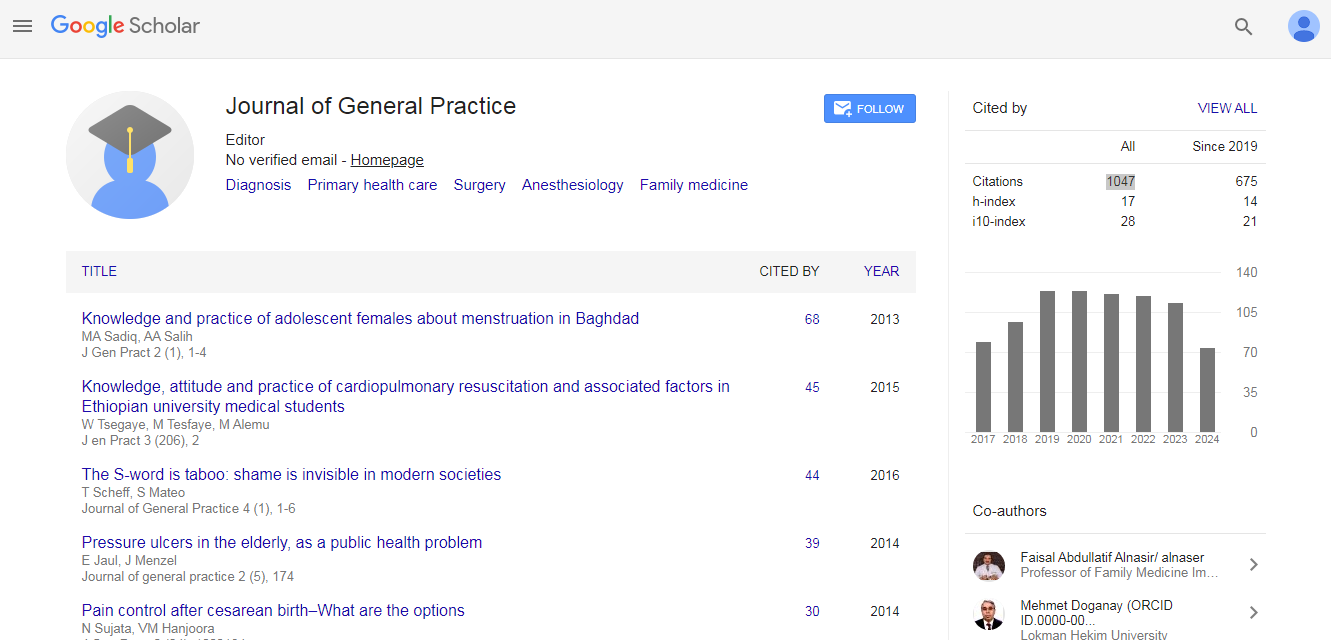
Journal of General Practice received 1047 citations as per Google Scholar report