Opinion - (2025) Volume 13, Issue 2
Received: 01-Apr-2025, Manuscript No. JGPR-26-188009;
Editor assigned: 03-Apr-2025, Pre QC No. P-188009;
Reviewed: 17-Apr-2025, QC No. Q-188009;
Revised: 22-Apr-2025, Manuscript No. R-188009;
Published:
29-Apr-2025
, DOI: 10.37421/2329-9126.2025.13.611
Citation: Smith, Oliver. ”Evidence-Based Medicine: Enhancing Patient Care And Outcomes.” J Gen Pract 13 (2025):611.
Copyright: © 2025 Smith O. This is an open-access article distributed under the terms of the Creative Commons Attribution License, which permits unrestricted use, distribution and reproduction in any medium, provided the original author and source are credited.
Evidence-based medicine (EBM) is a cornerstone of modern general practice, guiding clinicians in integrating the most robust research findings with their clinical acumen and the unique values of their patients. This integrated approach is fundamental for enhancing diagnostic precision, optimizing therapeutic strategies, and ultimately improving patient outcomes. The successful implementation of EBM necessitates a commitment to continuous professional development, the cultivation of critical appraisal skills, and the ability to effectively communicate complex evidence to translate it into individualized patient care plans. However, practitioners often face significant challenges, including time constraints, difficulties in accessing reliable evidence, and the inherent variability among patient populations, which can impede its widespread adoption [1].
Translating scientific research into the day-to-day realities of general practice presents a complex set of practical challenges that require strategic solutions. This paper explores various approaches and strategies designed to overcome the common barriers to EBM implementation, such as the limited time available for thorough literature searches and critical evaluation of studies. It emphasizes the crucial role that decision support tools and collaborative, team-based learning can play in fostering an organizational culture that prioritizes evidence-informed practice. Furthermore, the importance of acknowledging and actively addressing clinician resistance to change is highlighted as a key factor in successful EBM integration [2].
A fundamental skill underpinning the effective practice of EBM is the critical appraisal of medical literature. General practitioners must possess the proficiency to meticulously evaluate the validity, reliability, and applicability of research studies to their clinical context. This article offers a practical, step-by-step guide to appraising various study designs, with a particular focus on identifying and understanding key methodological aspects that significantly influence the trustworthiness of research findings. Recognizing and understanding potential sources of bias and inherent limitations within studies are essential prerequisites for making sound and informed clinical decisions [3].
Central to the philosophy of evidence-based practice is the recognition and incorporation of patient preferences and values into the clinical decision-making process. This paper delves into the practical methods by which general practitioners can effectively elicit and integrate patient perspectives into shared decision-making scenarios. It underscores the profound importance of maintaining clear and open communication, demonstrating empathy, and providing patients with information that is easily understandable regarding their treatment options, along with their associated risks and benefits [4].
The role of well-established clinical guidelines in providing essential support for EBM within the general practice setting is a critical area of examination. This research undertakes an assessment of the practical usability and the actual impact of both national and international guidelines on the daily clinical decision-making processes of general practitioners. It identifies specific facilitators that promote guideline implementation and conversely, highlights barriers that impede it, proposing actionable recommendations for enhancing the relevance and adherence to these guidelines among primary care physicians [5].
This systematic review offers a comprehensive evaluation of the effectiveness of diverse methodologies employed in the teaching and learning of EBM skills among primary care physicians. It meticulously analyzes a range of educational interventions, including interactive workshops, self-paced online modules, and integrated learning approaches, assessing their impact on physician knowledge, skill acquisition, and subsequent practice behaviors. The findings derived from this review are intended to inform the development and refinement of more impactful EBM training programs specifically tailored for general practitioners [6].
The integration of advanced digital tools and technologies into the fabric of general practice holds significant potential to enhance and support the principles and practice of EBM. This article explores the multifaceted ways in which electronic health records, sophisticated clinical decision support systems, and accessible online databases can streamline and facilitate the crucial processes of evidence retrieval, application, and ongoing learning. It further discusses the prospective benefits alongside the inherent challenges associated with the widespread adoption of these transformative technologies aimed at improving the delivery of evidence-informed care [7].
This qualitative study employs an in-depth investigative approach to explore the perceptions and lived experiences of general practitioners concerning the implementation of EBM within their routine daily practice. It successfully identifies key facilitators that support this process, such as readily available professional development opportunities and supportive organizational practice environments, while also pinpointing significant barriers, including persistent time pressures and various organizational constraints. The insights gleaned from these findings aim to provide valuable guidance on how to cultivate a more robust and effective EBM culture within primary care settings [8].
The profound impact of Evidence-Based Medicine on patient safety and the overall quality of care delivered within general practice is a critical area of ongoing research and discussion. This particular research examines how diligent adherence to evidence-based recommendations can contribute significantly to the reduction of medical errors, the enhancement of treatment efficacy, and the overall improvement of patient well-being. The paper articulates the imperative for a systematic and integrated approach to embedding EBM principles effectively throughout primary healthcare services [9].
This opinion piece offers a thoughtful perspective on the dynamically evolving landscape of EBM within general practice, strongly emphasizing the indispensable need for continuous adaptation and a commitment to lifelong learning among practitioners. It highlights the ever-increasing complexity of medical knowledge and the formidable challenges associated with staying current with the relentless influx of new research evidence. The author strongly advocates for the proactive development and implementation of strategic initiatives and supportive structural frameworks within general practices to actively foster a culture dedicated to continuous quality improvement driven by the principles of EBM [10].
Evidence-based medicine (EBM) plays a pivotal role in general practice, serving as a guiding framework for clinicians to synthesize the best available research evidence with their accumulated clinical expertise and the distinct values of their patients. This multifaceted approach is essential for elevating diagnostic accuracy, optimizing the selection of treatments, and ultimately leading to improved patient outcomes. The effective implementation of EBM hinges on a commitment to ongoing learning, the development of robust critical appraisal skills, and proficient communication strategies to ensure that research evidence is successfully translated into personalized patient care. Nevertheless, practitioners frequently encounter obstacles such as stringent time limitations, challenges in accessing dependable evidence, and the considerable variability observed across different patient populations [1].
Bridging the gap between research findings and their practical application in routine general practice is often fraught with practical difficulties. This paper critically examines various strategies that can be employed to surmount the common obstacles hindering the successful implementation of EBM. These include addressing the scarcity of time dedicated to literature searches and the thorough critical appraisal of studies. The importance of leveraging decision support tools and fostering a culture of team-based learning is emphasized as a means to promote evidence-informed practice. Moreover, the paper underscores the necessity of recognizing and proactively managing clinician resistance to change [2].
The critical appraisal of medical literature stands as a fundamental pillar of EBM. General practitioners are required to be proficient in evaluating the validity, reliability, and applicability of research studies to their clinical practice. This article presents a practical toolkit for appraising diverse study designs, focusing on the crucial methodological elements that determine the trustworthiness of research findings. A thorough understanding of potential biases and inherent limitations is indispensable for making well-informed clinical decisions [3].
Patient preferences and values are an integral and non-negotiable component of evidence-based practice. This paper investigates the various techniques that general practitioners can utilize to effectively gather and incorporate patient perspectives into the process of shared decision-making. It places significant emphasis on the importance of fostering clear communication, demonstrating genuine empathy, and providing patients with easily comprehensible information regarding their treatment alternatives, including the associated risks and benefits [4].
The supportive function of clinical guidelines in advancing EBM within the realm of general practice is thoroughly examined. This research critically assesses the practicality and the actual influence of both national and international guidelines on the daily clinical decision-making practices of general practitioners. It identifies key enablers that facilitate the implementation of guidelines, as well as barriers that impede their uptake, and subsequently proposes strategies to enhance their relevance and adherence among practitioners [5].
This systematic review undertakes an evaluation of the effectiveness of various pedagogical approaches used to teach and learn EBM skills among primary care physicians. It meticulously analyzes a spectrum of educational interventions, encompassing workshops, online learning modules, and integrated learning strategies, assessing their impact on the knowledge base, skill proficiency, and practical behaviors of physicians. The outcomes of this review are intended to guide the creation and enhancement of more effective EBM training programs tailored for general practitioners [6].
The integration of digital technologies into the daily workflow of general practice offers substantial benefits for supporting EBM. This article explores how tools such as electronic health records, clinical decision support systems, and comprehensive online databases can significantly simplify and enhance the processes of retrieving evidence, applying it in practice, and facilitating continuous learning. The discussion encompasses both the potential advantages and the inherent challenges associated with the adoption of these technologies to improve the delivery of evidence-informed care [7].
This qualitative study delves into the perceptions and practical experiences of general practitioners concerning the integration of EBM into their day-to-day clinical activities. It identifies critical factors that facilitate this integration, such as opportunities for professional growth and supportive practice environments, alongside barriers like significant time constraints and broader organizational limitations. The findings offer valuable insights into fostering a more robust culture of EBM within primary care settings [8].
The influence of EBM on patient safety and the overall quality of care provided in general practice is a subject of considerable importance. This research investigates how strict adherence to evidence-based recommendations can lead to a reduction in medical errors, an improvement in treatment effectiveness, and an enhancement of overall patient well-being. The paper emphasizes the necessity of a systematic approach to embedding EBM principles within the operational framework of primary healthcare services [9].
This opinion piece reflects on the continually changing landscape of EBM in general practice, stressing the vital need for constant adaptation and a commitment to lifelong learning. It addresses the increasing complexity of medical knowledge and the difficulties associated with keeping abreast of emerging evidence. The author champions the adoption of proactive strategies and the establishment of supportive infrastructures within general practices to cultivate an environment of continuous quality improvement through the application of EBM [10].
Evidence-based medicine (EBM) is crucial in general practice, integrating research evidence with clinical expertise and patient values to improve diagnosis, treatment, and outcomes. Implementing EBM involves continuous learning, critical appraisal, and effective communication, though challenges like time constraints and access to reliable evidence persist. Translating research into practice requires overcoming barriers through decision support tools and team learning, while addressing clinician resistance is key. Critical appraisal of medical literature is fundamental for evaluating study validity and applicability. Patient preferences are integral to shared decision-making, requiring clear communication and empathy. Clinical guidelines support EBM by influencing daily decisions, with strategies to improve their relevance and adherence. Educational interventions aim to enhance EBM skills in primary care physicians. Digital tools like EHRs and clinical decision support systems facilitate evidence retrieval and application, presenting both benefits and challenges. Qualitative studies reveal that supportive environments and professional development foster EBM, while time pressures and organizational constraints act as barriers. EBM positively impacts patient safety and care quality by reducing errors and improving treatment. The future of EBM demands continuous adaptation and lifelong learning, with a need for proactive strategies to foster a culture of quality improvement.
None.
None
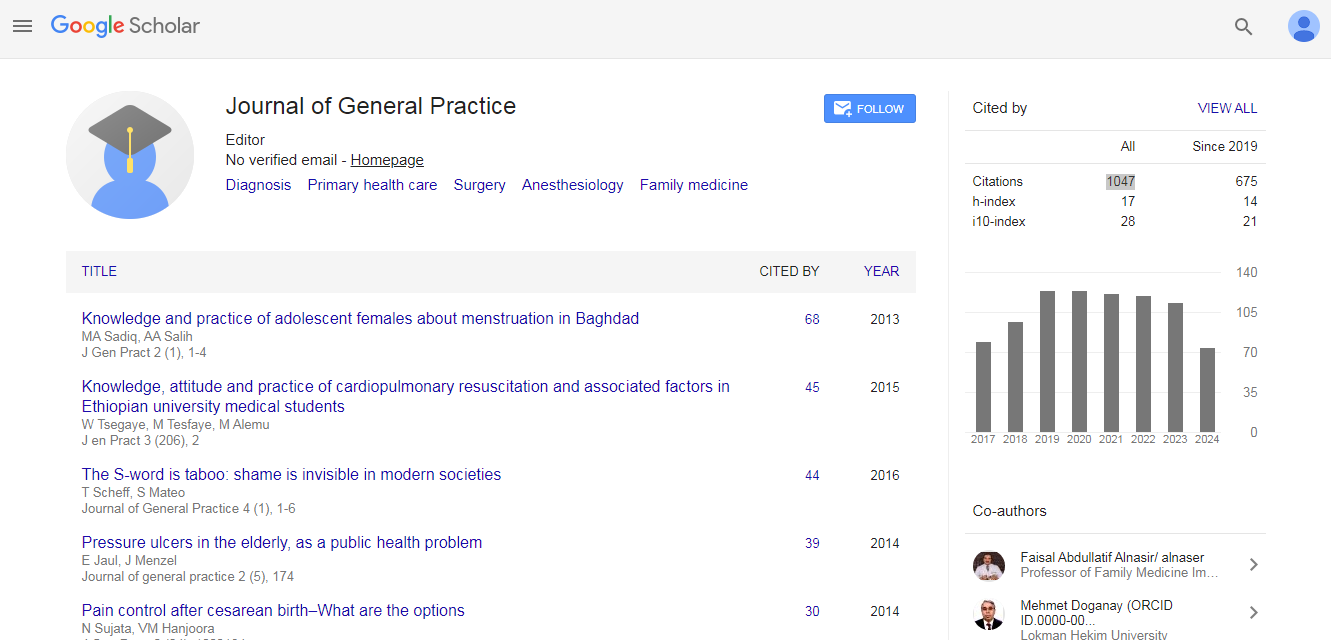
Journal of General Practice received 1047 citations as per Google Scholar report