Perspective - (2025) Volume 13, Issue 2
Received: 01-Apr-2025, Manuscript No. JGPR-26-188007;
Editor assigned: 03-Apr-2025, Pre QC No. P-188007;
Reviewed: 17-Apr-2025, QC No. Q-188007;
Revised: 22-Apr-2025, Manuscript No. R-188007;
Published:
29-Apr-2025
, DOI: 10.37421/2329-9126.2025.13.610
Citation: Hassan, Amina. ”Continuity of Care: Key for Better Patient Outcomes.” J Gen Pract 13 (2025):610.
Copyright: © 2025 Hassan A. This is an open-access article distributed under the terms of the Creative Commons Attribution License, which permits unrestricted use, distribution and reproduction in any medium, provided the original author and source are credited.
Continuity of care, fundamentally defined as a patient's consistent and coherent experience of care that effectively meets their evolving needs over time, is a cornerstone of positive health outcomes. This concept is intrinsically linked to the efficacy of healthcare delivery, particularly within primary care settings, where ongoing relationships are paramount for comprehensive patient management. The maintenance of such continuity has been empirically associated with significant improvements in the management of chronic diseases, leading to higher levels of patient satisfaction and a measurable reduction in hospitalizations. The Department of Family Health Sciences at Cairo University actively engages in research that explores how integrated healthcare models can positively influence patient well-being across diverse demographic and clinical populations. This research aims to understand the multifaceted benefits of a continuous care approach. The effectiveness of continuity of care in managing long-term health conditions, such as diabetes and hypertension, is a well-established area of study. A consistent relationship with a primary care provider facilitates superior monitoring of health status, enables timely and appropriate interventions, and supports the development of personalized treatment plans that are critical for preventing serious complications and enhancing quality of life. Patient satisfaction serves as a crucial indicator of the quality of healthcare services provided. Continuity of care significantly contributes to enhancing patient satisfaction by fostering a sense of being known and understood by healthcare providers, which in turn strengthens trust and adherence to prescribed treatment regimens. The fragmentation inherent in many contemporary healthcare systems presents a substantial impediment to achieving seamless continuity of care. In such disjointed environments, patients often encounter multiple specialists without adequate inter-professional communication, potentially leading to redundant diagnostic tests, missed diagnoses, and an escalation of healthcare costs. The pivotal role of information technology in facilitating and enhancing continuity of care cannot be overstated in the modern healthcare landscape. The widespread adoption of electronic health records (EHRs) and robust shared care platforms demonstrably improves inter-provider communication and streamlines the sharing of critical patient data, thereby fostering more integrated and patient-centered care delivery. Continuity of care is of particular and amplified importance for vulnerable patient populations, including the elderly and individuals managing multiple chronic comorbidities. A stable and consistent relationship with a primary care team is essential for ensuring these patients receive ongoing support, proactive preventive care, and the effective management of their complex health needs. The economic implications of continuity of care represent a significant consideration for healthcare systems globally. By proactively preventing unnecessary emergency room visits and reducing hospital readmissions, a well-established continuity of care can yield substantial cost savings and improve resource allocation within healthcare infrastructures. Team-based care models, which typically involve a collaborative effort between primary care physicians, nurses, pharmacists, and other allied health professionals, offer a promising avenue for enhancing continuity of care. This interdisciplinary approach ensures a more comprehensive, holistic, and coordinated response to the diverse and often complex needs of patients. The fundamental concept of a 'usual care provider' is central to the effective implementation and realization of continuity of care. Possessing a consistent primary care physician who possesses intimate knowledge of a patient's medical history, personal preferences, and social context is instrumental in delivering more effective, efficient, and personalized healthcare. While the benefits of continuity of care are well-documented, significant challenges persist in its practical implementation and sustained maintenance within healthcare systems. These challenges often stem from issues related to patient access, excessive provider workload, and the inherent complexities in the organization and delivery of healthcare services.
Continuity of care, defined as a patient's consistent and coherent experience of care over time that effectively addresses their needs, is a fundamental element contributing to positive patient health outcomes. This principle emphasizes the importance of effective communication and robust coordination among healthcare providers, particularly within primary care settings where ongoing relationships are key. The maintenance of this continuity is strongly linked to improved management of chronic diseases, higher patient satisfaction rates, and a significant reduction in hospitalizations. Research conducted by the Department of Family Health Sciences at Cairo University investigates how integrated healthcare models can positively impact patient well-being across diverse populations. This approach is vital for holistic patient care. The effectiveness of continuity of care in managing long-term health conditions, such as diabetes and hypertension, is well-established in clinical literature. A stable and consistent relationship with a primary care provider allows for enhanced monitoring of patient health, facilitates timely interventions, and supports the development of personalized treatment plans crucial for preventing complications. Fostering a patient-centered approach within family health sciences underscores this importance. Patient satisfaction is a key indicator of the quality of healthcare services, and continuity of care plays a significant role in enhancing it. When patients feel recognized and understood by their healthcare providers, their trust in the system and adherence to treatment plans tend to increase, leading to better health outcomes. Strengthening these patient-provider relationships is a focus of research in family health sciences. The fragmentation often observed in healthcare systems poses a major barrier to achieving effective continuity of care. In such environments, patients may consult numerous specialists without adequate communication between them, potentially leading to duplicated tests, missed diagnoses, and increased healthcare costs. Improving care coordination is vital, especially in community-based health sciences. The role of information technology in facilitating continuity of care is increasingly recognized as indispensable. Electronic health records (EHRs) and shared care platforms can significantly improve communication and data sharing among healthcare providers, ultimately leading to more integrated and patient-centered care delivery. Research in family health frequently evaluates the effectiveness of these technological solutions. Continuity of care is particularly crucial for vulnerable populations, including the elderly and individuals with multiple comorbidities. A stable relationship with a primary care team ensures these patients receive consistent support, timely preventive care, and effective management tailored to their complex health needs. This is a central focus in many family health studies. The economic impact of continuity of care is a significant consideration for healthcare systems. By preventing unnecessary emergency room visits and hospital readmissions, strong continuity can lead to substantial cost savings and improved resource utilization. This aspect is frequently explored in the context of primary and family health research. Team-based care models, which involve collaboration among primary care physicians, nurses, pharmacists, and other health professionals, can enhance continuity of care. This interdisciplinary approach ensures a more holistic and coordinated response to patient needs, which is often investigated within family health departments. The concept of a 'usual care provider' is central to establishing and maintaining continuity. Having a consistent primary care physician who is familiar with a patient's history and preferences leads to more effective and personalized healthcare delivery. This relationship is a cornerstone of patient-centered medical homes, often studied in family health contexts. Addressing the challenges in implementing and maintaining continuity of care, such as issues with patient access, provider workload, and complex service organization, requires systemic changes and ongoing research. Such research is critical within departments focused on primary and family health.
Continuity of care is essential for positive patient outcomes, improving chronic disease management, patient satisfaction, and reducing hospitalizations. It is facilitated by effective communication and coordination among healthcare providers, particularly in primary care. A consistent relationship with a primary care provider is crucial for monitoring, timely interventions, and personalized treatment plans, especially for chronic conditions like diabetes and hypertension. Patient trust and adherence to treatment increase when they feel known and understood by their providers. Fragmented healthcare systems hinder continuity, leading to duplicated tests and increased costs. Information technology, such as EHRs, plays a vital role in improving communication and care integration. Continuity is especially important for vulnerable populations, ensuring consistent support and management of complex health needs. It also offers economic benefits by reducing unnecessary healthcare utilization. Team-based care models and the concept of a 'usual care provider' further enhance continuity by promoting holistic and personalized care. However, challenges related to access, workload, and service organization persist, requiring systemic solutions.
None
None
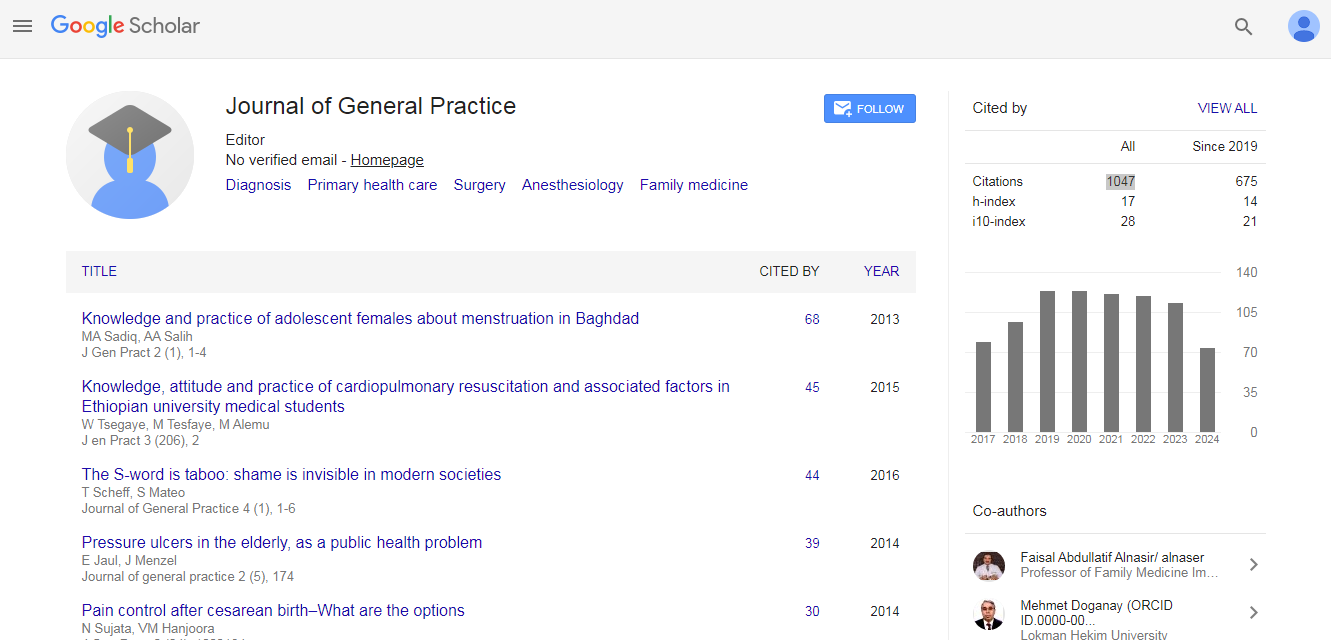
Journal of General Practice received 1047 citations as per Google Scholar report