Shin Young Park, Ki Yun Kim, Young-Seuk Bae, Do Youn Jun and Young Ho Kim*
DOI: 10.37421/2165-7831.2025.15.340
3,6-Anhydro-L-Galactose (L-AHG), a bioactive carbohydrate derived from agarose extracted from red algae, is produced via a two- step enzymatic hydrolysis process, yielding high purity. It effectively inhibits the proliferation of activated T and B lymphocytes, key players in adaptive immunity, by suppressing the Janus Kinase-Signal Transducer and Activator of Transcription (JAK-STAT) signaling pathway and blocking the G1-S traverse in the cell cycle. This dual mechanism reduces adaptive immune responses, positioning L- AHG as a next-generation immunosuppressant. Its targeted approach promises greater safety and efficacy compared to traditional therapies, with potential applications in autoimmune disease treatment, transplant rejection prevention and managing hyperactive immune responses. This review presents detailed insights into the production process, mechanisms of action and therapeutic possibilities of L-AHG, highlighting its capacity to address many of the shortcomings of current immunosuppressive drugs.
Limei Chen and Juping Liu*
DOI: 10.37421/2165-7831.2025.15.337
Diabetic Retinopathy (DR), a leading cause of blindness in diabetic populations, necessitates early detection strategies beyond conventional fundus photography. This review synthesizes evidence on hematological inflammatory indices as potential biomarkers for DR screening. The Neutrophil-to-lymphocyte Ratio (NLR) emerges as the most consistent independent risk factor, with composite indices like SII and SIRI showing diagnostic value. Pathophysiologically, these indices reflect systemic inflammation driven by neutrophil-mediated vascular damage, monocyte-induced insulin resistance, and plateletleukocyte interactions. While NLR correlates strongly with proliferative DR, PLR/SII demonstrate utility in non-proliferative stages. Current limitations include lack of standardized cut-offs and susceptibility to transient confounders. Future research should prioritize multicenter validation and integration with glycemic/ hemodynamic parameters to enhance predictive models.
DOI: 10.37421/2165-7831.2025.15.339
Multiple Myeloma (MM) remains incurable and thus, innovative therapeutic options are needed. MM cells not only reside in the bone marrow, but also expand outside bone. The extramedullary expansion of plasmacytoma is generally accepted to represent a high-risk condition with more aggressive features and a poorer prognosis. Therefore, novel therapeutic options with different modes of action against MM and extramedullary plasmacytoma need to be developed. Hyperthermia is an ancient and unique treatment option for cancers. We previously reported the anti-MM effects of hyperthermia combined with proteasome inhibitors. To apply the cytotoxic effect of hyperthermia, we developed novel superparamagnetic nanoparticles, which accumulate in extramedullary tumors in mouse plasmacytoma models and generate heat locally with alternative magnetic currency. This commentary provides detailed insights into the mechanisms of action and therapeutic potential of hyperthermia for plasma cell dyscrasias.
Hua Jiang and Sophie Paczesny*
DOI: 10.37421/2165-7831.2025.15.338
While anti-PD1/PDL1 immune checkpoint blockade has shown promising clinical success in solid tumors [1,2] its effectiveness in Acute Myeloid Leukemia (AML) remains limited, AML is considered an immunologically 'cold' tumor [3] despite evidence of CD8+ T cell exhaustion in patients. Although advances in targeted therapies and supportive care have improved survival outcomes in AML, the pace of therapeutic immune innovation in AML has notably lagged behind that observed in acute B-cell and T-cell leukemias, lymphomas and multiple myeloma over the past three decades [4,5].
Flor Navarro*, Teresa Lozano and Juan Jose Lasarte
DOI: 10.37421/2165-7831.2025.15.344
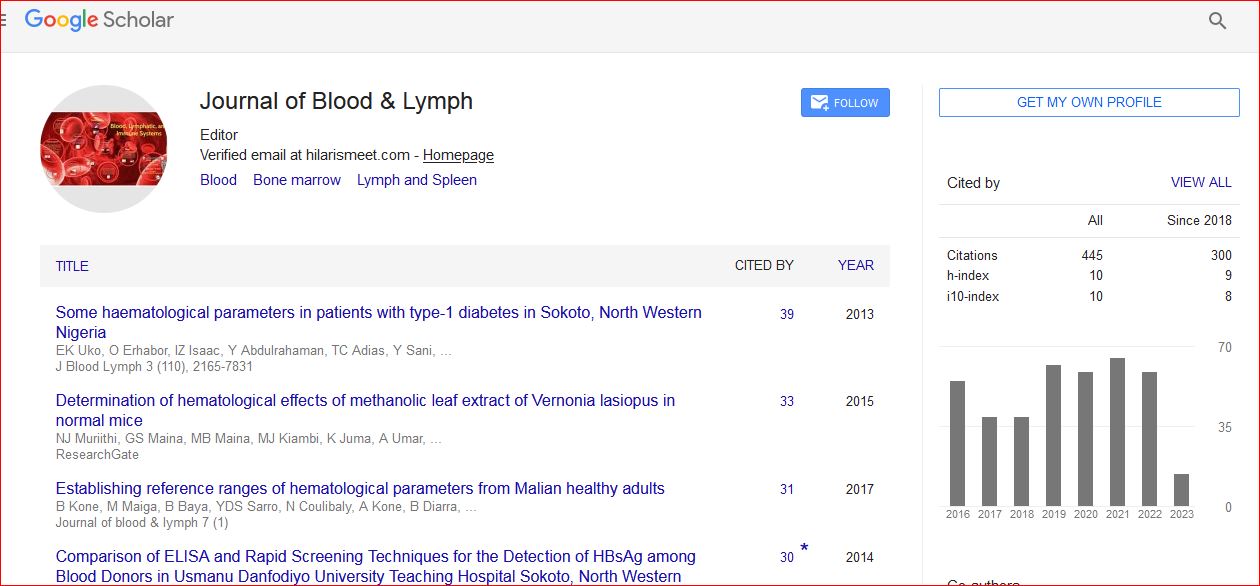
Journal of Blood & Lymph received 443 citations as per Google Scholar report
 Spanish
  Chinese
  Russian
  German
  French
  Japanese
  Portuguese
  Hindi
Hindi 