Commentary - (2025) Volume 15, Issue 3
Received: 09-Sep-2025, Manuscript No. JBL-25-171126 ;
Editor assigned: 11-Sep-2025, Pre QC No. JBL-25-171126 (PQ);
Reviewed: 24-Sep-2025, QC No. JBL-25-171126 ;
Revised: 30-Sep-2025, Manuscript No. JBL-25-171126 (R);
Published:
10-Oct-2025
, DOI: 10.37421/2165-7831.2025.15.338
Citation: Hua Jiang and Sophie Paczesny. "Unveiling ST2 as a Novel Immune Checkpoint in AML ". J Blood Lymph (15):(3) (2025) :338
Copyright: © 2025 Jiang H, et al. This is an open-access article distributed under the terms of the creative commons attribution license which permits unrestricted use,
distribution and reproduction in any medium, provided the original author and source are credited.
While anti-PD1/PDL1 immune checkpoint blockade has shown promising clinical success in solid tumors [1,2] its effectiveness in Acute Myeloid Leukemia (AML) remains limited, AML is considered an immunologically 'cold' tumor [3] despite evidence of CD8+ T cell exhaustion in patients. Although advances in targeted therapies and supportive care have improved survival outcomes in AML, the pace of therapeutic immune innovation in AML has notably lagged behind that observed in acute B-cell and T-cell leukemias, lymphomas and multiple myeloma over the past three decades [4,5].
While anti-PD1/PDL1 immune checkpoint blockade has shown promising clinical success in solid tumors [1,2] its effectiveness in Acute Myeloid Leukemia (AML) remains limited, AML is considered an immunologically 'cold' tumor [3] despite evidence of CD8+ T cell exhaustion in patients. Although advances in targeted therapies and supportive care have improved survival outcomes in AML, the pace of therapeutic immune innovation in AML has notably lagged behind that observed in acute B-cell and T-cell leukemias, lymphomas and multiple myeloma over the past three decades [4,5]. A potential immune checkpoint could emerge within CD4+ regulatory T (Treg) cells, which play a pivotal role in shaping the Tumor Microenvironment (TME). While Treg cells represent a promising source of novel immune checkpoint targets, the specific checkpoints driving immune evasion within leukemic Bone Marrow (BM) niches remain largely undefined [6]. Jiang et al, identified the alarmin IL-33 and its receptor STimulation-2 (ST2) pathway as a potent novel immune checkpoint in AML through bulk and single-cell RNA sequencing of bone marrow samples from healthy donors, chemotherapy-responsive and nonresponsive patients at diagnosis and post-induction and immunocompetent mouse models [7].
In this study, the researchers uncovered a distinct subset of ST2+ Treg cells that becomes progressively enriched within the leukemic bone marrow niche as AML advances especially in cases of refractory disease. Unlike other Treg populations, ST2+ Treg cells localize specifically to leukemic niches rather than circulating systemically. Marked by expression of KLRG1 and other activation markers, these cells are highly functional and potently suppress conventional T cells, most notably CD8+ T cells. Strikingly, ST2+ Treg cells also produce high levels (~40%) of cytolytic molecules such as Granzyme B (GZMB) and perforin, reinforcing their tumor-suppressive capabilities previously attributed to the broader Treg population. The frequency of ST2+ Treg cells strongly correlates with T cell exhaustion in both mice and humans [8]. Mechanistically, AMLactivated ST2+ Treg cells directly kill infiltrating, exhausted CD8+ and CD4+ Foxp3- conventional T cells previously primed by leukemia through GZMB-mediated cytotoxicity further amplified by IL-33 and completely abrogated by the selective GZMB inhibitor Z-AADCMK. Remarkably, the cytotoxic activity of ST2+ Treg cells is highly selective targeting only tumor-experienced CD8 T cells while sparing their naive counterparts. This specificity suggests an antigendependent mechanism in which Treg cells precisely eliminate the subset of T cells that have been primed to recognize and attack leukemic cells. Such targeted immunosuppression not only undermines anti-leukemic immunity but also marks a significant shift in our understanding of Treg function in AML. Rather than acting as broad, nonspecific suppressors, these Treg cells function as precision immune silencers strategically dismantling the most effective components of the anti-tumor response. Additional mechanistic insights revealed that ST2+ Treg cells precursors are actively recruited from the lymph nodes to leukemia-associated niches through chemokine-mediated signaling. Upon entering these specialized microenvironments, ST2+ Treg cells exhibit a distinct transcriptional profile characterized by low expression of T-bet and Bcl-6 transcription factors, typically associated with effector functions and immune restraint, alongside a marked upregulation of Blimp [1]. This unique expression pattern suggests that IL-33/ST2+ signaling plays a pivotal role in reprogramming Treg cells within the leukemia niche, actively suppressing regulatory pathways that would normally limit their cytotoxic potential.
Conditional deletion of ST2+ specifically in Treg cells, using Foxp3CreST2fl/fl mice, led to a marked reduction in leukemia burden and significantly prolonged survival in AML-bearing mice. This targeted knockout also reprogrammed the TME, resulting in a reinvigorated population of CD8+ T cells. These CD8+ T cells exhibited enhanced proliferation, including expansion of antigenspecific clones targeting Wilms’ Tumor 1 (WT1), elevated production of key effector cytokines such as IFN-γ and TNF-α and a phenotypic shift toward a memory-like state suggesting improved anti-tumor immunity and long-term immune surveillance.
Building on the promising potential of ST2+ as a novel immune checkpoint in AML, the authors developed Fc-silenced neutralizing antibodies targeting both murine and human ST2. The Fcsilencing strategy was employed to prevent non-specific Fc receptor engagement, thereby enhancing T-cell trafficking, and maximizing antitumor efficacy. These engineered antibodies selectively induced apoptosis in ST2+ Treg cells, effectively eliminating them from leukemic BM niches [9]. This falloff facilitated the restoration of functional CD8+ T cell responses, marked by enhanced cytotoxic activity and immune reconstitution. Therapeutically, ST2 blockade significantly prolonged survival in both aggressive immunocompetent and humanized AML models. The antibodies demonstrated potent efficacy as monotherapy and synergized with anti-PD-1 therapy to produce even greater therapeutic benefit positioning ST2 targeting as a compelling candidate for combination immunotherapy. Crucially, treatment was well tolerated and did not trigger gastrointestinal toxicity, a common drawback of systemic Treg depletion, underscoring the advantage of selectively targeting a tissue-adapted Treg subset within the TME.
While the findings of this study are compelling, several important questions remain and warrant future investigation. A key limitation lies in the unclear mechanism by which ST2+ Treg cells identify and suppress CD8+ T cell targets. Whether this interaction is mediated through TCR recognition of shared antigens, co-stimulatory/coinhibitory surface molecules, or alternative pathways remains to be elucidated and could uncover new immune regulatory checkpoints. Another unresolved aspect involves the metabolic landscape of infiltrating, exhausted CD8+ T cells particularly those rendered susceptible to ST2+ Treg cells killing but capable of reprogramming into functional, antigen-specific effectors remains poorly understood. Defining the metabolic dependencies and vulnerabilities of this subset could open new avenues for therapies aimed at restoring anti-tumor immunity. Moreover, the potential roles of non-Treg ST2-expressing cells within the TME such as the myeloid-derived suppressive cells, stromal populations, and other niche-supporting elements or the malignant cells themselves also warrant further investigation, as these cells may significantly influence disease progression, immune evasion, or therapeutic response. myeloid or stromal populations should not be overlooked, as they may contribute to disease progression or therapeutic responses. This is particularly relevant given recent evidence demonstrating that leukemia stem cells also exploit ST2 signaling in the same AML models, highlighting a broader, multifaceted role for this pathway beyond immunoregulation by Treg cells [10,11]. Ultimately, translating these preclinical insights into clinical benefit will depend on rigorous testing in human trials, which will serve as the definitive benchmark for the therapeutic promise of targeting ST2 in AML.
In conclusion, this study uncovers a critical immunosuppressive axis centered on the IL-33/ST2 pathway within a specialized subset of Treg cells that plays a key role in undermining anti-leukemic immunity in both retrovirally and epigenetically induced AML models. By pinpointing this pathway as a driver of immune evasion, the work not only advances our understanding of AML pathogenesis but also lays the groundwork for a novel therapeutic strategy. The development of a targeted, ST2-neutralizing antibody provides a compelling and precise approach to dismantle this barrier, reinvigorate cytotoxic T cell responses, and potentially transform the landscape of AML treatment. These findings open the door to harnessing immunotherapy in a disease long considered resistant to such interventions, marking a promising step toward more effective and durable clinical outcomes.
[Crossref] [Google Scholar] [Pubmed]
[Crossref] [Google Scholar] [Pubmed]
[Crossref] [Google Scholar] [Pubmed]
[Crossref] [Google Scholar] [Pubmed]
[Crossref] [Google Scholar] [Pubmed]
[Crossref] [Google Scholar] [Pubmed]
[Crossref] [Google Scholar] [Pubmed]
[Crossref] [Google Scholar] [Pubmed]
[Crossref] [Google Scholar] [Pubmed]
[Crossref] [Google Scholar] [Pubmed]
[Crossref] [Google Scholar] [Pubmed]
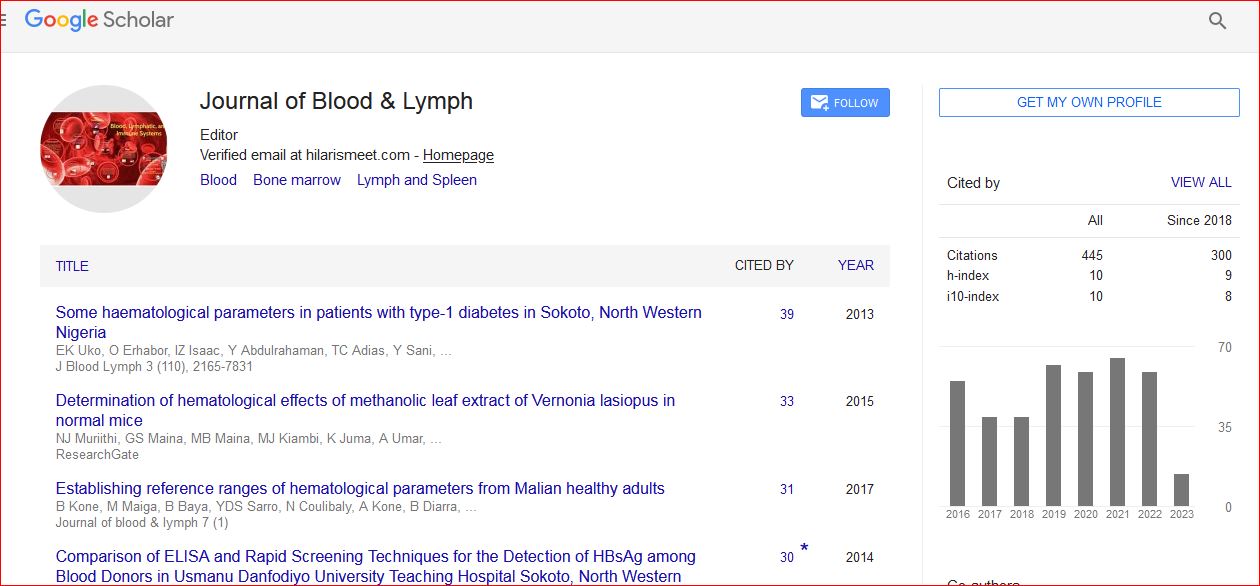
Journal of Blood & Lymph received 443 citations as per Google Scholar report