Mini Review - (2025) Volume 15, Issue 3
Received: 26-Mar-2025, Manuscript No. JBL-25- 164011 ;
Editor assigned: 28-Mar-2025, Pre QC No. .JBL-25- 164011 (PQ);
Reviewed: 10-Apr-2025, QC No. JBL-25- 164011 (R);;
Revised: 16-Apr-2025, Manuscript No. JBL-25- 164011 (R);
Published:
25-Apr-2025
, DOI: 10.37421/2165-7831.2025.15.340
Citation: Park, Shin Young, Ki Yun Kim, Young-Seuk Bae and Do Youn Jun, et al. ''The Potential of 3,6-Anhydro-L-Galactose (L-AHG) as a Novel Immunosuppressant" J Blood Lymph 15(2025):340.
Copyright: © 2025 Park SY, et al. This is an open-access article distributed under the terms of the creative commons attribution license which permits unrestricted use,
distribution and reproduction in any medium, provided the original author and source are credited.
3,6-Anhydro-L-Galactose (L-AHG), a bioactive carbohydrate derived from agarose extracted from red algae, is produced via a two- step enzymatic hydrolysis process, yielding high purity. It effectively inhibits the proliferation of activated T and B lymphocytes, key players in adaptive immunity, by suppressing the Janus Kinase-Signal Transducer and Activator of Transcription (JAK-STAT) signaling pathway and blocking the G1-S traverse in the cell cycle. This dual mechanism reduces adaptive immune responses, positioning L- AHG as a next-generation immunosuppressant. Its targeted approach promises greater safety and efficacy compared to traditional therapies, with potential applications in autoimmune disease treatment, transplant rejection prevention and managing hyperactive immune responses. This review presents detailed insights into the production process, mechanisms of action and therapeutic possibilities of L-AHG, highlighting its capacity to address many of the shortcomings of current immunosuppressive drugs.
3,6-Anhydro-L-galactose • Immunosuppressant • Disruption of JAK-STAT pathway • Retardation of G1-S progression • Inhibition of lymphocyte proliferation
Immunosuppressive therapies are crucial for managing immunemediated conditions like autoimmune diseases, allergies and organ transplantation. These treatments aim to control overactive or harmful immune responses, preventing tissue damage and transplant rejection [1]. However, traditional immunosuppressants (e.g., corticosteroids, antimetabolites) often cause broad immune suppression, increasing the risk of infections, cancers and other serious side effects [2,3]. While targeted therapies (e.g., small molecule inhibitors like calcineurin, mTOR and JAK inhibitors and biologics like fusion proteins and antibodies) have advanced treatment, there's still a need for safer, more precise options with fewer off-target effects [4,5].
In this context, 3,6-Anhydro-L-Galactose (L-AHG) has garnered interest as a novel immunosuppressive compound [6]. Derived from agarose, L-AHG is an innovative bioactive sugar that has been shown to inhibit the proliferation of activated T and B lymphocytes [6]. Unlike traditional immunosuppressants, which often act broadly, LAHG seems to act selectively, targeting activated immune cells while sparing quiescent ones. This distinctive mechanism, coupled with its interference in pivotal pathways such as the JAK-STAT signaling cascade and Cyclin-Dependent Kinase (CDK) activity, underscores its therapeutic potential in the management of immune-mediated disorders.
L-AHG is produced through an enzymatic hydrolysis process, which ensures high purity and scalability for potential clinical applications. This review explores the immunosuppressive properties of L-AHG, its mechanisms of action, production and potential therapeutic applications, emphasizing its promise as a novel and safer alternative to conventional immunosuppressive therapies. The targeted nature of L-AHG could open up new possibilities for precision immunomodulation with improved safety profiles.
Production of L-AHG
L-AHG is produced from agarose through a two-step enzymatic hydrolysis process optimized for industrial scalability [6]. The process involves liquefaction and saccharification (Figure 1).
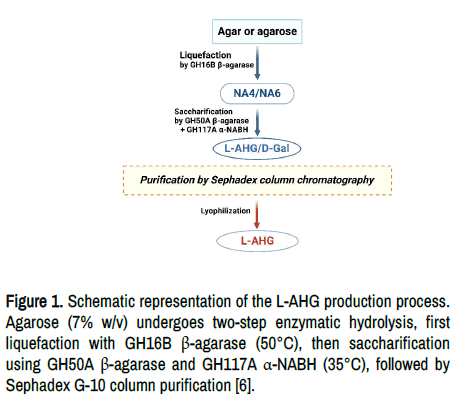
Figure 1. Schematic representation of the L-AHG production process. Agarose (7% w/v) undergoes two-step enzymatic hydrolysis, first liquefaction with GH16B β-agarase (50°C), then saccharification using GH50A β-agarase and GH117A α-NABH (35°C), followed by Sephadex G-10 column purification [6].
Liquefaction: Agarose is broken down into oligosaccharides, Neoagarotetraose (NA4) and Neoagarohexaose (NA6) using a recombinant thermostable β-agarase enzyme (GH16B) [7].
Saccharification: These oligosaccharides are further hydrolyzed into L-AHG and D-galactose by two key enzymes: GH50A β-agarase and GH117A α-neoagarobiose hydrolase (GH117A α-NABH) [8,9]. This step produces high-purity L-AHG, which is further purified via Sephadex gel filtration to exceed 98% purity, a standard crucial for medical applications. This advanced enzymatic process uses thermostable and mesostable enzymes to improve efficiency, precision and reliability, making it cost-effective and suitable for large-scale pharmaceutical production. The resulting high-quality LAHG is now a promising candidate for clinical and drug development.
Immunosuppressive mechanisms of action
L-AHG has shown strong immunosuppressive activity by targeting key processes that regulate immune cell function. Its mechanisms of action involve the inhibition of lymphocyte proliferation and blockade of the JAK-STAT signaling pathway [6] (Figure 2). These activities collectively contribute to its role as an effective negative immune modulator.
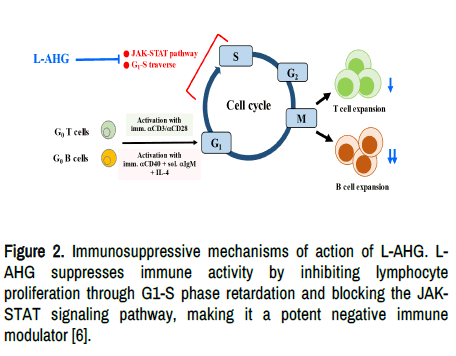
Figure 2. Immunosuppressive mechanisms of action of L-AHG. LAHG suppresses immune activity by inhibiting lymphocyte proliferation through G1-S phase retardation and blocking the JAKSTAT signaling pathway, making it a potent negative immune modulator [6].
Inhibition of lymphocyte proliferation: Activated T and B lymphocytes are critical players in the immune response, expanding rapidly to better combat the infection [10]. However, their uncontrolled proliferation can lead to autoimmunity, chronic inflammatory conditions, or transplant rejection. L-AHG directly prevents the proliferation of these immune cells by interfering with the cell cycle. Specifically, it blocks the traverse from the G1 to the S phase, resulting in retardation of DNA synthesis and cell division. At the molecular level, the L-AHG-induced retardation of G1–S progression of activated T and B cells was associated with impairment of CDKs-driven phosphorylation of Rb, resulting from L-AHG-induced suppression of the activating phosphorylation of CDKs (CDK4, CDK2, and CDK1) and down-regulation of the levels of cyclin D3, cyclin A2, and cyclin B1.
Disruption of the JAK-STAT pathway: L-AHG also interferes with the JAK-STAT signaling pathway, which is integral to immune cell activation and survival [11,12]. By inhibiting the phosphorylation of JAK1, L-AHG blocks activation signals that would otherwise lead to the transcription of critical immune-related genes by STAT1 and STAT3, which is a prerequisite for G1–S phase progression. This disruption prevents activated T and B cells from sustaining their activation and proliferation. L-AHG’s specificity for this pathway distinguishes it from existing immunosuppressants, which often affect broader cellular pathways and have greater potential for unwanted side effects.
Comparative advantages of L-AHG
Traditional immunosuppressive drugs are known for their broadspectrum activity, leading to undesirable side effects including increased infection risk and organ damage. L-AHG, however, provides several key advantages over these conventional agents:
Target specificity: L-AHG specifically targets activated T and B lymphocytes, with a more pronounced effect on B cells. Importantly, it does not exhibit antiproliferative or apoptotic effects on various cell lines, including Jurkat A3 (human leukemia T cells), EL4 (mouse Tcell lymphoma), L-929 (mouse fibroblast-like cells), or Vero (African green monkey kidney cells) [6].
Low cytotoxicity: L-AHG does not hinder the G0/G1 phase transition in activated T and B cells, unlike conventional immunosuppressants. This is evidenced by L-AHG's lack of effect on early activation markers (e.g., CD69 and CD25), and on the downregulation of p27Kip1. Moreover, gut bacteria, prevalent in East Asian populations with high seaweed consumption, can metabolize agar into L-AHG [13]. This suggests dietary agar is broken down into neoagaro-oligosaccharides and L-AHG by gut microbes. While these breakdown products may significantly affect the gut environment and offer various reported health benefits, no toxicity from them has been observed.
Broad immunomodulatory potential: By inhibiting both T and B cells, L-AHG shows promise as a versatile therapeutic agent for conditions driven by overactive immune responses. These include autoimmune diseases, transplant rejection, allergies, and cytokine release syndrome.
Superior oral bioavailability: Unlike current immunosuppressants (cyclosporin A, tacrolimus, sirolimus, and tofacitinib) which are waterinsoluble, L-AHG's high water solubility will enable better oral administration and gastrointestinal absorption, potentially improving treatment efficacy.
Therapeutic potential and applications
The unique mechanisms and safety profile of L-AHG establish it as a promising agent for a variety of immune-related conditions. Its selective and potent action could overcome many of the drawbacks (an increased susceptibility to infectious diseases, elevated cardiovascular risk, and potential damage to the kidneys and livers), associated with traditional immunosuppressive therapies.
Treatment of autoimmune diseases: Autoimmune diseases, such as rheumatoid arthritis, lupus, and multiple sclerosis, involve overactive immune responses against the body's own tissues [14]. LAHG’s ability to modulate immune activation by targeting proliferative and cytokine pathways makes it an ideal candidate for managing these disorders. Its action on JAK-STAT, in particular, could allow for precise control of inflammation and disease progression while minimizing the broad immunosuppressive effects seen with existing therapies.
Organ transplantation: One of the primary clinical applications of L-AHG lies in organ transplantation, where preventing rejection is crucial. L-AHG, with its ability to target activated lymphocytes specifically, has the potential to reduce the risk of organ rejection while maintaining the body’s general immune competency, offering a safer alternative for transplant recipients.
Inflammatory and allergic disorders: Excessive immune activation can also lead to allergic and inflammatory conditions [15]. Current treatments for such conditions, including corticosteroids, often have severe side effects due to their lack of specificity. L-AHG presents a more targeted option, with the potential to suppress inflammation and reduce immune cell proliferation without causing widespread immunosuppression.
Advances and future directions
The production of L-AHG through enzymatic hydrolysis represents a significant biotechnological advancement, providing a reliable supply for clinical testing. However, several aspects demand further exploration.
Preclinical and clinical testing: While in vitro studies confirm its efficacy, the immunosuppressive potential of L-AHG needs validation in vivo to assess safety and immunological impact in complex biological systems.
Formulation and delivery: Developing optimal delivery mechanisms, such as encapsulated formulations, could enhance bioavailability and therapeutic outcomes.
Combination therapies: Investigating synergies between L-AHG and existing immunosuppressants, such as calcineurin inhibitors, could provide an improved treatment regimen.
L-AHG is a promising new immunosuppressant derived from red algae agarose. It works by selectively targeting key immune pathways, specifically inhibiting the JAK-STAT signaling cascade and G1-S cell cycle progression in T and B lymphocytes. This targeted approach suggests L-AHG may be safer and more effective than traditional immunosuppressants. Potential applications include organ transplantation, autoimmune diseases and inflammatory conditions. Further research is needed to confirm L-AHG's clinical safety, longterm effects and optimal use. However, L-AHG holds the potential to significantly improve the treatment of immune-related diseases.
This research was supported by the Ministry of SMEs and Startups (MSS) through the Technology Development Program (Dideumdol) (Grant No. [RS-2024-00467369].
[Crossref] [Google Scholar] [Pubmed]
[Crossref] [Google Scholar] [Pubmed]
[Google Scholar] [Pubmed]
[Crossref] [Google Scholar] [Pubmed]
[Crossref] [Google Scholar] [Pubmed]
[Crossref] [Google Scholar] [Pubmed]
[Crossref] [Google Scholar] [Pubmed]
[Crossref] [Google Scholar] [Pubmed]
[Crossref] [Google Scholar] [Pubmed]
[Crossref] [Google Scholar] [Pubmed]
[Crossref] [Google Scholar] [Pubmed]
[Crossref] [Google Scholar] [Pubmed]
[Crossref] [Google Scholar] [Pubmed]
Journal of Blood & Lymph received 443 citations as per Google Scholar report