Brief Report - (2025) Volume 14, Issue 4
Received: 02-Jul-2025, Manuscript No. jamk-25-177293;
Editor assigned: 04-Jul-2025, Pre QC No. P-177293;
Reviewed: 18-Jul-2025, QC No. Q-177293;
Revised: 23-Jul-2025, Manuscript No. R-177293;
Published:
30-Jul-2025
, DOI: 10.37421/2168-9601.2025.14.565
Citation: Dubois, Pierre. ”The Multifaceted Nature of Cash Flow Management.” J Account Mark 14 (2025):565.
Copyright: © 2025 Dubois P. This is an open-access article distributed under the terms of the Creative Commons Attribution License, which permits unrestricted use, distribution and reproduction in any medium, provided the original author and source are credited.
Research indicates that the quality of a company's cash flow significantly influences its overall valuation, particularly within developing economic contexts. Specifically, enhanced cash flow quality demonstrably increases a firm's intrinsic worth, underscoring that investors prioritize the reliability and consistency of cash generation as a critical metric for financial health and future viability [1].
This study examines the intricate relationship between working capital management practices and corporate cash flow performance, especially within dynamic emerging economies. The findings highlight that strategic approaches to working capital, such as optimized inventory control and efficient receivables management, are fundamental for cultivating robust and predictable cash flows, thereby underpinning a company's financial stability and growth trajectory in these challenging environments [2].
An investigation into forecasting future cash flows reveals that integrating qualitative textual data from management reports can substantially enhance predictive accuracy, moving beyond purely quantitative financial metrics. This implies that narrative information, encompassing strategic discussions and market condition analyses, provides a more holistic perspective, leading to superior cash flow projections compared to reliance solely on numerical figures [3].
This paper explores the association between accounting conservatism and the level of cash reserves maintained by corporations. It suggests that entities adopting more conservative accounting principles typically retain larger cash balances. This tendency arises because conservatism often results in a deliberate understatement of assets and overstatement of liabilities, which can create a perception of heightened risk or diminished prospective earnings, consequently encouraging a precautionary accumulation of cash [4].
Focusing on the Chinese market, this research analyzes how real earnings management, operational decisions intended to manipulate financial reporting, affects a firm's subsequent cash flow performance. The central argument is that while real earnings management might artificially smooth reported profits in the short term, it frequently compromises a company's long-term operating cash flows, revealing a fundamental trade-off between superficial earnings adjustments and sustainable financial health [5].
Investigating the influence of audit quality on the comprehensibility of cash flow statements, particularly in China, this article concludes that superior audit quality significantly improves statement readability. Enhanced auditing practices lead to reduced complexity and increased transparency, reinforcing the critical role of robust oversight in making financial reports more accessible and valuable for investors and other stakeholders [6].
This study investigates the impact of corporate governance structures on the effectiveness of cash flow management within South African enterprises. The primary finding indicates that robust governance mechanisms, such as independent board oversight and active audit committees, correlate with more efficient cash flow handling. This suggests that effective governance optimizes cash utilization, ensuring adequate liquidity and supporting strategic investments [7].
This paper examines the implications of adopting International Financial Reporting Standards (IFRS) on both the predictability and investment relevance of cash flow information. The evidence suggests that transitioning to IFRS can significantly improve the accuracy of future cash flow forecasts and concurrently enhance the perceived value of cash flow data among market participants, thereby promoting greater financial transparency and more informed decision-making [8].
Research into the nexus between accounting information quality and a firm's investment decisions, particularly their sensitivity to available cash flow, reveals an important dynamic. When accounting information is of higher quality, investment decisions become less constrained by immediate cash availability. This implies that superior information empowers companies to pursue more strategic, long-term investments, rather than being dictated by short-term liquidity concerns [9].
This article investigates the relationship between a company's commitment to corporate social responsibility (CSR) initiatives and its cash flow performance within an emerging market context. The findings suggest that active engagement in CSR activities positively impacts a firm's cash flow, demonstrating that ethical and sustainable practices can yield tangible financial advantages, such as enhanced customer loyalty and operational efficiencies, thereby bolstering cash generation [10].
An analysis of emerging markets demonstrates that the caliber of a companyâ??s cash flow significantly contributes to its overall enterprise value. Specifically, superior cash flow quality is directly associated with an increase in firm worth, highlighting that investors critically assess the stability and dependability of a companyâ??s cash generating capabilities as a fundamental indicator of its financial resilience and future growth prospects [1]. This study investigates the critical influence of working capital strategies on corporate cash flow outcomes, particularly within the unique economic landscapes of developing nations. It underscores that optimized working capital practices, including diligent management of inventory and accounts receivable, are indispensable for cultivating stronger, more predictable cash flows, which are vital for fostering corporate financial stability and facilitating sustained expansion in dynamic markets [2]. This research explores advanced methodologies for enhancing the precision of future cash flow predictions by integrating qualitative data from management reports alongside traditional financial figures. The core finding is that non-numerical information, such as strategic insights and contextual market analyses, substantially improves the accuracy of cash flow forecasts, thereby providing a more comprehensive and nuanced financial outlook than quantitative data alone [3]. The relationship between a companyâ??s adoption of accounting conservatism and its strategic decisions regarding cash reserves is examined in this paper. It concludes that firms employing more conservative accounting practices tend to maintain higher levels of cash. This behavior is attributed to the inherent tendency of conservative accounting to potentially understate assets and overstate liabilities, which can lead management to hold greater cash balances as a precautionary measure against perceived financial uncertainties [4]. This investigation, centered on Chinese firms, assesses how real earnings management, operational maneuvers designed to influence reported earnings, ultimately impacts future cash flow generation. The key revelation is that while these management tactics might achieve short-term earnings smoothing, they often come at the expense of long-term operating cash flows, signifying a detrimental trade-off between immediate accounting appearances and enduring financial health [5]. Focusing on the Chinese context, this article assesses the role of audit quality in enhancing the clarity and comprehensibility of cash flow statements. The research establishes that higher audit quality is instrumental in making these financial statements more readable, effectively reducing their inherent complexity and promoting greater transparency. This highlights the indispensable contribution of robust auditing to the utility and interpretability of financial disclosures for all stakeholders [6]. An examination into South African businesses reveals the significant role of corporate governance structures in optimizing the efficiency of cash flow management. The study demonstrates that strong governance mechanisms, exemplified by independent boards and effective audit committees, directly lead to more judicious and efficient handling of cash resources. This correlation underscores how sound oversight fosters optimal cash utilization, supporting both liquidity requirements and strategic investment initiatives [7]. This study investigates the consequences of International Financial Reporting Standards (IFRS) adoption on two key dimensions: the predictability of cash flows and their relevance to investor valuation. The findings indicate that the transition to IFRS positively influences the accuracy with which future cash flows can be forecasted and concurrently augments the perceived value of cash flow information for market participants, thereby fostering improved financial insight and decision-making capabilities [8]. This research delves into how the quality of accounting information influences the responsiveness of corporate investment decisions to fluctuations in available cash flow. It concludes that when accounting information is of superior quality, firmsâ?? investment choices become less tethered to their immediate liquidity status. This implies that enhanced informational quality empowers companies to make more deliberate, long-term strategic investments, freeing them from the constraints of current cash availability [9]. The nexus between a company's engagement in corporate social responsibility (CSR) activities and its subsequent cash flow performance is explored within the context of an emerging market. The study reveals a positive correlation, suggesting that commitment to CSR initiatives can tangibly bolster a firm's cash flow. This indicates that ethical and sustainable business practices not only cultivate goodwill but also translate into concrete financial advantages, such as enhanced market reputation and operational efficiencies [10].
This collection of research underscores the multifaceted nature of cash flow in modern finance, particularly within emerging markets. Studies highlight that the quality of cash flow directly impacts firm value, with investors prioritizing stable and reliable cash generation. Effective working capital management is identified as crucial for predictable cash flows, supporting stability and growth. Beyond quantitative data, incorporating textual information from management reports significantly enhances cash flow forecast accuracy. Accounting conservatism influences cash holdings, often leading to increased reserves due to perceived risk. Furthermore, real earnings management, while potentially smoothing short-term earnings, can detrimentally affect future operating cash flows. The readability of cash flow statements is improved by high audit quality, while robust corporate governance structures foster efficient cash flow management. The adoption of IFRS boosts both cash flow predictability and its relevance to valuation. Finally, high-quality accounting information reduces the sensitivity of investment decisions to immediate cash availability, and corporate social responsibility initiatives are shown to positively influence cash flow performance. Together, these studies emphasize the critical role of transparent, well-managed, and strategically considered cash flow practices for corporate success and investor confidence.
None
None
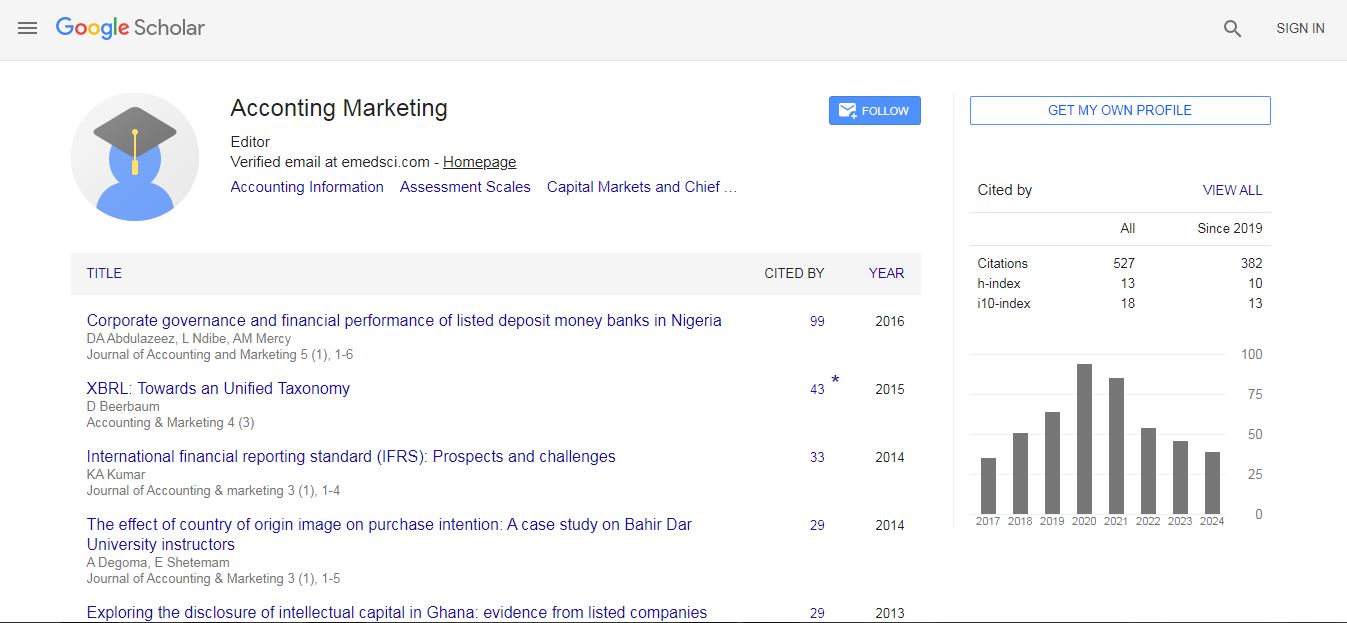
Accounting & Marketing received 487 citations as per Google Scholar report