Short Communication - (2025) Volume 14, Issue 3
Received: 01-May-2025, Manuscript No. jamk-25-177285;
Editor assigned: 03-May-2025, Pre QC No. P-177285;
Reviewed: 17-May-2025, QC No. Q-177285;
Revised: 24-May-2025, Manuscript No. R-177285;
Published:
31-May-2025
, DOI: 10.37421/2168-9601.2025.14.560
Citation: Chatterjee, Amit. ”Technology Reshaping Accounting and Auditing.” J Account Mark 14 (2025):560.
Copyright: © 2025 Chatterjee A. This is an open-access article distributed under the terms of the Creative Commons Attribution License, which permits unrestricted use, distribution and reproduction in any medium, provided the original author and source are credited.
The role of Artificial Intelligence in accounting and auditing has become a significant area of academic inquiry, demonstrating its potential to transform operational paradigms. Research systematically reviews existing literature to identify key trends and uncover prevailing research gaps within this evolving domain. AI applications are shown to streamline various processes, substantially enhance fraud detection mechanisms, and improve the overall quality of decision making. However, the adoption of AI also introduces considerable challenges, particularly concerning data privacy and the ethical implications that accounting professionals must navigate [1].
Blockchain technology represents a pivotal innovation with profound implications for accounting information systems. This technology fundamentally alters how financial transactions are recorded, verified, and subsequently audited, primarily by offering enhanced transparency, immutability, and security. The inherent features of blockchain significantly contribute to greater data integrity and foster improved operational efficiency across financial operations, marking a paradigm shift in how trust and reliability are established in digital records [2].
Cloud computing has emerged as a transformative force within the accounting profession, necessitating a systematic review of its widespread impact. The adoption of cloud based solutions significantly enhances data accessibility, provides superior scalability for accounting systems, and contributes to notable cost efficiencies. Despite these advantages, the integration of cloud computing introduces critical concerns related to data security, privacy, and the imperative for accounting professionals to develop updated skills to effectively manage these new environments [3].
The synthesis of research on data analytics in accounting and finance reveals its extensive and transformative capabilities. This advanced methodology plays a crucial role in improving strategic decision making, enhancing the accuracy of risk assessments, and bolstering predictive capabilities within financial contexts. The embrace of data analytics signals a fundamental shift from traditional reactive accounting practices towards a more proactive, insight driven approach. Nevertheless, challenges pertaining to implementation and the continuous development of requisite skills persist [4].
Robotic Process Automation RPA has garnered significant attention for its application in accounting and auditing functions. Reviews clarify that RPA excels at automating repetitive, rule based tasks, which leads to substantial boosts in efficiency and accuracy. By offloading these routine operations, RPA effectively frees human accountants to concentrate on more complex, analytical work that requires higher cognitive skills. The literature also explores the practical challenges associated with RPA implementation and its broader future implications for the profession [5].
Research into green accounting emphasizes the pivotal role of technology in facilitating the precise measurement and transparent reporting of environmental performance. This domain leverages advanced systems to meticulously track resource consumption, monitor waste generation, and quantify emissions, thereby supporting the implementation of sustainable business practices. Ultimately, such technological integration fosters transparent environmental disclosures, enabling organizations to effectively communicate their ecological impact and sustainability efforts [6].
Enterprise Resource Planning ERP systems exert a significant influence on the quality of accounting information, a topic extensively examined through systematic reviews. The integration of ERP solutions plays a critical role in standardizing data formats, which in turn improves the reliability and timeliness of real time reporting. This enhanced data consistency and accessibility significantly improves decision making accuracy, fostering greater financial transparency and strengthening operational control across various organizational functions [7].
The identification and categorization of cybersecurity risks within accounting information systems are critical aspects of modern financial management. Reviews highlight vulnerabilities that arise directly from ongoing digital transformation efforts, underscoring the urgent need for robust security measures. Implementing stringent data protection protocols and maintaining continuous vigilance are essential to safeguard the integrity and confidentiality of sensitive financial data against evolving cyber threats [8].
The Internet of Things IoT presents a substantial influence on both accounting and auditing practices, as systematically reviewed in recent literature. IoT devices generate real time data streams that significantly enhance various operational areas, including inventory management and asset tracking. This constant influx of accurate, timely information also bolsters audit evidence, providing deeper financial insights. However, managing the immense volume of data and addressing inherent security complexities remain significant challenges [9].
The application of big data analytics in accounting is a rapidly expanding field, thoroughly investigated through systematic literature reviews. This approach empowers accountants to process and analyze vast datasets, enabling them to identify intricate patterns and generate more precise forecasts and risk assessments. Moving beyond conventional financial reporting, big data analytics facilitates deeper analytical insights, transforming how financial information is understood and utilized for strategic planning [10].
Artificial intelligence AI is fundamentally reshaping the landscape of accounting and auditing by automating routine tasks, enhancing analytical capabilities, and improving decision making processes. Systematic reviews of current literature reveal how AI algorithms are employed in areas such as predictive analytics for financial forecasting, advanced anomaly detection for fraud prevention, and automated reconciliation of complex data sets. Despite its transformative potential, the widespread adoption of AI introduces significant challenges related to ensuring data privacy, navigating complex ethical considerations, and preparing accounting professionals with the requisite skills to work alongside these advanced systems [1]. Blockchain technology provides a decentralized, immutable, and transparent ledger system that is poised to revolutionize accounting information systems. By recording transactions in a secure, verifiable, and permanent manner, blockchain significantly enhances the integrity and reliability of financial data, making it less susceptible to manipulation. This technology not only streamlines the verification and auditing processes but also offers unprecedented levels of transparency, allowing all authorized participants to access a consistent and up to date record of transactions. These attributes foster trust and reduce the need for intermediaries, thereby improving operational efficiency across financial operations [2]. Cloud computing has become an indispensable component for modern accounting practices, enabling organizations to store, access, and process financial data remotely and efficiently. Its impact is characterized by increased data accessibility from any location, enhanced scalability to accommodate growing data volumes, and considerable cost reductions through reduced infrastructure investment. Nevertheless, the migration to cloud based systems presents critical considerations, particularly concerning the robust security of sensitive financial data, adherence to privacy regulations, and the continuous need for accounting professionals to update their technological competencies to manage these dynamic environments effectively [3]. The application of data analytics in accounting and finance signifies a strategic shift toward evidence based decision making. This discipline involves collecting, processing, and analyzing large datasets to uncover trends, predict future outcomes, and identify potential risks. It empowers accountants to move beyond traditional historical reporting to provide forward looking insights that drive business strategy. The transformative role of data analytics is evident in improving financial reporting accuracy, optimizing resource allocation, and developing more sophisticated risk assessment models, though successful implementation requires significant investment in technology and human capital development [4]. Robotic Process Automation RPA is a key technological advancement for automating repetitive and rule based tasks within accounting and auditing departments. RPA bots can efficiently handle processes such as data entry, invoice processing, bank reconciliations, and report generation, significantly reducing manual errors and improving processing speed. This automation capability allows human accountants to reallocate their efforts to more strategic, value added activities that require critical thinking, judgment, and complex problem solving. While RPA offers substantial efficiency gains, organizations must address challenges related to process standardization and integration with existing systems during its deployment [5]. Green accounting focuses on incorporating environmental costs and benefits into financial reporting, and technology plays a crucial role in its implementation. Advanced accounting systems are vital for accurately measuring, monitoring, and reporting environmental performance indicators such as resource consumption, waste output, and carbon emissions. This technological integration enables organizations to track their ecological footprint more effectively, support sustainable business strategies, and provide transparent environmental disclosures to stakeholders. By quantifying environmental impacts, green accounting facilitates better corporate social responsibility and compliance with evolving environmental regulations [6]. Enterprise Resource Planning ERP systems are integrated software solutions that centralize an organizations various functions, including finance, human resources, and supply chain management. In accounting, ERP systems are instrumental in improving the quality of financial information by standardizing data inputs and processes across departments. This integration facilitates real time reporting, reduces data redundancy, and enhances the accuracy and reliability of financial statements. Consequently, ERP adoption leads to better informed decision making, increased financial transparency, and more robust operational control, ultimately fostering greater organizational efficiency and accountability [7]. Cybersecurity risks pose significant threats to the integrity and confidentiality of accounting information systems in an increasingly digitalized business environment. The interconnectedness of modern systems, while offering efficiency, also expands the attack surface for malicious actors. Reviews emphasize the critical importance of implementing comprehensive cybersecurity strategies, including robust data encryption, multi factor authentication, intrusion detection systems, and regular security audits. Continuous vigilance and adherence to stringent data protection protocols are essential to mitigate risks, safeguard sensitive financial data, and maintain stakeholder trust [8]. The Internet of Things IoT is transforming accounting and auditing by providing a continuous stream of real time operational data from connected devices. This influx of granular information offers unprecedented opportunities for enhanced inventory management, precise asset tracking, and more reliable audit evidence. For instance, IoT sensors can provide immediate data on inventory levels or asset locations, improving accuracy and reducing the need for manual checks. However, the sheer volume and velocity of IoT data, coupled with complex security considerations, necessitate robust data management and protection frameworks to harness its full potential effectively [9]. Big data analytics has become an invaluable tool for modern accounting, enabling professionals to derive deeper insights from massive, diverse datasets that extend beyond traditional financial figures. This analytical approach empowers accountants to identify complex patterns, detect anomalies, predict future financial trends with greater accuracy, and perform more comprehensive risk assessments. By leveraging advanced statistical techniques and machine learning algorithms, big data analytics transforms the role of the accountant from a historical reporter to a strategic advisor, facilitating more informed and proactive decision making across the enterprise [10].
Recent literature extensively explores the transformative impact of various technologies on the accounting and auditing professions. Artificial intelligence streamlines processes and enhances fraud detection, while blockchain technology revolutionizes financial record keeping through enhanced transparency and immutability. Cloud computing improves data accessibility and scalability, offering cost efficiencies but also raising security concerns. Data analytics and big data analytics empower accountants with predictive capabilities and deeper insights for risk assessment and decision making, shifting towards a proactive approach. Robotic Process Automation automates repetitive tasks, boosting efficiency and freeing human capital for more complex work. Green accounting leverages technology for environmental performance measurement, supporting sustainability. Enterprise Resource Planning systems integrate data for improved information quality and operational control. Finally, cybersecurity measures are critical for protecting financial data in an increasingly digital landscape, and the Internet of Things provides real time data for enhanced tracking and audit evidence, albeit with data volume and security complexities. Collectively, these technologies are reshaping accounting towards greater efficiency, accuracy, and strategic relevance.
None
None
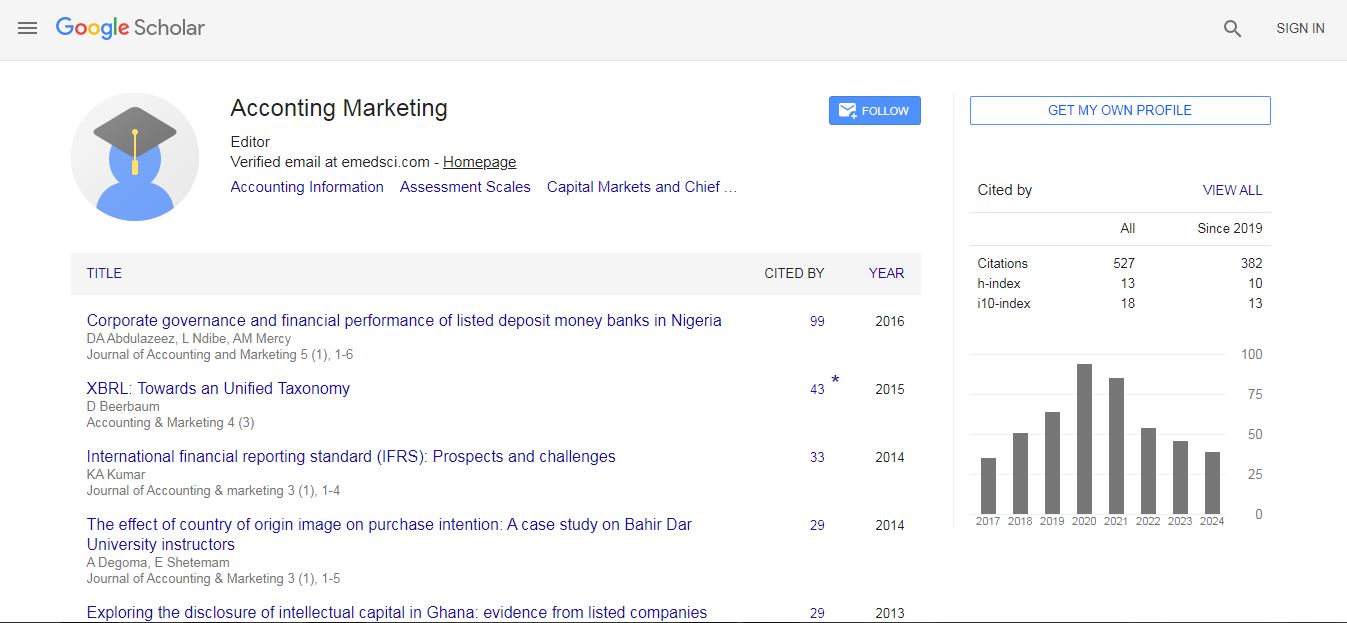
Accounting & Marketing received 487 citations as per Google Scholar report