Commentary - (2025) Volume 10, Issue 4
Received: 01-Aug-2025, Manuscript No. cgj-26-186530;
Editor assigned: 04-Aug-2025, Pre QC No. P-186530;
Reviewed: 18-Aug-2025, QC No. Q-186530;
Revised: 22-Aug-2025, Manuscript No. R-186530;
Published:
29-Aug-2025
, DOI: 10.37421/2952-8518.2025.10.325
Citation: Wright, Samuel J.. ”Pediatric Gastrointestinal and Liver Disorders: A Comprehensive Guide.” Clin Gastroenterol J 10 (2025):325.
Copyright: © 2025 Wright J. Samuel This is an open-access article distributed under the terms of the Creative Commons Attribution License, which permits unrestricted use, distribution and reproduction in any medium, provided the original author and source are credited.
This comprehensive overview explores the diverse landscape of gastrointestinal disorders impacting pediatric populations, presenting a foundational understanding of their clinical presentations and contemporary management approaches. The text aims to equip healthcare professionals with the knowledge necessary to accurately diagnose and effectively treat these conditions, thereby improving the quality of life for young patients. The initial focus is on functional abdominal pain, a common ailment characterized by recurrent discomfort without identifiable organic cause. Management strategies emphasize a holistic approach, integrating dietary modifications, pharmacotherapy, and psychosocial support to address the multifactorial nature of this condition [1].
Pediatric constipation is another significant concern, with articles differentiating between functional and organic etiologies. The management protocols highlight the importance of disimpaction, consistent bowel habit training, and the judicious use of osmotic laxatives, underscoring the need for comprehensive parental education to ensure sustained success [2].
Gastroesophageal reflux disease (GERD) in infants and children is thoroughly examined, distinguishing physiological reflux from its more pathological counterpart. Diagnostic tools and pharmacological interventions, including proton pump inhibitors, alongside lifestyle and dietary adjustments, are discussed, with attention given to managing potential complications [3].
Inflammatory bowel disease (IBD) in children, encompassing Crohn's disease and ulcerative colitis, is addressed through the lens of recent advancements. The article details updated diagnostic techniques, the pivotal role of immunomodulators and biologic therapies, and the necessity of a multidisciplinary team approach for optimal patient outcomes [4].
Celiac disease, an autoimmune disorder triggered by gluten ingestion, is explored from diagnosis through management. Current serological and genetic markers, endoscopic findings, and the cornerstone of a lifelong gluten-free diet are reviewed, along with strategies for monitoring potential long-term complications [5].
Eosinophilic esophagitis (EoE), a chronic immune-mediated esophageal disease, is presented with insights into its pathogenesis, clinical manifestations, and diagnostic criteria. Key management strategies, primarily focused on dietary elimination and topical corticosteroid therapy, are outlined, emphasizing endoscopic surveillance and patient education [6].
Acute diarrhea in children remains a prevalent issue, with a practical approach focusing on the critical importance of fluid and electrolyte repletion. The article also delves into the appropriate use of antimicrobial agents, probiotics, and the distinction between infectious and non-infectious causes, alongside nutritional support [7].
Malabsorption syndromes in pediatric patients are investigated, detailing diagnostic pathways for conditions such as cystic fibrosis, short bowel syndrome, and pancreatic insufficiency. Therapeutic interventions, including enzyme replacement, nutritional supplementation, and specialized dietary regimens, are discussed [8].
Finally, the evolving understanding and treatment of pediatric functional gastrointestinal disorders (FGIDs) are highlighted. This section moves beyond symptom-based management to emphasize the gut-brain axis and the influence of psychological factors, advocating for personalized treatment plans that integrate dietary and pharmacological interventions [9].
The initial article provides a broad overview of common gastrointestinal disorders in children, covering functional abdominal pain, constipation, GERD, and IBD. It stresses accurate diagnosis and tailored management, utilizing evidence-based treatments such as dietary changes, medication, and psychosocial support to enhance the well-being of pediatric patients [1].
Focusing on pediatric constipation, the subsequent text differentiates between functional and organic causes. It underscores the significance of disimpaction, regular bowel habit training, and the careful administration of osmotic laxatives. Parental education and managing expectations are identified as crucial for achieving long-term success in managing this condition [2].
The review on GERD in infants and children carefully distinguishes physiological reflux from pathological GERD. It elaborates on diagnostic methods, pharmacological treatments like proton pump inhibitors, and the impact of lifestyle and dietary modifications, while also addressing the management of associated complications [3].
Updates on pediatric inflammatory bowel disease, including Crohn's disease and ulcerative colitis, are presented. The article highlights progress in diagnostic techniques, the therapeutic roles of immunomodulators and biologics, and the importance of a multidisciplinary approach in managing IBD and ensuring optimal growth and development in affected children [4].
Celiac disease in children is examined from a diagnostic and management perspective. The article reviews current serological and genetic markers, endoscopic biopsy findings, and the critical necessity of a strict gluten-free diet, emphasizing long-term adherence and complication monitoring [5].
Eosinophilic esophagitis (EoE) in children is explored, detailing its pathogenesis, clinical presentation, and diagnostic criteria. Management strategies, predominantly dietary elimination and topical corticosteroids, are discussed, alongside the role of endoscopic surveillance and patient education in optimizing care [6].
The article on acute diarrhea in children emphasizes the paramount importance of fluid and electrolyte replacement. It also addresses the judicious use of antimicrobials and probiotics, the differentiation between infectious and non-infectious etiologies, and the provision of adequate nutritional support during and after diarrheal episodes [7].
Malabsorption syndromes in pediatric populations are discussed, outlining diagnostic approaches for conditions like cystic fibrosis and short bowel syndrome. Therapeutic strategies, including enzyme replacement therapy, nutritional supplementation, and specialized diets, are presented as key components of management [8].
The evolving treatment landscape for pediatric functional gastrointestinal disorders (FGIDs) is explored, shifting from a symptom-focused approach to one that acknowledges the gut-brain axis and psychological factors. The article advocates for personalized treatment plans integrating dietary adjustments and pharmacological interventions [9].
Lastly, pediatric liver diseases, including viral hepatitis, autoimmune hepatitis, and metabolic disorders, are reviewed. Diagnostic methods and management strategies, encompassing antiviral therapy, immunosuppression, nutritional support, and the potential role of liver transplantation, are covered [10].
This collection of articles offers a comprehensive overview of pediatric gastrointestinal disorders. It covers functional abdominal pain, constipation, gastroesophageal reflux disease (GERD), inflammatory bowel disease (IBD), celiac disease, eosinophilic esophagitis (EoE), acute diarrhea, and malabsorption syndromes. Key management strategies discussed include dietary modifications, pharmacotherapy, psychosocial support, bowel habit training, and the use of specialized treatments like immunomodulators and biologics for IBD. The importance of accurate diagnosis, a multidisciplinary approach, and patient/parent education is emphasized throughout. Additionally, pediatric liver diseases are reviewed, outlining diagnostic and management approaches. The content highlights advancements in treatment and the evolving understanding of these conditions in children.
None
None
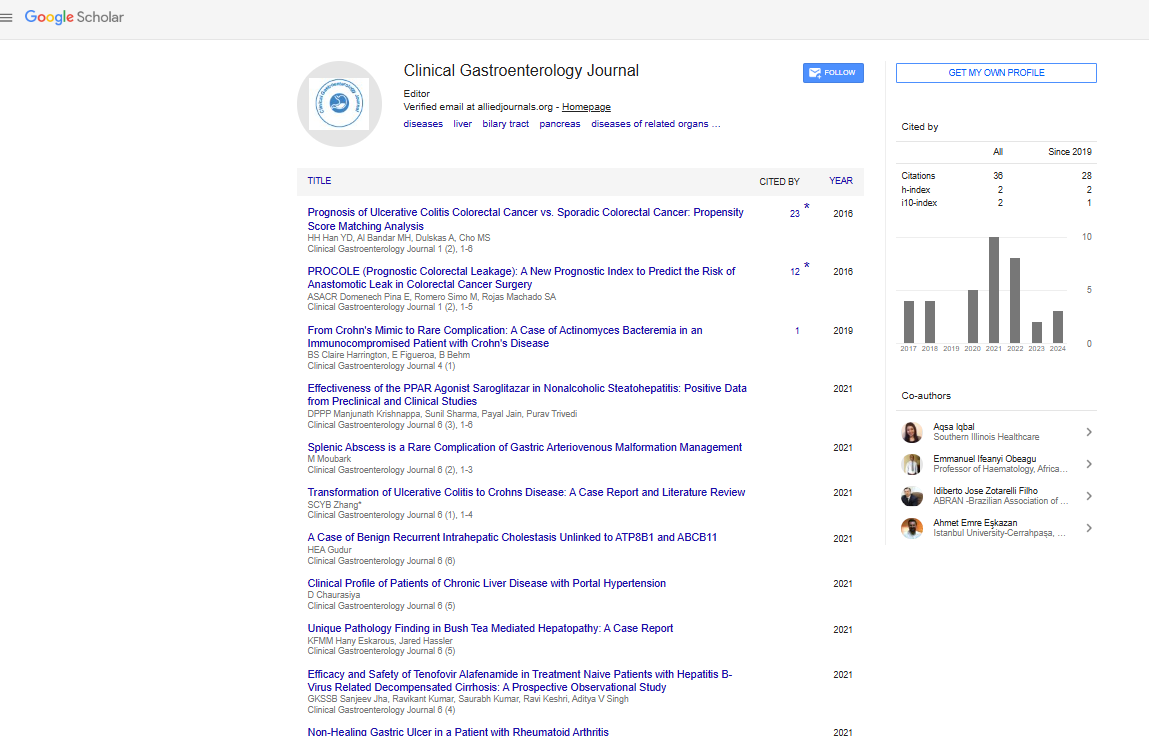
Clinical Gastroenterology Journal received 33 citations as per Google Scholar report