Perspective - (2025) Volume 10, Issue 3
Received: 02-Jun-2025, Manuscript No. cgj-26-186520;
Editor assigned: 04-Jun-2025, Pre QC No. P-186520;
Reviewed: 18-Jun-2025, QC No. Q-186520;
Revised: 23-Jun-2025, Manuscript No. R-186520;
Published:
30-Jun-2025
, DOI: 10.37421/2952-8518.2025.10.316
Citation: Carter, Emily J.. ”Novel Ulcerative Colitis Therapies: Targeting Inflammation.” Clin Gastroenterol J 10 (2025):316.
Copyright: © 2025 Carter J. Emily This is an open-access article distributed under the terms of the Creative Commons Attribution License, which permits unrestricted use, distribution and reproduction in any medium, provided the original author and source are credited.
Recent advancements in the therapeutic landscape for ulcerative colitis (UC) have ushered in a new era of treatment modalities, moving beyond traditional biologics to target specific inflammatory pathways with novel agents. These innovations offer a spectrum of options for patients suffering from moderate to severe UC that has proven refractory to existing treatments. Understanding the intricate mechanisms of action, demonstrated efficacy, and safety profiles of these new therapies is paramount for the optimization of patient care and the achievement of sustained remission. A significant class of these emerging oral therapies comprises Janus kinase (JAK) inhibitors, which have exhibited rapid symptom relief and endoscopic healing in clinical trials. The selectivity of different JAK inhibitors for various JAK isoforms plays a crucial role in determining their individual efficacy and safety profiles, necessitating careful patient selection and diligent monitoring for potential adverse events. Another promising avenue involves sphingosine-1-phosphate (S1P) receptor modulators, which represent a novel oral treatment strategy for UC. By sequestering lymphocytes in lymphoid tissues, these agents effectively reduce their migration to the inflamed intestinal lining. Medications such as ozanimod and etrasimod exemplify this class, showing considerable promise in achieving and maintaining clinical remission in UC patients. Further broadening the therapeutic arsenal, mirikizumab, an interleukin-23 (IL-23) p19 subunit inhibitor, has demonstrated substantial efficacy in both inducing and maintaining remission in individuals with moderate to severe UC. Its targeted approach to the IL-23 pathway, a critical mediator of inflammation in UC, positions it as a valuable alternative to current therapies. The ongoing development of new biological therapies for UC continues to focus on identifying novel targets and enhancing safety profiles. Established agents like vedolizumab, a gut-selective integrin inhibitor, and ustekinumab, which targets IL-12/23, maintain significant roles, while research into other emerging targets and drug delivery systems is actively progressing. The integration of precision medicine approaches is becoming increasingly vital in the comprehensive management of UC. The ongoing investigation of biomarkers that can accurately predict patient response to specific novel therapies aims to personalize treatment selection, thereby improving outcomes and minimizing exposure to ineffective treatments and their associated risks. Beyond these emerging classes, the safety and efficacy of upadacitinib, another JAK inhibitor, have been well-documented in the treatment of moderate to severe active UC. Its pan-JAK inhibitory profile may confer distinct clinical advantages, although careful consideration of its side effect profile, particularly concerning cardiovascular and thrombotic events, is imperative. The broader therapeutic landscape for UC is characterized by the exploration of next-generation biologics and small molecules that target previously unaddressed inflammatory pathways. This diversification of treatment options is crucial for developing more tailored strategies, especially for patients who exhibit a lack of response or intolerance to current standard-of-care therapies. In line with these advancements, risankizumab, another IL-23 inhibitor, has shown significant efficacy in managing moderate to severe active UC. Its selective inhibition of the p19 subunit of IL-23 is believed to contribute to its favorable safety profile and its ability to achieve sustained clinical responses during both induction and maintenance phases. Finally, the long-term safety and efficacy of these novel UC therapies are of paramount importance for ensuring sustained patient well-being. Continuous research, encompassing ongoing studies and comprehensive post-marketing surveillance, is indispensable for a thorough understanding of the real-world effectiveness and potential long-term adverse events associated with these evolving treatment modalities.
The field of ulcerative colitis (UC) therapy has been significantly advanced by the introduction of novel agents that target specific inflammatory pathways, offering alternatives to traditional biologics. These innovations include small molecules such as Janus kinase (JAK) inhibitors and sphingosine-1-phosphate (S1P) receptor modulators, which provide new therapeutic avenues for patients with moderate to severe UC refractory to existing treatments. A thorough understanding of their mechanisms, efficacy, and safety profiles is essential for optimizing patient care and achieving desired clinical outcomes [1].
JAK inhibitors represent a critical class of oral therapies for UC, demonstrating rapid symptom alleviation and endoscopic healing in clinical trials. The differential selectivity of various JAK inhibitors for specific JAK isoforms influences their efficacy and safety profiles, underscoring the importance of careful patient selection and vigilant monitoring for potential adverse events [2].
Sphingosine-1-phosphate (S1P) receptor modulators offer a distinct oral treatment strategy for UC by effectively sequestering lymphocytes in lymphoid tissues, thereby reducing their infiltration into the inflamed gastrointestinal tract. Agents like ozanimod and etrasimod are examples of S1P modulators that have shown considerable promise in achieving and sustaining clinical remission in UC patients [3].
Mirikizumab, a targeted inhibitor of the interleukin-23 (IL-23) p19 subunit, has proven to be highly effective in inducing and maintaining remission in patients diagnosed with moderate to severe UC. Its precise targeting of the IL-23 pathway, a key inflammatory mediator in UC, positions it as a valuable alternative to current treatment options [4].
The ongoing evolution of UC treatment includes the continuous development of new biological therapies that focus on novel targets and improved safety profiles. Established treatments such as vedolizumab, a gut-selective integrin inhibitor, and ustekinumab, which targets IL-12/23, continue to play significant roles, while research into other emerging targets and drug delivery systems is actively underway [5].
The application of precision medicine approaches is gaining increasing relevance in the management of UC. Biomarkers designed to predict patient response to specific novel therapies are under intensive investigation, with the ultimate goal of personalizing treatment selection and enhancing outcomes by avoiding ineffective treatments and their associated risks [6].
The safety and efficacy of upadacitinib, another JAK inhibitor, have been well-established in the treatment of moderate to severe active UC. Its comprehensive pan-JAK inhibitory profile may offer unique clinical benefits, although a careful assessment of its side effect profile, particularly regarding cardiovascular and thrombotic events, is necessary [7].
The expanding armamentarium for UC management encompasses the exploration of next-generation biologics and small molecules that target novel inflammatory pathways. This increased diversification enables the development of more individualized treatment strategies, particularly for those patients who do not respond to or tolerate current standard-of-care therapies [8].
Risankizumab, an IL-23 inhibitor, has exhibited significant efficacy in treating moderate to severe active UC. Its selective inhibition of the p19 subunit of IL-23 contributes to a favorable safety profile and the achievement of sustained clinical responses during both induction and maintenance phases of treatment [9].
Lastly, the long-term safety and efficacy data for novel UC therapies are crucial for ensuring sustained patient well-being. Ongoing clinical studies and post-marketing surveillance are indispensable for comprehensively understanding the real-world effectiveness and potential long-term adverse events associated with these emerging treatment modalities [10].
Recent advancements in ulcerative colitis (UC) treatment include novel agents targeting specific inflammatory pathways, such as JAK inhibitors and S1P receptor modulators. These therapies offer new options for patients with moderate to severe UC refractory to existing treatments. JAK inhibitors provide rapid symptom relief, while S1P modulators work by sequestering lymphocytes. IL-23 inhibitors like mirikizumab and risankizumab have shown significant efficacy in inducing and maintaining remission. Precision medicine approaches and biomarkers are being investigated to personalize treatment. Long-term safety and efficacy data are crucial for ongoing patient well-being, with continuous research and surveillance being vital for understanding real-world effectiveness and potential adverse events of these emerging treatment modalities.
None
None
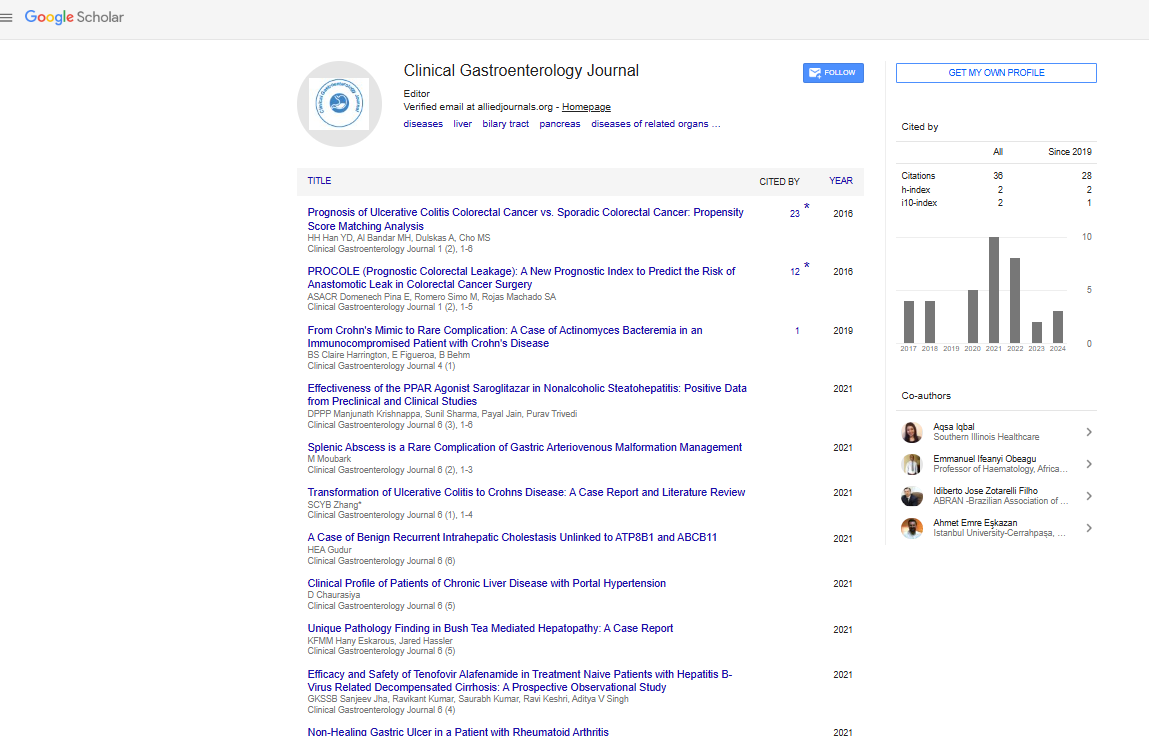
Clinical Gastroenterology Journal received 33 citations as per Google Scholar report