Commentary - (2025) Volume 14, Issue 5
Received: 01-Sep-2026, Manuscript No. jamk-25-177311;
Editor assigned: 03-Sep-2025, Pre QC No. P-177311;
Reviewed: 17-Sep-2025, QC No. Q-177311;
Revised: 22-Sep-2025, Manuscript No. R-177311;
Published:
29-Sep-2025
, DOI: 10.37421/2168-9601.2025.14.573
Citation: Wright, Helen. ”Marketing Performance Measurement: Evolution and Impact.” J Account Mark 14 (2025):573.
Copyright: © 2025 Wright H. This is an open-access article distributed under the terms of the Creative Commons Attribution License, which permits unrestricted use, distribution and reproduction in any medium, provided the original author and source are credited.
This paper meticulously examines the current practices and inherent challenges companies encounter when measuring and reporting on their marketing performance. It delves into crucial aspects such as internal communication of results and the effective quantification of marketing efforts. The authors ultimately propose a robust framework designed to enhance the alignment of marketing metrics with overarching strategic objectives, facilitating more insightful decisionmaking processes. [1].
The article critically assesses both the persistent difficulties and the burgeoning opportunities associated with accurately measuring marketings return on investment ROI, particularly within the increasingly complex digital ecosystem. It emphasizes the imperative for traditional ROI models to evolve and adapt, accommodating the nuances of fragmented customer journeys and the proliferation of novel data sources. The discussion also provides valuable directions for future research aimed at achieving more precise and reliable measurement methodologies. [2].
This comprehensive review systematically synthesizes the contemporary state of marketing mix modeling in the rapidly evolving digital era. It precisely identifies how the advent of new data streams and sophisticated analytical methods are fundamentally transforming its practical application. The work provides a structured overview of these significant advancements and delineates a forwardlooking research agenda, thereby assisting practitioners in better understanding and optimizing their marketing expenditure for enhanced efficiency and impact. [3].
This paper provides an indepth exploration of how Customer Lifetime Value CLV can be effectively integrated into strategic marketing resource allocation decisions. It establishes a foundational understanding of CLV principles, offering clear and actionable guidance for managers. The insights enable leaders to make more datadriven choices regarding the optimal investment of marketing budgets, aiming for the maximization of longterm customer profitability and sustainable growth. [4].
This research rigorously investigates the substantial contribution of robust marketing analytics capabilities to a firms overall performance metrics. It specifically illuminates the critical mediating role played by marketing innovation within this relationship. The findings demonstrate that effective analytical prowess not only yields profound insights but also actively stimulates the development of innovative marketing strategies, which collectively lead to superior business outcomes and competitive advantage. [5].
This systematic review meticulously explores a diverse array of methods employed for measuring brand performance and thoroughly assessing its financial implications. It precisely identifies key metrics and established frameworks relevant to this domain, offering a comprehensive overview for both researchers and practitioners. The ultimate goal is to enable a direct linkage between indicators of brand health and tangible bottomline results, ensuring accountability and strategic investment. [6].
This study delves into the nuanced impact of Chief Marketing Officers CMOs financial expertise on the broader performance of a firm. It uncovers compelling evidence that CMOs possessing strong financial acumen are significantly better equipped to translate diverse marketing investments into measurable and tangible business outcomes. This research emphatically underscores the paramount importance of financial literacy and strategic understanding within contemporary marketing leadership roles. [7].
This extensive literature review provides a comprehensive exploration of the transformative role of artificial intelligence AI within the marketing domain. It meticulously identifies pivotal applications of AI, encompassing areas such as significantly enhanced performance measurement and sophisticated predictive analytics. Furthermore, the review outlines a robust and forwardlooking research agenda essential for fully understanding and strategically optimizing AIs profound potential in marketing contexts. [8].
This article thoroughly reviews various advanced approaches to crosschannel attribution modeling, a methodology deemed crucial for accurately measuring the performance of complex, integrated marketing campaigns. It synthesizes extant knowledge within the field and proactively proposes a comprehensive research agenda. This agenda aims to foster the development of even more sophisticated models capable of precisely allocating credit across diverse and interconnected customer touchpoints, improving resource allocation. [9].
This systematic review offers an exhaustive overview of the methodologies utilized to measure marketing performance specifically within BusinesstoBusiness B2B contexts. It diligently identifies common metrics, prevalent frameworks, and the unique challenges intrinsic to B2B marketing environments. The review provides invaluable insights for both researchers and practitioners, facilitating the effective assessment of B2B marketing return on investment and optimizing strategic B2B initiatives. [10].
The foundational challenges in marketing performance measurement involve not only quantifying efforts but also effectively communicating these outcomes within an organization. Companies struggle to align varied marketing metrics with overarching strategic objectives, often leading to disconnected reporting and suboptimal resource allocation. Addressing these issues requires a systematic approach to define relevant key performance indicators and establish clear internal reporting structures, moving beyond siloed departmental views to a holistic understanding of marketings contribution. [1]. Accurately determining marketings return on investment ROI presents considerable difficulties, particularly in the current digital landscape characterized by numerous customer touchpoints and diverse data streams. Traditional ROI frameworks frequently fall short in capturing the complexity of modern customer journeys. There is a pressing need for innovative models that can integrate new data sources, such as social media engagement and mobile interactions, to provide a more comprehensive and realistic assessment of marketing effectiveness across all digital channels. [2]. Marketing mix modeling has undergone significant transformations due to the digital age, with new data and advanced analytical techniques fundamentally reshaping its utility. The ability to integrate vast datasets from online interactions, along with sophisticated machine learning algorithms, allows for more granular insights into how different marketing elements contribute to overall sales. Practitioners benefit from understanding these advancements to optimize their marketing spend and achieve better campaign results, moving towards predictive rather than purely reactive strategies. [3]. The strategic integration of Customer Lifetime Value CLV into marketing resource allocation decisions is paramount for fostering longterm profitability. By shifting focus from shortterm campaign metrics to the enduring value of customer relationships, firms can make more informed investments. This involves developing robust CLV models that account for customer acquisition costs, retention rates, and future purchase probabilities, thereby guiding marketing managers in allocating budgets towards customer segments with the highest potential for sustained revenue generation. [4]. Marketing analytics capabilities are increasingly recognized as a vital driver of a firms performance, primarily through their mediating influence on marketing innovation. Strong analytical insights enable organizations to identify emerging market trends, optimize campaign targeting, and personalize customer experiences. These datadriven insights then fuel the development of novel marketing strategies and product offerings, ultimately translating into enhanced competitive advantage and superior financial outcomes through a continuous cycle of analysis and innovation. [5]. A thorough understanding of brand performance requires a systematic evaluation of various metrics and their financial implications. This includes not only traditional brand awareness and perception measures but also their direct correlation with sales, market share, and investor confidence. Developing comprehensive frameworks that link qualitative brand health indicators with quantitative financial outcomes allows researchers and practitioners to justify brand investments and manage brand equity as a tangible asset contributing directly to a companys bottom line. [6]. The financial expertise of Chief Marketing Officers CMOs significantly impacts a firms ability to convert marketing expenditures into demonstrable business performance. CMOs with strong financial literacy can articulate the financial rationale behind marketing initiatives, measure campaign success in monetary terms, and effectively communicate value to the executive board. This acumen ensures that marketing is viewed not merely as an expense but as a strategic investment capable of generating measurable returns and contributing to overall corporate financial health. [7]. Artificial intelligence AI is rapidly redefining the landscape of marketing, offering unprecedented capabilities for enhanced performance measurement and predictive analytics. AI applications, such as personalized recommendations, sentiment analysis, and automated ad bidding, allow marketers to operate with greater efficiency and precision. A structured research agenda is crucial to explore the ethical considerations, operational challenges, and strategic opportunities presented by AI, ensuring its responsible and effective deployment to maximize its potential in marketing. [8]. Crosschannel attribution modeling is fundamental for accurately assessing the effectiveness of integrated marketing campaigns across multiple touchpoints. The challenge lies in crediting each channel appropriately for its contribution to a customers conversion path, moving beyond lastclick attribution. Advanced models incorporating machine learning and econometric techniques are necessary to understand complex customer journeys, enabling marketers to optimize their budget allocation across online and offline channels for maximum synergistic effect and return. [9]. Measuring marketing performance within the BusinesstoBusiness B2B sector presents distinct challenges compared to B2C markets, primarily due to longer sales cycles, complex decisionmaking units, and relationshipdriven sales. A systematic review highlights the need for specialized metrics and frameworks that capture unique B2B aspects like lead quality, accountbased marketing effectiveness, and client retention. Understanding these nuances is critical for B2B practitioners and researchers to accurately assess marketing ROI and drive sustainable growth in industrial contexts. [10].
The collection of research articles underscores the evolving landscape of marketing performance measurement, addressing both persistent challenges and emerging opportunities. Key themes include the necessity for improved marketing performance measurement and reporting practices, especially concerning the alignment of metrics with strategic objectives. The complexities of quantifying marketing return on investment in the digital age are explored, advocating for adaptive ROI models that accommodate fragmented customer journeys and new data sources. Advancements in marketing mix modeling, driven by new data and analytical methods, are transforming how marketing spend is optimized. The integration of Customer Lifetime Value CLV into resource allocation is highlighted as crucial for longterm profitability. Furthermore, the role of marketing analytics capabilities in driving firm performance through innovation, the financial impact of brand performance, and the influence of CMOs financial expertise on business outcomes are examined. The reviews also cover the strategic applications of artificial intelligence in marketing, the development of crosschannel attribution modeling, and specific methodologies for measuring B2B marketing performance. Collectively, these papers emphasize the growing importance of datadriven insights, advanced analytics, and financial acumen for effective marketing strategy and achieving superior business results in a dynamic environment.
None
None
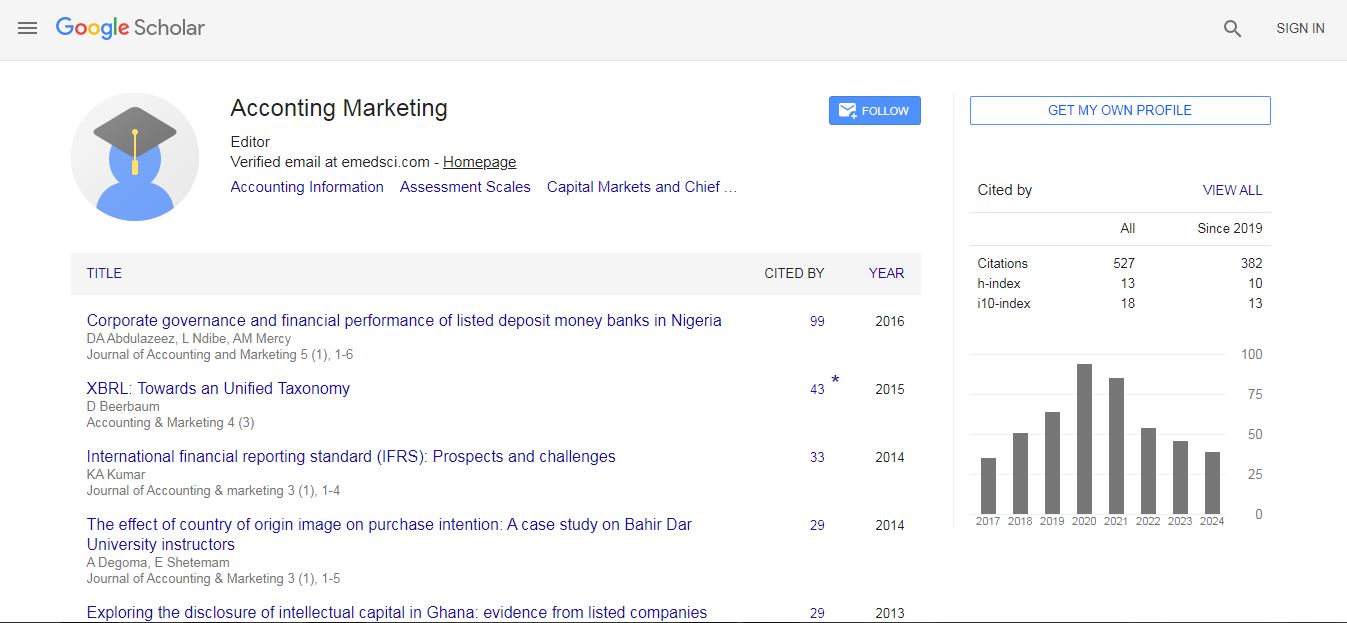
Accounting & Marketing received 487 citations as per Google Scholar report