Commentary - (2025) Volume 10, Issue 6
Received: 01-Dec-2025, Manuscript No. cgj-26-186552;
Editor assigned: 03-Dec-2025, Pre QC No. P-186552;
Reviewed: 17-Dec-2025, QC No. Q-186552;
Revised: 22-Dec-2025, Manuscript No. R-186552;
Published:
29-Dec-2025
, DOI: 10.37421/2952-8518.2025.10.345
Citation: Zhao, Ling. ”Managing Portal Hypertension: A Comprehensive Guide.” Clin Gastroenterol J 10 (2025):345.
Copyright: © 2025 Zhao L. This is an open-access article distributed under the terms of the Creative Commons Attribution License, which permits unrestricted use, distribution and reproduction in any medium, provided the original author and source are credited.
Portal hypertension, a complex sequela of chronic liver disease, presents a significant clinical challenge due to its association with severe and potentially life-threatening complications. Effective management necessitates a proactive and comprehensive approach, focusing on early identification of at-risk individuals and timely implementation of therapeutic strategies to mitigate adverse outcomes such as variceal bleeding and hepatic encephalopathy [1].
This review delves into the intricate management of gastroesophageal varices, a major source of morbidity and mortality in patients with portal hypertension. It provides a thorough overview of current guidelines encompassing screening protocols, primary prophylaxis to prevent the first variceal bleeding episode, and definitive management of acute variceal bleeding events, comparing various pharmacological agents, endoscopic interventions, and the transjugular intrahepatic portosystemic shunt (TIPS) [2].
The diagnosis and management of portal hypertensive gastropathy and duodenopathy, often elusive conditions, continue to pose clinical difficulties. This article offers an updated perspective on their endoscopic appearance, histopathological characteristics, and current treatment strategies, examining the utility of pharmacological interventions like beta-blockers and octreotide in reducing portal pressure and alleviating symptoms, while also acknowledging treatment limitations and the need for further research [3].
Hepatic encephalopathy (HE), a profound neuropsychiatric complication of portal hypertension, exerts a substantial impact on patient quality of life and overall mortality. This paper systematically reviews the current understanding of HE pathophysiology, including the critical roles of gut-brain axis dysfunction and altered ammonia metabolism, alongside detailing diagnostic approaches and evidence-based therapeutic strategies, with a particular focus on lactulose and rifaximin [4].
The transjugular intrahepatic portosystemic shunt (TIPS) stands as a pivotal intervention for managing complications of portal hypertension that are refractory to conventional medical and endoscopic therapies. This article furnishes an updated examination of TIPS indications, contraindications, and procedural techniques, discussing its efficacy in controlling variceal bleeding, ascites, and hepatorenal syndrome, as well as its associated complications like hepatic encephalopathy and shunt dysfunction, with emerging evidence on expanded polytetrafluoroethylene (ePTFE)-covered stents also being presented [5].
Ascites, a pervasive manifestation of portal hypertension, presents a considerable management hurdle. This review delineates the current diagnostic criteria and a stepwise therapeutic approach to ascites management, underscoring the crucial roles of sodium restriction and diuretics. It further elaborates on the indications and techniques for paracentesis, the judicious use of albumin, and the management of tense ascites, alongside discussing the attendant complications such as spontaneous bacterial peritonitis (SBP) and hepatorenal syndrome [6].
The paramount importance of preventing recurrent variceal bleeding is a central tenet in the comprehensive management of portal hypertension. This article critically appraises the existing pharmacological and endoscopic strategies employed for secondary prophylaxis, juxtaposing the effectiveness of combined pharmacotherapy (non-selective beta-blockers and nitrates) with endoscopic variceal ligation (EVL) in curtailing rebleeding rates, while also addressing patient selection, treatment adherence, and the role of TIPS in refractory scenarios [7].
The management paradigm for patients afflicted with cirrhosis and ascites, a critical determinant of outcomes in portal hypertension, has undergone significant evolution. This article synthesizes the latest guidelines pertaining to the diagnosis and treatment of ascites, emphasizing the established roles of diuretics, paracentesis, and albumin. It also addresses the critical aspects of preventing and managing spontaneous bacterial peritonitis (SBP) and hepatorenal syndrome (HRS), with a spotlight on emerging therapies and the indispensable maintenance of fluid and electrolyte balance [8].
Non-invasive markers for the precise assessment of portal hypertension and the quantification of variceal bleeding risk are increasingly recognized for their clinical utility. This article elucidates the value of spleen stiffness measurement (SSM) via transient elastography and the platelet count-spleen diameter ratio (PC-SDR) in accurately predicting the presence and severity of esophageal varices, highlighting how these non-invasive modalities can refine the necessity for endoscopic surveillance and inform therapeutic decision-making [9].
Managing refractory ascites, a severe and often debilitating complication of portal hypertension, demands a sophisticated and integrated therapeutic approach. This review specifically targets therapeutic options for patients exhibiting a lack of response to standard diuretic regimens, detailing the indications and procedural aspects of large-volume paracentesis with albumin infusion, the strategic application of TIPS, and the pivotal role of liver transplantation, while also addressing strategies for preventing and managing associated complications such as SBP and HRS [10].
Portal hypertension, a serious complication stemming from various forms of liver disease, necessitates proactive management to avert life-threatening events, including variceal bleeding and hepatic encephalopathy. This review outlines current clinical strategies, emphasizing early diagnosis and risk stratification through non-invasive markers and endoscopic surveillance to identify high-risk patients. Therapeutic modalities discussed encompass pharmacotherapy with beta-blockers and nitrates, endoscopic interventions like band ligation and sclerotherapy, and the TIPS procedure for refractory cases, alongside recent advancements in understanding pathophysiology and novel therapeutic targets aimed at improving patient outcomes [1].
The management of gastroesophageal varices in individuals suffering from portal hypertension is meticulously explored in this review. It provides a comprehensive overview of current guidelines for screening, prophylaxis against initial variceal bleeding, and the treatment of acute bleeding episodes. The article systematically compares the efficacy and safety profiles of diverse pharmacological agents, endoscopic therapies, and the transjugular intrahepatic portosystemic shunt (TIPS), while also touching upon emerging therapeutic strategies and the significance of multidisciplinary care [2].
This article addresses the persistent clinical challenge posed by the diagnosis and management of portal hypertensive gastropathy and duodenopathy. It presents an updated perspective on the endoscopic appearances, histopathological features, and prevailing treatment strategies for these conditions. The role of pharmacologic interventions, particularly beta-blockers and octreotide, in moderating portal pressure and alleviating symptoms is examined, along with the limitations of current treatments and the imperative for further research into more efficacious therapeutic avenues [3].
Hepatic encephalopathy (HE), a debilitating neuropsychiatric complication of portal hypertension, significantly impacts patient quality of life and contributes to mortality. This paper reviews the current understanding of HE pathophysiology, focusing on the gut-brain axis dysfunction and ammonia metabolism. It delineates diagnostic approaches and evidence-based therapeutic strategies, emphasizing lactulose and rifaximin, and discusses the management of overt HE and the prevention of recurrent episodes, stressing the importance of identifying and addressing precipitating factors [4].
The transjugular intrahepatic portosystemic shunt (TIPS) is a critical intervention for patients experiencing portal hypertension complications that are refractory to medical and endoscopic therapies. This article provides an updated review of TIPS indications, contraindications, and procedural techniques. It assesses the efficacy of TIPS in controlling variceal bleeding, ascites, and hepatorenal syndrome, as well as its associated complications, including hepatic encephalopathy and shunt dysfunction, with recent data on expanded polytetrafluoroethylene (ePTFE)-covered stents also being presented [5].
Ascites, a prevalent manifestation of portal hypertension, presents a significant management challenge. This review outlines the current diagnostic criteria and a stepwise therapeutic approach for ascites management, highlighting the essential roles of sodium restriction and diuretics. It further details the indications and techniques for paracentesis, the use of albumin, and the management of tense ascites, while also exploring complications such as spontaneous bacterial peritonitis (SBP) and hepatorenal syndrome, and their respective management strategies [6].
Preventing recurrent variceal bleeding is a fundamental objective in the management of portal hypertension. This article critically evaluates existing pharmacological and endoscopic strategies for secondary prophylaxis, comparing the effectiveness of combined pharmacotherapy (non-selective beta-blockers and nitrates) with endoscopic variceal ligation (EVL) in reducing rebleeding rates. The authors also discuss patient selection, treatment adherence, and the role of TIPS in refractory cases, advocating for a personalized approach to risk reduction [7].
The management of cirrhosis with ascites, a critical outcome of portal hypertension, has undergone substantial evolution. This article reviews the most recent guidelines for the diagnosis and treatment of ascites, emphasizing the roles of diuretics, paracentesis, and albumin. It also addresses the prevention and management of spontaneous bacterial peritonitis (SBP) and hepatorenal syndrome (HRS), with emerging therapies and the critical importance of fluid and electrolyte balance being highlighted [8].
Non-invasive markers for assessing portal hypertension and the risk of variceal bleeding are increasingly utilized. This article discusses the utility of spleen stiffness measurement (SSM) using transient elastography and the platelet count-spleen diameter ratio (PC-SDR) in predicting the presence and severity of esophageal varices. It emphasizes how these non-invasive methods can optimize the need for endoscopic surveillance and guide therapeutic decisions, potentially reducing healthcare costs and patient burden [9].
Managing refractory ascites, a severe complication of portal hypertension, requires a comprehensive strategy. This review focuses on therapeutic options for patients who do not respond to standard diuretic therapy. It details the indications and techniques for large-volume paracentesis with albumin infusion, the application of TIPS, and the role of liver transplantation. The article also addresses strategies for preventing and managing complications associated with refractory ascites, such as SBP and HRS [10].
This collection of articles addresses the multifaceted management of portal hypertension, a serious complication of liver disease. Key areas covered include clinical strategies for early diagnosis and risk stratification, with emphasis on non-invasive markers and endoscopic surveillance. Therapeutic approaches discussed range from pharmacotherapy and endoscopic interventions for varices to the transjugular intrahepatic portosystemic shunt (TIPS) for refractory cases. The management of ascites, hepatic encephalopathy, portal hypertensive gastropathy, and duodenopathy are also detailed, along with strategies for preventing complications like variceal rebleeding and spontaneous bacterial peritonitis. The importance of multidisciplinary care and personalized treatment approaches is highlighted throughout.
None
None
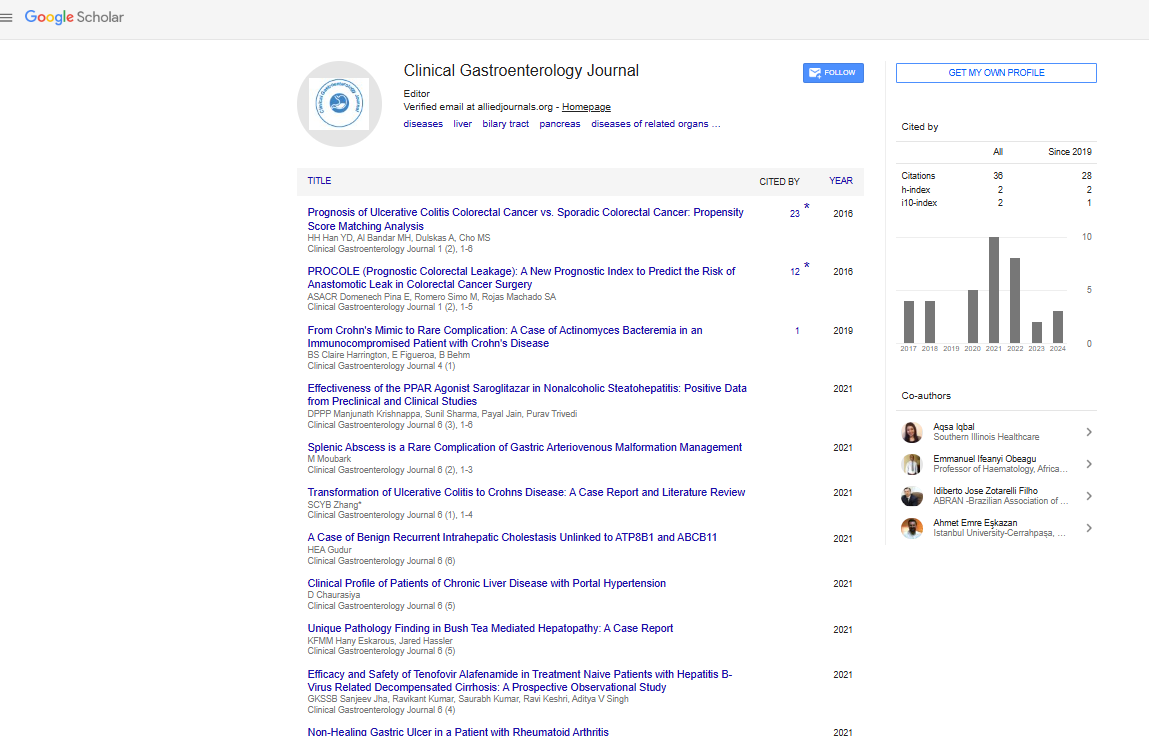
Clinical Gastroenterology Journal received 33 citations as per Google Scholar report