Short Communication - (2025) Volume 10, Issue 4
Received: 01-Dec-2025, Manuscript No. jib-25-175304;
Editor assigned: 03-Dec-2025, Pre QC No. P-175304;
Reviewed: 17-Dec-2025, QC No. Q-175304;
Revised: 22-Dec-2025, Manuscript No. R-175304;
Published:
29-Dec-2025
, DOI: 10.37421/2476-1966.2025.10.299
Citation: Rojas, Arturo. ”Immunological Synapse: Orchestrating Immunity and Therapy.” J Immuno Biol 10 (2025):299.
Copyright: © 2025 Rojas A. This is an open-access article distributed under the terms of the Creative Commons Attribution License, which permits unrestricted use, distribution and reproduction in any medium, provided the original author and source are credited.
The immunological synapse is a dynamic interface essential for critical immune cell functions. Initially recognized for its role in T cell activation, differentiation, and effector functions, its discovery has unveiled an intricate molecular choreography involving receptors, signaling molecules, and cytoskeletal components that orchestrate T cell responses [1].
Understanding the architecture of this synapse provides a fundamental basis for developing novel therapeutic strategies aimed at immune diseases and cancer [1].
It's clear the immunological synapse plays a vital role in the context of cancer immunotherapy, governing the efficacy of anti-tumor immune responses [2].
Researchers explore how the precise spatiotemporal organization of molecules at the synapse dictates T cell recognition of cancer cells and subsequent killing, highlighting its potential as a target for enhancing current immunotherapeutic strategies [2].
While traditionally studied in T cells, the immunological synapse is not exclusive to them. B cells also form immunological synapses that are crucial for antigen presentation, affinity maturation, and humoral immunity [3].
Research discusses the unique structural and signaling properties of the B cell synapse, emphasizing its differences and similarities with the T cell synapse, and its implications for B cell activation and function [3].
Engineering T-cell Receptor (TCR) signaling at the immunological synapse holds significant promise for advancing cell-based immunotherapies [4].
This approach delves into strategies for precisely manipulating TCR signaling pathways and synapse formation to enhance T cell sensitivity, specificity, and persistence, which is critical for the effective treatment of cancer and autoimmune diseases [4].
The reach of the immunological synapse extends beyond adaptive immunity, playing a fundamental role in natural killer (NK) cell functions [5].
Work in this area examines how the NK cell immunological synapse contributes to NK cell education, the establishment of immunological memory, and its implications for developing NK cell-based therapies against cancer and viral infections [5].
The dynamic regulation of TCR signaling at the immunological synapse is central to dictating T cell fate and function [6].
This review elucidates the complex interplay of molecular components and mechanical forces that modulate TCR signal strength and duration, influencing T cell activation, differentiation, and anergy, with implications for immune modulation [6].
Recent advancements in single-cell analysis reveal the intricate dynamics of receptor interactions and signaling elements within the immunological synapse [7].
By providing high-resolution insights into the spatiotemporal organization of molecules, these studies uncover key regulatory mechanisms that fine-tune immune cell activation, offering new targets for precise immune intervention [7].
The immunological synapse is also a crucial determinant of the success of cancer immunotherapies, particularly those involving immune checkpoint blockade [8].
Investigations into how checkpoint inhibitors modulate the formation and function of the synapse to unleash anti-tumor immunity are proposing strategies to optimize their therapeutic efficacy by targeting synaptic interactions [8].
TCR-mediated signaling at the immunological synapse is fundamental for initiating adaptive immune responses [9].
Reviews examine the intricate molecular events that occur at the synapse upon TCR engagement and discuss how these insights are being leveraged for the rational design of novel immunotherapeutics, including Chimeric Antigen Receptor (CAR) T cells and TCR-mimetic antibodies [9].
Furthermore, the immunological synapse plays an underappreciated but critical role in the pathogenesis of neuroinflammatory diseases [10].
Research synthesizes current understanding of how aberrant synaptic interactions between immune cells and neural cells contribute to neuroinflammation, neurodegeneration, and autoimmune conditions affecting the central nervous system, identifying potential therapeutic targets [10].
The immunological synapse stands as a pivotal interface in immunology, orchestrating vital functions across various immune cell types. In T cells, it's a dynamic hub crucial for activation, differentiation, and effector functions, driven by an intricate molecular choreography of receptors, signaling molecules, and cytoskeletal components [1]. This complex interplay is fundamental for initiating adaptive immune responses, with T Cell Receptor (TCR)-mediated signaling at the synapse being a key event [9]. The dynamic regulation of this TCR signaling is central to dictating T cell fate and function, where molecular components and mechanical forces precisely modulate signal strength and duration, influencing T cell activation, differentiation, and even anergy, thereby offering implications for immune modulation [6]. Engineering these TCR signaling pathways at the immunological synapse holds significant promise for advancing cell-based immunotherapies, aiming to enhance T cell sensitivity, specificity, and persistence critical for treating cancer and autoimmune diseases [4].
Beyond T cells, the immunological synapse extends its influence to other key players in the immune system. B cells also form these specialized synapses, which are essential for antigen presentation, affinity maturation, and humoral immunity [3]. Researchers highlight the unique structural and signaling properties of the B cell synapse, contrasting them with the T cell synapse to understand their implications for B cell activation and function [3]. Moreover, this dynamic interface is not exclusive to adaptive immunity; it plays a fundamental role in Natural Killer (NK) cell functions [5]. Investigations explore how the NK cell immunological synapse contributes to NK cell education, the establishment of immunological memory, and its broad implications for developing NK cell-based therapies against cancer and viral infections [5].
A critical application of understanding the immunological synapse lies in cancer immunotherapy. It plays a vital role in governing the efficacy of anti-tumor immune responses [2]. The precise spatiotemporal organization of molecules at the synapse directly dictates T cell recognition and killing of cancer cells, making it a key target for enhancing current immunotherapeutic strategies [2]. This is particularly evident in the context of immune checkpoint blockade, where the immunological synapse is a crucial determinant of therapeutic success [8]. Research investigates how checkpoint inhibitors modulate the formation and function of the synapse to unleash anti-tumor immunity, proposing strategies to optimize their efficacy by targeting synaptic interactions [8]. Insights derived from TCR-mediated signaling at the synapse are being leveraged for the rational design of novel immunotherapeutics, including advanced therapies like Chimeric Antigen Receptor T cells and TCR-mimetic antibodies [9].
Recent technological advancements, such as single-cell analysis, are providing unprecedented high-resolution insights into the intricate dynamics of receptor interactions and signaling elements within the immunological synapse [7]. These studies uncover key regulatory mechanisms that fine-tune immune cell activation, thereby offering new targets for precise immune intervention [7]. What this really means is that a deeper understanding allows us to develop more targeted and effective treatments. Interestingly, the immunological synapse also plays an underappreciated yet critical role in the pathogenesis of neuroinflammatory diseases [10]. The current understanding synthesizes how aberrant synaptic interactions between immune cells and neural cells contribute to neuroinflammation, neurodegeneration, and autoimmune conditions affecting the central nervous system, identifying potential therapeutic targets in this emerging field [10].
The immunological synapse is a dynamic and multifaceted interface crucial for diverse immune cell functions, extending beyond T cells to B and Natural Killer cells. It orchestrates T cell activation, differentiation, and effector functions through intricate molecular choreography, providing a foundation for novel therapeutic strategies against immune diseases and cancer. Researchers are exploring how its precise molecular organization dictates T cell recognition and killing of cancer cells, positioning it as a key target for enhancing immunotherapies, including checkpoint blockade. The synapse's role in B cell antigen presentation and affinity maturation, as well as NK cell education and memory, highlights its broad importance in immunity. Advances in engineering T Cell Receptor (TCR) signaling at this synapse promise to improve T cell sensitivity and persistence for treatments. Single-cell analysis is revealing high-resolution insights into its regulatory mechanisms, offering new targets for intervention. Furthermore, the immunological synapse is implicated in neuroinflammatory diseases, where aberrant synaptic interactions contribute to neuroinflammation and neurodegeneration. Leveraging insights into TCR-mediated signaling is driving the rational design of new immunotherapeutics like CAR T cells. This collective understanding underscores the synapse's central role in both fundamental immunology and the development of advanced therapies for a range of diseases.
None
None
Ana EZ, Sabrina MDP, SofÃa AA. "The T Cell Immunological Synapse: From Discovery to Novel Therapeutic Targets".Front Immunol 12 (2021):709667.
Indexed at, Google Scholar, Crossref
Tal B, Noa BB, Ronen A. "The Immunological Synapse in Cancer Immunotherapy".Front Immunol 13 (2022):902877.
Indexed at, Google Scholar, Crossref
Peng C, Jieling H, Yong Z. "The Immunological Synapse in B Cells".Front Immunol 13 (2022):900609.
Indexed at, Google Scholar, Crossref
Zhiyao L, Xuanxuan X, Qi Z. "Engineering T-cell receptor signaling at the immunological synapse".Cell Mol Immunol 20 (2023):115-125.
Indexed at, Google Scholar, Crossref
Melanie S, Maroun M, Matthias D. "The role of the immunological synapse in NK cell education, memory, and therapy".Immunogenetics 75 (2023):151-167.
Indexed at, Google Scholar, Crossref
Xinzhu W, Miaomiao Z, Xiumin Z. "Dynamic Regulation of T-Cell Receptor Signaling at the Immunological Synapse".Cells 13 (2024):74.
Indexed at, Google Scholar, Crossref
Jing C, Ruixian H, Na L. "Single-cell analysis of receptor dynamics reveals key signaling elements and their regulation in the immunological synapse".Cell Discov 10 (2024):22.
Indexed at, Google Scholar, Crossref
Elisa R, Barbara M, Laura C. "The Immunological Synapse in Cancer Immunotherapy: A Focus on Checkpoint Blockade".Cancers (Basel) 15 (2023):440.
Indexed at, Google Scholar, Crossref
Benjamin AS, Huitong W, Qihui W. "T Cell Receptor-Mediated Signaling at the Immunological Synapse and Its Implications for Therapeutic Development".Cancers (Basel) 15 (2023):4357.
Indexed at, Google Scholar, Crossref
Min Z, Jing L, Xiumin Z. "The Role of Immunological Synapses in Neuroinflammatory Diseases".Front Cell Neurosci 17 (2023):1184719.
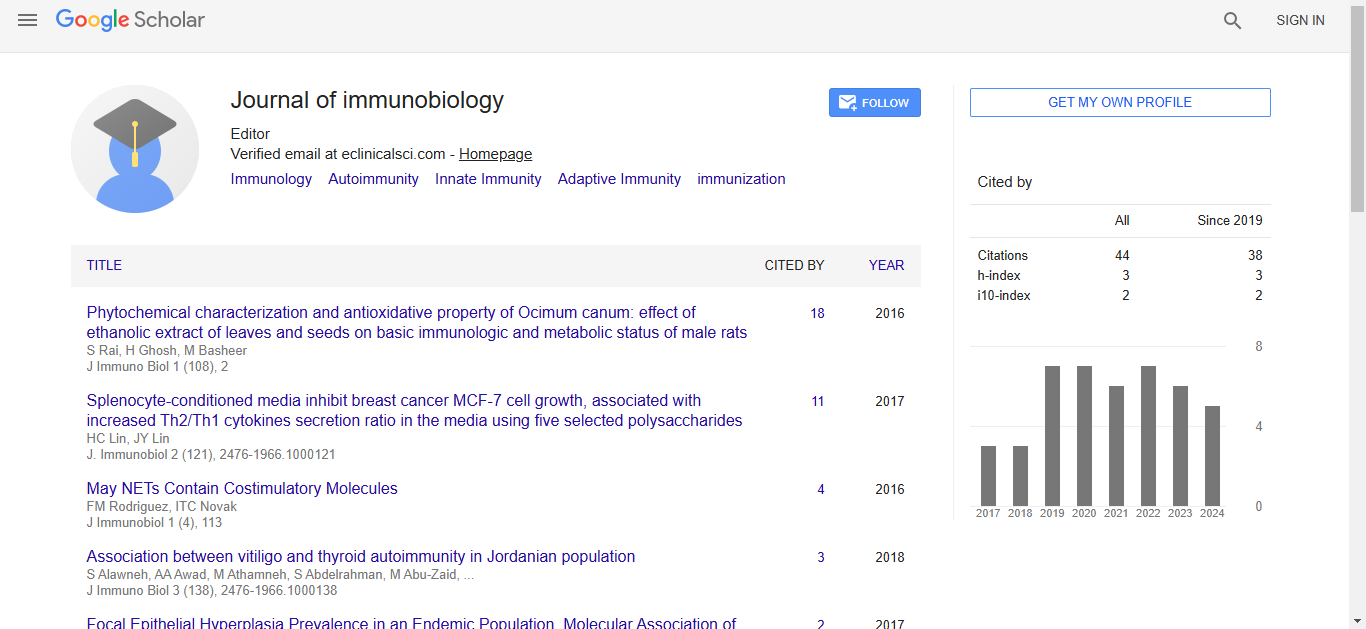
Journal of Immunobiology received 34 citations as per Google Scholar report