Brief Report - (2025) Volume 14, Issue 2
Received: 01-Mar-2025, Manuscript No. jamk-25-177263;
Editor assigned: 03-Mar-2025, Pre QC No. P-177263;
Reviewed: 17-Mar-2025, QC No. Q-177263;
Revised: 24-Mar-2025, Manuscript No. R-177263;
Published:
31-Mar-2025
, DOI: 10.37421/2168-9601.2025.14.545
Citation: Thompson, Michael. ”Financial Reporting: Auditing, Technology, and Governance.” J Account Mark 14 (2025):545.
Copyright: © 2025 Thompson M. This is an open-access article distributed under the terms of the Creative Commons Attribution License, which permits unrestricted use, distribution and reproduction in any medium, provided the original author and source are credited.
Research consistently examines the factors influencing auditors' ability to detect significant misstatements in financial reports. A key focus is on how human elements, such as an auditor's accumulated experience, their inherent professional skepticism (basically, not taking things at face value), and the cognitive load they manage during an audit, collectively shape their effectiveness in identifying material errors. These human factors underscore the complexity of auditing and suggest that even highly skilled professionals can overlook critical issues under certain pressures, thereby emphasizing the need for robust support systems and training methodologies tailored to these cognitive challenges [1].
The integrity of financial reporting is fundamentally linked to the strength of a company's internal control framework. Studies have established a direct correlation between weak internal controls and a degradation in the quality of financial reporting. This connection highlights that inadequate internal checks and balances significantly increase the propensity for errors and misstatements, affirming the indispensable role of robust internal control systems in safeguarding the accuracy and reliability of financial information for all stakeholders [2].
The transition to International Financial Reporting Standards (IFRS) has brought about significant changes in corporate financial reporting, prompting scrutiny into practices like earnings management. This shift necessitates a critical examination of how companies adjust their earnings management strategies under IFRS and the corresponding capacity of audit processes to detect such maneuvers. High-quality audits are paramount in this evolving landscape to ensure that financial presentations remain transparent and prevent any form of misleading reporting [3].
Auditor specialization within specific industries has emerged as a crucial determinant of audit quality and effectiveness in detecting financial misstatements. Auditors who possess deep industry-specific knowledge are better equipped to navigate the unique risks, intricate transactions, and operational complexities inherent to that sector. This specialized understanding significantly enhances their capacity to identify potential errors or deliberate misrepresentations, thereby leading to a higher overall quality of audit outcomes [4].
The adoption of cloud accounting systems represents a technological advancement with profound implications for financial data accuracy and reporting efficiency. These systems offer significant advantages by automating many manual processes, which inherently reduces the likelihood of human error and streamlines the entire financial reporting cycle. Consequently, cloud accounting can substantially improve the reliability and integrity of financial statements, fostering greater confidence in reported data [5].
The pursuit of aggressive tax avoidance strategies by corporations has broader implications that extend beyond just tax liabilities. Research indicates that such strategies can paradoxically diminish a firm's overall value while concurrently impairing the quality of its financial reporting. This suggests that the intense focus on minimizing tax burdens might introduce other forms of financial risk and contribute to reduced transparency, making it more challenging for external parties to ascertain the true financial health of the entity [6].
The advent of machine learning technologies is revolutionizing the field of financial reporting fraud detection. Artificial intelligence algorithms are now capable of analyzing vast and complex datasets to identify subtle anomalies, patterns, and red flags that are indicative of fraudulent activities. This technological advancement provides a sophisticated and proactive defense mechanism against intentional misstatements, offering a new dimension to the ongoing efforts to ensure financial integrity [7].
An auditor's professional identity plays a pivotal role in their capacity to prevent financial fraud. A strong professional identity, characterized by an unwavering commitment to ethical principles and a dedication to serving the public interest, empowers auditors to rigorously challenge suspicious transactions and uphold the highest standards of reporting integrity. This internal compass acts as a vital safeguard against various forms of financial misrepresentation, reinforcing the auditor's gatekeeping function [8].
The effectiveness of internal controls over financial reporting is critical in the ongoing battle against accounting fraud. Recent evidence consistently demonstrates that well-implemented and rigorously maintained internal controls significantly enhance the likelihood of detecting fraudulent activities. These control mechanisms are thus indispensable in preserving the trustworthiness of financial statements and ensuring that reported financial data accurately reflects an organization's economic reality [9].
Artificial intelligence (AI) is rapidly transforming the landscape of accounting and auditing, presenting both substantial opportunities and considerable challenges. While AI offers immense potential for automating routine tasks, improving error detection, and processing large volumes of data, it also introduces complexities related to data privacy, ethical deployment, and the need for new skill sets. The profession must adapt to leverage AI's benefits while effectively mitigating its associated risks as data complexity continues to escalate [10].
This specific research thoroughly investigates the multifaceted elements that influence an auditor's capability to pinpoint major errors within financial statements. The core argument posits that auditor experience, the degree of professional skepticism applied (basically, not taking things at face value), and the current cognitive load borne by the auditor are critical determinants in the detection of material misstatements. It further elaborates that even highly skilled auditing professionals can inadvertently miss significant issues if their mental effort or cognitive burden is excessive, thereby emphasizing the necessity for sophisticated training programs and systemic supports that account for these inherent human factors in the audit process [1]. The study unequivocally demonstrates a pronounced relationship between the robustness of a company's internal controls and the resultant quality of its financial reporting. It provides compelling evidence that deficiencies in internal control mechanisms directly correlate with a heightened probability of encountering errors and misstatements in financial disclosures. This empirical finding serves as a strong affirmation that meticulously designed and consistently executed internal checks and balances are not merely regulatory requirements but are foundational pillars for ensuring the accuracy, reliability, and ultimately, the trustworthiness of an entity's financial information [2]. This academic contribution meticulously scrutinizes the prevalence and methods of earnings management employed by corporations, particularly in the aftermath of their adoption of International Financial Reporting Standards (IFRS). The investigation reveals that while IFRS aims to foster greater transparency, its implementation can be associated with shifts in how earnings are managed, potentially creating new avenues for manipulation. Consequently, the paper underscores the indispensable requirement for consistently high-quality audits to counteract these evolving practices and prevent financial statements from presenting a misleading portrayal of economic performance [3]. A central theme of this research is the pronounced advantage gained when auditors develop specialized expertise within a particular industry sector. The study articulates that such industry specialization significantly sharpens an auditor's acumen in discerning financial misstatements. This enhanced capability stems from their profound understanding of industry-specific operational nuances, unique transactional complexities, and inherent risk profiles, which collectively enable them to more effectively identify both unintentional errors and deliberate misrepresentations, thereby markedly elevating the overall efficacy and integrity of the audit function [4]. This investigation meticulously evaluates the transformative impact of integrating cloud accounting systems on the precision of financial data and the operational efficiency of reporting processes. The seminal finding highlights that these modern systems possess a substantial capacity to elevate data accuracy and extensively streamline reporting workflows. By automating numerous tasks previously performed manually, cloud accounting mitigates common human-induced errors and significantly bolsters the dependability and integrity of an organization's financial statements, thus promoting higher confidence in reported figures [5]. The implications of aggressive corporate tax avoidance strategies are thoroughly examined in this study, extending beyond the immediate tax benefits. The research uncovers a dual negative effect: aggressive tax avoidance not only potentially erodes a firm's intrinsic value but also simultaneously compromises the quality of its financial reporting. This paradoxical outcome suggests that while companies may aim to reduce tax liabilities, such strategies can introduce unforeseen financial risks and create an environment of opacity, making it increasingly difficult for stakeholders to accurately assess the firm's genuine financial standing [6]. This pioneering study illustrates the burgeoning utility of machine learning in revolutionizing the detection of financial reporting fraud. It articulates how advanced artificial intelligence algorithms are uniquely positioned to meticulously analyze intricate financial data patterns, swiftly identifying anomalies and critical red flags that often signify fraudulent activities. This innovative methodological approach represents a significant advancement, offering a potent, data-driven line of defense designed to preempt and counteract intentional misstatements, thereby reinforcing the overall integrity of financial disclosures [7]. This research thoroughly investigates the profound influence of an auditor's professional identity on their integral role in the prevention of corporate fraud. The findings compellingly suggest that a deeply ingrained sense of professional identityâ??manifesting as an unwavering commitment to core ethical tenets and a steadfast dedication to safeguarding the public interestâ??significantly empowers auditors. This commitment enables them to proactively challenge dubious activities and steadfastly uphold the integrity of financial reporting, thereby serving as an indispensable bulwark against financial misrepresentation and ensuring accountability [8]. The effectiveness of internal control over financial reporting as a crucial mechanism for detecting accounting fraud is robustly evidenced in this study. The research provides fresh and substantial data demonstrating that well-structured and conscientiously implemented internal controls markedly improve the probability of uncovering fraudulent schemes. This underscores the paramount importance of robust internal checks and balances in maintaining the reliability and trustworthiness of financial statements, serving as a fundamental safeguard against deceptive financial practices [9]. This comprehensive paper meticulously explores the expansive landscape of artificial intelligence (AI) applications within the domains of accounting and auditing. It elucidates that AI presents a dual nature, offering substantial opportunities such as the automation of repetitive processes and enhanced error detection capabilities, while simultaneously posing considerable challenges. These challenges include ensuring stringent data privacy, navigating complex ethical considerations in AI deployment, and fostering the development of new professional competencies. The profession must strategically adapt to harness AI's potential while effectively mitigating its inherent risks as the volume and complexity of financial data continue to grow exponentially [10].
This collection of research comprehensively addresses the multifaceted determinants of financial reporting quality, audit effectiveness, and the evolving landscape of accounting practices. Key findings indicate that an auditor's ability to detect material misstatements is significantly influenced by their experience, professional skepticism, and cognitive load, with specialized industry knowledge further enhancing their detection capabilities. Robust internal controls are consistently identified as foundational for mitigating errors and preventing accounting fraud, thereby upholding the trustworthiness of financial statements. The integration of modern technologies like cloud accounting systems is shown to boost data accuracy and reporting efficiency, while machine learning emerges as a powerful tool for sophisticated fraud detection. However, challenges persist, including the negative impact of aggressive tax avoidance on firm value and reporting quality, and the complexities of earnings management in the IFRS era. The importance of an auditor's professional identity in fraud prevention is also underscored, alongside a broader discussion of artificial intelligence's transformative opportunities and ethical challenges within the accounting and auditing professions. This body of work collectively highlights the critical interplay of human factors, internal governance, and technological innovation in ensuring financial transparency and accountability.
None
None
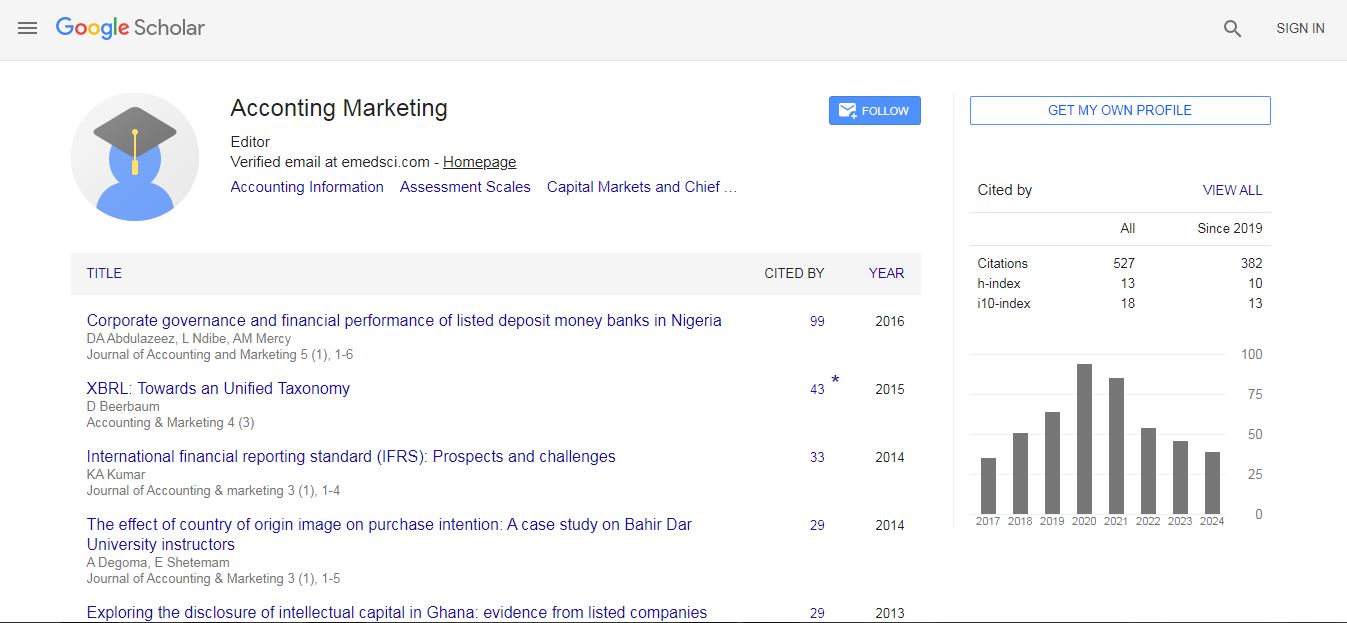
Accounting & Marketing received 487 citations as per Google Scholar report