Commentary - (2025) Volume 14, Issue 4
Received: 02-Jul-2025, Manuscript No. jamk-25-177288;
Editor assigned: 04-Jul-2025, Pre QC No. P-177288;
Reviewed: 18-Jul-2025, QC No. Q-177288;
Revised: 23-Jul-2025, Manuscript No. R-177288;
Published:
30-Jul-2025
, DOI: 10.37421/2168-9601.2025.14.562
Citation: Santos, Maria. ”Cost Management: Driving Performance, Profit, Innovation.” J Account Mark 14 (2025):562.
Copyright: © 2025 Santos M. This is an open-access article distributed under the terms of the Creative Commons Attribution License, which permits unrestricted use, distribution and reproduction in any medium, provided the original author and source are credited.
Strategic cost management practices are increasingly recognized as fundamental drivers for enhancing overall firm performance. This article delves into the intricate mechanisms through which these practices contribute to organizational success, specifically emphasizing the pivotal role of innovation capabilities. Innovation acts as a crucial mediating factor, translating efficient cost strategies into tangible improvements in business outcomes. Organizations that adeptly combine robust cost management frameworks with a strong focus on fostering innovation are positioned to not only achieve superior financial results but also to cultivate a sustained competitive advantage in dynamic markets [1].
Activity-Based Costing (ABC) is presented as a powerful methodology for transforming strategic decision-making and boosting overall organizational performance. This method facilitates accurate cost allocation, providing managers with precise insights into the true cost drivers of activities and products. Such detailed cost information empowers leaders to make more informed and strategic choices, ultimately contributing to increased profitability and operational efficiency across the enterprise [2].
The adoption of lean accounting practices is shown to profoundly influence organizational profitability by focusing on value stream optimization and waste reduction. By providing timely and relevant financial information, lean accounting enables businesses to identify and eliminate non-value-added activities. This strategic focus on efficiency and continuous improvement leads to substantial enhancements in financial performance and strengthens the company's competitive standing in the market [3].
Target costing systems are highlighted as an effective tool for manufacturing companies aiming to achieve desired product profitability from the outset. This proactive approach involves setting a target cost early in the product development cycle, guiding design and production decisions to ensure profitability goals are met. By actively managing costs before production, companies can mitigate financial risks and deliver products that are both competitive and financially viable [4].
Environmental cost accounting significantly impacts financial performance, with environmental innovation serving as a crucial mediator. This study suggests that organizations effectively tracking and managing environmental costs not only reduce their ecological footprint but also stimulate innovative solutions. These innovations, in turn, lead to improved financial results and foster sustainable profit maximization, demonstrating a clear link between ecological responsibility and economic benefit [5].
Strategic management accounting practices are vital for enhancing the financial performance of Small and Medium Enterprises (SMEs). Integrating strategic cost information into decision-making processes allows SMEs to gain a clearer understanding of their cost structures and market positioning. This adoption empowers them to make more informed strategic choices, which are essential for improving profitability and ensuring sustainable growth in a competitive business environment [6].
Effective budgeting and stringent cost control mechanisms are critical for improving the financial performance of manufacturing companies. This research underscores how meticulous planning and rigorous oversight of expenditures lead to greater operational efficiency and reduced waste. Ultimately, these disciplined financial practices translate into enhanced profit margins, solidifying the financial health and competitive viability of manufacturing enterprises [7].
The effective utilization of quality cost information profoundly influences a firm's financial performance. By systematically tracking and analyzing costs associated with quality, businesses can identify areas for improvement, reduce defects, and optimize operational processes. This proactive management of quality-related expenses not only minimizes waste but also significantly boosts profitability, demonstrating the economic value of investing in quality assurance [8].
Digitalization is transforming cost accounting practices, reshaping how organizations manage and analyze their costs. This systematic literature review reveals how emerging technologies enable more precise data collection, advanced analytical capabilities, and deeper strategic insights. These digital advancements are crucial for developing future profit maximization strategies, allowing businesses to adapt and thrive in an increasingly data-driven economic landscape [9].
The integration of life cycle costing with sustainability performance offers a holistic view of costs throughout a product's entire life cycle. This approach considers not only economic but also environmental and social aspects, fostering sustainable business models. By accounting for long-term impacts, companies can make informed decisions that enhance profitability and contribute to greater sustainability, creating enduring value for stakeholders and the planet [10].
This article meticulously examines the mechanisms by which strategic cost management practices contribute to a stronger firm performance. It particularly emphasizes that innovation capabilities act as a vital mediating element in this relationship. The findings suggest that companies capable of synergistically blending their cost strategies with innovative approaches are better equipped to achieve superior financial outcomes, thereby securing a durable competitive advantage in their respective markets [1]. This study thoroughly investigates the practical implementation of Activity-Based Costing (ABC) and its substantial positive impact on refining strategic decision-making processes. The research demonstrates how the accurate and granular cost allocation provided by ABC empowers management with clearer financial insights. This enhanced clarity enables executives to make more judicious and effective choices that directly translate into improved organizational performance and heightened profitability [2]. The research conducted delves into the specific ways lean accounting practices can significantly elevate organizational profitability. It elucidates that by concentrating on optimizing value streams, diligently reducing waste, and ensuring the timely provision of financial intelligence, businesses can realize considerable improvements. These integrated practices collectively bolster a companyâ??s financial health and sharpen its competitive edge within the industry [3]. This paper meticulously details the efficacy of target costing systems as deployed in manufacturing companies, specifically in their quest for predetermined product profitability. It convincingly illustrates that by establishing a target cost early in the product development cycle, firms can proactively manage expenses. This foresight ensures that new products are engineered to meet precise profit objectives, thereby minimizing financial deviations and maximizing market potential [4]. The study meticulously explores the intricate link between environmental cost accounting and a firmâ??s financial performance, positing environmental innovation as a crucial intervening factor. It reveals that businesses which effectively monitor and control their environmental expenditures are more likely to foster innovative solutions. Such innovations, in turn, are shown to lead to superior financial results and promote long-term, sustainable profit maximization [5]. This article systematically investigates the widespread adoption and profound implications of strategic management accounting practices on the financial performance of Small and Medium Enterprises (SMEs). It conclusively determines that when SMEs integrate strategic cost information into their fundamental decision-making processes, they are significantly empowered. This integration enables them to robustly enhance their profitability and sustain long-term organizational growth [6]. This research definitively highlights the indispensable role played by effective budgeting and rigorous cost control mechanisms in strengthening the financial performance of manufacturing sector entities. It thoroughly illustrates how these disciplined financial practices lead to markedly greater operational efficiency and a substantial reduction in waste. Ultimately, these measures are critical for achieving enhanced profit margins and securing robust financial health [7]. The study methodically examines how the astute application of quality cost information can exert a considerable influence on a firm's financial performance. It strongly asserts that by systematically tracking and meticulously analyzing all costs associated with maintaining product and service quality, businesses can decisively optimize their operational workflows. This leads to fewer defects, higher customer satisfaction, and a significant boost in overall profitability [8]. This systematic literature review comprehensively explores the revolutionary impact of digitalization on contemporary cost accounting practices. It precisely identifies how rapidly advancing new technologies are fundamentally reshaping the landscape of cost management. These advancements facilitate more accurate data collection, enable sophisticated analytical capabilities, and provide strategic insights that are indispensable for future profit maximization strategies in an evolving global economy [9]. This review meticulously investigates the critical integration of life cycle costing with sustainability performance, revealing a comprehensive approach to cost analysis. It emphasizes how a holistic evaluation of costs across a productâ??s entire lifespan, encompassing environmental and social dimensions, can drive significant long-term profitability. Such an integrated perspective fosters the development of truly sustainable business models that benefit both the enterprise and society [10].
This collection of studies extensively explores various facets of cost management and their profound impact on organizational performance, profitability, and strategic decision-making. Key themes emerge, including the critical role of strategic cost management, Activity-Based Costing (ABC), lean accounting, and target costing in enhancing financial outcomes across diverse sectors, including manufacturing and SMEs. Innovation capabilities are frequently highlighted as a mediating factor, connecting cost strategies with improved firm performance and sustainable competitive advantage. The importance of managing specific cost categories, such as environmental and quality costs, is also emphasized, demonstrating how their effective tracking and optimization can drive innovation and boost profitability. Furthermore, the transformative influence of digitalization on cost accounting practices is recognized, pointing towards more precise data analysis and strategic insights crucial for future profit maximization. Collectively, these articles underscore the indispensable nature of sophisticated cost management techniques for achieving operational efficiency, robust financial health, and long-term sustainability in modern businesses.
None
None
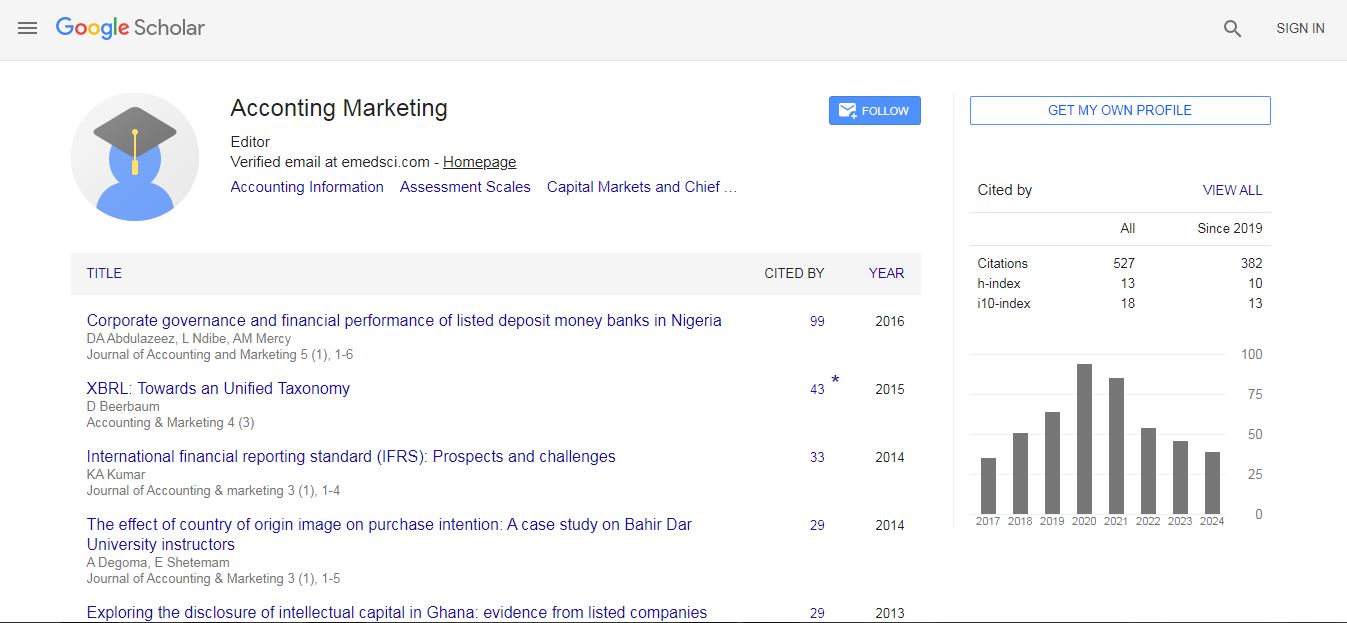
Accounting & Marketing received 487 citations as per Google Scholar report