Opinion - (2025) Volume 10, Issue 3
Received: 01-Sep-2025, Manuscript No. jib-25-175273;
Editor assigned: 03-Sep-2025, Pre QC No. P-175273;
Reviewed: 17-Sep-2025, QC No. Q-175273;
Revised: 22-Sep-2025, Manuscript No. R-175273;
Published:
29-Sep-2025
, DOI: 10.37421/2476-1966.2025.10.282
Citation: Barlow, Naomi. ”Complement: A Double-Edged Sword in Disease.” J Immuno Biol 10 (2025):282.
Copyright: © 2025 Barlow N. This is an open-access article distributed under the terms of the Creative Commons Attribution License, which permits unrestricted use, distribution and reproduction in any medium, provided the original author and source are credited.
The complement system, an integral component of innate immunity, plays a multifaceted and often dual role in the pathophysiology of diverse human diseases. Understanding its complex interplay, encompassing both protective functions and detrimental contributions when dysregulated, is fundamental for advancing diagnostic approaches and developing targeted therapeutic interventions. This introduction explores the broad impact of the complement system across medical fields, from neurodegeneration and autoimmune conditions to infectious diseases, cancer, and specific organ pathologies, emphasizing the critical need for precise modulation of its activity. This article explores how the complement system, a key part of innate immunity, plays a dual role in neurodegenerative diseases. While complement helps clear pathogens and debris, its dysregulation can fuel neuroinflammation and directly damage neurons and synapses, contributing to conditions like Alzheimer's and Parkinson's. Understanding this balance is crucial for developing targeted therapies [1].
This review focuses on the complement system's involvement in Systemic Lupus Erythematosus (SLE), an autoimmune disease. It details how both genetic deficiencies and acquired abnormalities in complement components contribute to SLE pathogenesis, leading to inflammation and tissue damage. Current and emerging therapeutic strategies specifically target the complement cascade to manage the disease [2].
This article examines the significant role of the complement system in the pathology of COVID-19. It explains how uncontrolled complement activation can drive severe inflammation, thrombosis, and organ damage in critically ill patients. Potential diagnostic markers and therapeutic interventions that modulate complement activity could improve outcomes in COVID-19 [3].
This paper investigates the complex, dual role of the complement system in cancer development and progression. Complement can initially contribute to anti-tumor immunity by enhancing immune surveillance, but it can also be co-opted by tumors to promote growth, metastasis, and immune evasion. Understanding this duality is critical for designing complement-targeted cancer therapies [4].
This review provides an overview of current and emerging strategies for therapeutically targeting the complement system. It discusses various approved and developing drugs that inhibit different components of the complement cascade. The article emphasizes the potential of these inhibitors in treating a wide range of complement-mediated diseases, from rare genetic disorders to more common inflammatory conditions [5].
This article delves into the critical involvement of the complement system in the pathogenesis of various glomerular diseases. It elucidates how dysregulation of complement activation, particularly the alternative pathway, leads to kidney injury and inflammation. The paper also discusses the diagnostic value of complement biomarkers and the therapeutic potential of complement inhibitors in managing these debilitating renal conditions [6].
This overview outlines the intricate regulatory mechanisms that control the complement system to prevent host tissue damage while maintaining its immune protective functions. It details various soluble and membrane-bound regulators that finely tune complement activation, preventing excessive or misdirected responses. Understanding these regulatory processes is key to developing treatments for complement-mediated diseases [7].
This paper discusses the significant role of the complement system in the pathogenesis of various retinal diseases, particularly age-related macular degeneration (AMD). It highlights how chronic, low-grade complement activation contributes to inflammation, drusen formation, and retinal damage. The article explores complement components as potential biomarkers and therapeutic targets for preserving vision [8].
This review explores the involvement of the complement system in Multiple Sclerosis (MS), an autoimmune neuroinflammatory disease. It details how complement activation contributes to demyelination, axonal damage, and inflammation in the central nervous system. Modulating complement activity could represent a promising therapeutic avenue for MS, given its central role in disease pathology [9].
This systematic review synthesizes the current understanding of the complement system's role in sepsis, a life-threatening condition caused by the body's overwhelming response to infection. It discusses how dysregulated complement activation contributes to systemic inflammation, organ dysfunction, and coagulopathy in septic patients. The article highlights complement as a potential diagnostic marker and therapeutic target for improving outcomes in sepsis [10].
The complement system, a crucial arm of innate immunity, plays a surprisingly diverse and often critical role in the pathogenesis of numerous human diseases, extending far beyond its traditional perception as a simple defense mechanism. Its complex activity, which can be both protective and destructive, forms a central theme across recent research. Delving into specific conditions reveals the intricate ways complement dysregulation contributes to illness, while also highlighting opportunities for therapeutic intervention.
Neurodegenerative diseases like Alzheimer's and Parkinson's exemplify the dual nature of the complement system [1]. While it is essential for clearing pathogens and cellular debris, a dysregulated complement response can paradoxically exacerbate conditions. This hyperactivation leads to neuroinflammation and direct damage to neurons and synapses, significantly contributing to disease progression. Understanding this delicate balance is paramount for developing targeted therapies that can selectively inhibit detrimental complement activity without compromising its beneficial immune functions.
Beyond the brain, the complement system is deeply implicated in systemic autoimmune conditions such as Systemic Lupus Erythematosus (SLE) [2]. Here, both inherited genetic deficiencies and acquired abnormalities in complement components drive the disease's pathogenesis. This leads to chronic inflammation and widespread tissue damage across various organs. Research efforts are increasingly focused on therapeutic strategies that specifically target the complement cascade, aiming to interrupt this damaging cycle and manage SLE more effectively.
The global health crisis of COVID-19 further underscored the complement system's critical role in severe infectious diseases [3]. Uncontrolled complement activation during COVID-19 infection was found to drive severe inflammation, lead to dangerous thrombotic events, and cause multi-organ damage in critically ill patients. This revelation has prompted a vigorous search for potential diagnostic markers to identify patients at risk of severe outcomes and therapeutic interventions designed to modulate complement activity, potentially improving patient survival and recovery.
In the realm of oncology, the complement system presents another fascinating duality [4]. Initially, complement can contribute to anti-tumor immunity by enhancing immune surveillance, effectively helping the body recognize and eliminate cancer cells. However, tumors are incredibly adaptable; they can co-opt complement pathways to promote their own growth, facilitate metastasis, and evade immune detection. This intricate balance between anti-tumor and pro-tumor complement functions necessitates a nuanced approach when designing complement-targeted cancer therapies, aiming to harness its beneficial effects while blocking its detrimental contributions.
The therapeutic targeting of the complement system represents a rapidly evolving field, given its widespread involvement in disease [5]. Numerous drugs, both approved for clinical use and currently under development, aim to inhibit various components of the complement cascade. These inhibitors hold immense potential for treating a broad spectrum of complement-mediated conditions, ranging from rare genetic disorders, where complement dysfunction is a primary driver, to more common inflammatory conditions where it plays a significant exacerbating role.
Organ-specific pathologies also reveal the complement system's profound impact. In glomerular diseases affecting the kidneys, dysregulation of complement activation, particularly involving the alternative pathway, is a key driver of kidney injury and inflammation [6]. The diagnostic value of complement biomarkers in identifying these conditions and the therapeutic potential of complement inhibitors in managing them are subjects of intensive research. Similarly, in retinal diseases, notably age-related macular degeneration (AMD), chronic, low-grade complement activation contributes significantly to inflammation, drusen formation, and subsequent retinal damage, highlighting complement components as critical biomarkers and therapeutic targets for preserving vision [8].
Maintaining the body's delicate equilibrium relies on intricate regulatory mechanisms that control the complement system [7]. These soluble and membrane-bound regulators finely tune complement activation, preventing excessive or misdirected responses that could harm host tissues while still allowing for effective immune protective functions. A comprehensive understanding of these regulatory processes is fundamental for developing precise and safe treatments for complement-mediated diseases, ensuring therapeutic interventions do not inadvertently compromise essential immune defenses.
Finally, autoimmune neuroinflammatory conditions like Multiple Sclerosis (MS) demonstrate the complement system's involvement in central nervous system damage [9]. Complement activation contributes directly to demyelination, axonal damage, and inflammation within the brain and spinal cord. Modulating complement activity, therefore, represents a promising therapeutic avenue for MS, given its central role in disease pathology. Furthermore, a systematic review underscores the complement system's significant role in sepsis, a life-threatening condition where dysregulated complement activation contributes to systemic inflammation, organ dysfunction, and coagulopathy, solidifying its importance as a diagnostic marker and therapeutic target for improving patient outcomes [10].
The complement system, a vital part of innate immunity, plays a complex and often dual role across a spectrum of human diseases. In neurodegenerative conditions like Alzheimer's and Parkinson's, complement helps clear pathogens but its dysregulation can fuel neuroinflammation and directly damage neurons and synapses [1]. Similarly, in cancer, complement can initially aid anti-tumor immunity by enhancing immune surveillance, yet tumors can also co-opt it to promote growth, metastasis, and immune evasion [4]. This intricate balance is crucial for developing targeted therapies in both areas. The system's involvement extends to autoimmune diseases such as Systemic Lupus Erythematosus (SLE), where genetic deficiencies and acquired abnormalities in complement components drive pathogenesis, inflammation, and tissue damage [2]. Furthermore, uncontrolled complement activation is a significant factor in the severe inflammation, thrombosis, and organ damage observed in critically ill COVID-19 patients [3], as well as in the systemic inflammation and dysfunction seen in sepsis [10]. Beyond these systemic challenges, complement dysregulation is central to specific organ-focused pathologies. It contributes to kidney injury and inflammation in glomerular diseases, particularly through the alternative pathway [6]. In the eyes, chronic, low-grade complement activation is implicated in retinal diseases, including age-related macular degeneration (AMD), contributing to inflammation and damage [8]. Neuroinflammatory conditions like Multiple Sclerosis (MS) also see complement activation contributing to demyelination and axonal damage in the central nervous system [9]. Given this broad involvement, understanding the intricate regulatory mechanisms that control complement activation is paramount to prevent host tissue damage [7]. Therapeutic strategies are emerging, with both approved and developing drugs targeting various components of the complement cascade, offering potential treatments for a wide range of complement-mediated diseases, from rare genetic disorders to more common inflammatory conditions [5].
None
None
Wang, X, Lv, M, Zhao, W. "Neuroinflammation and complement system in neurodegenerative diseases.".Cell Mol Neurobiol 43 (2023):1165-1181.
Indexed at, Google Scholar, Crossref
Frangou, E, Bertsias, GK, Fanouriakis, A. "Targeting the Complement System in Systemic Lupus Erythematosus.".Front Immunol 13 (2022):948743.
Indexed at, Google Scholar, Crossref
Ramadan, KS, Ahmed, RM, El-Sayed, RA. "The complement system in COVID-19: implications for diagnosis and therapy.".Egypt J Intern Med 35 (2023):16.
Indexed at, Google Scholar, Crossref
Sun, Z, Li, S, Wang, T. "The Dual Role of Complement in Cancer: From Tumor Immune Surveillance to Immune Evasion.".Front Immunol 12 (2021):650742.
Indexed at, Google Scholar, Crossref
Morgan, BP, Harris, CL, Kemper, C. "Therapeutic Targeting of the Complement System: A Review of Current and Emerging Strategies.".Front Immunol 13 (2023):1108253.
Indexed at, Google Scholar, Crossref
Paixao, R, Zand, L, Cattran, D. "The Complement System in Glomerular Diseases.".Clin J Am Soc Nephrol 17 (2022):1227-1238.
Indexed at, Google Scholar, Crossref
Rai, RR, Khera, D, Sharma, D. "Regulation of the Complement System: An Overview.".Mini Rev Med Chem 22 (2022):2439-2454.
Indexed at, Google Scholar, Crossref
Bhattarai, M, Song, D, Li, B. "The Complement System in Retinal Disease.".Int J Mol Sci 23 (2022):3001.
Indexed at, Google Scholar, Crossref
Ljubojevic-Holzer, S, Reindl, M, Lutterotti, A. "Complement System: An Overlooked Target for Therapy in Multiple Sclerosis?".Int J Mol Sci 22 (2021):2465.
Indexed at, Google Scholar, Crossref
Kishore, U, Gaboriaud, C, Schwaeble, WJ. "The Complement System in Sepsis: A Systematic Review.".Front Immunol 11 (2020):25.
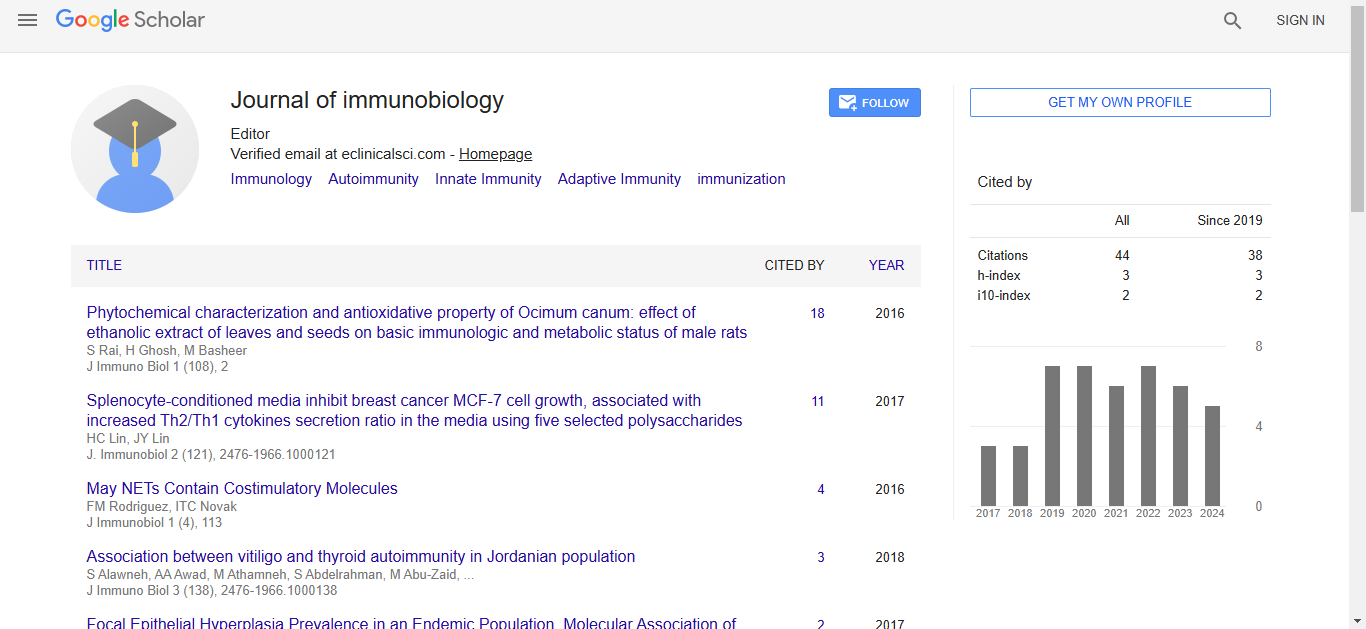
Journal of Immunobiology received 34 citations as per Google Scholar report