Perspective - (2025) Volume 10, Issue 2
Received: 01-Apr-2025, Manuscript No. cgj-26-186510;
Editor assigned: 03-Apr-2025, Pre QC No. P-186510;
Reviewed: 17-Apr-2025, QC No. Q-186510;
Revised: 22-Apr-2025, Manuscript No. R-186510;
Published:
29-Apr-2025
, DOI: 10.37421/2952-8518.2025.10.306
Citation: Romano, Isabella. ”Colonoscopy Screening: Advanced Detection of Colorectal Cancer.” Clin Gastroenterol J 10 (2025):306.
Copyright: © 2025 Romano I. This is an open-access article distributed under the terms of the Creative Commons Attribution License, which permits unrestricted use, distribution and reproduction in any medium, provided the original author and source are credited.
Recent advancements in colonoscopy screening and polyp detection are significantly enhancing colorectal cancer prevention. Innovations include improved imaging technologies like high-definition and narrow-band imaging, which offer superior visualization of subtle mucosal changes. Artificial intelligence (AI)-assisted detection systems are also emerging, showing promise in reducing miss rates by highlighting suspicious polyps in real-time, thereby improving the quality and consistency of colonoscopies. Furthermore, refinements in techniques such as endoscope design and improved patient preparation are contributing to higher adenoma detection rates and overall procedure efficacy. [1] Advanced endoscopic imaging, particularly narrow-band imaging (NBI) and its applications, aids in differentiating between neoplastic and non-neoplastic polyps during colonoscopy. The enhanced contrast provided by NBI allows endoscopists to better visualize vascular patterns and surface morphology, leading to more precise characterization and management decisions, potentially reducing unnecessary biopsies and excisions of benign lesions. [2] The integration of artificial intelligence in colonoscopy represents a paradigm shift in polyp detection. AI algorithms trained on large datasets can analyze video feeds in real-time, flagging polyps that might be missed by the human eye. This technology aims to standardize the quality of colonoscopy and improve adenoma detection rates across different endoscopists and patient populations. [3] The impact of endoscope design and maneuverability on colonoscopy performance, including polyp detection rates, is explored. Newer endoscopes with enhanced flexibility and control can improve navigation in tortuous colonic anatomy, potentially leading to more thorough examinations and reduced cecal intubation times. This directly contributes to better screening outcomes. [4] The role of adjuncts to colonoscopy, such as cap-assisted colonoscopy, in improving polyp detection is investigated. Caps can flatten the colonic mucosa, improving visualization of flat or sessile polyps, which are often harder to detect. This technique has shown promise in increasing adenoma detection rates, particularly in the distal colon. [5] The evolution of colonoscopy techniques beyond standard white-light endoscopy, focusing on chromoendoscopy and other advanced visualization methods, is discussed. These techniques involve applying dyes or using specific light spectra to highlight mucosal irregularities, thereby enhancing polyp detection and characterization, crucial for early cancer detection. [6] The impact of different bowel preparation strategies on colonoscopy quality and polyp detection is a critical area of research. Optimal preparation ensures a clear view of the colonic mucosa, reducing the likelihood of missed lesions. This paper examines newer agents and strategies that aim to improve patient tolerance and efficacy. [7] The potential of artificial intelligence to enhance the skills of less experienced endoscopists is investigated. By providing real-time feedback and polyp detection assistance, AI could help bridge the gap in adenoma detection rates between novice and experienced practitioners, thus standardizing colonoscopy quality. [8] The evolving landscape of colonoscopy technology includes advancements in endoscope optics and imaging processing. High-definition (HD) colonoscopy offers superior resolution compared to standard definition, allowing for better visualization of subtle mucosal features, which is essential for detecting diminutive polyps and early neoplastic lesions. [9] The clinical utility and implementation challenges of computer-aided detection (CAD) systems in colonoscopy are reviewed. CAD systems, particularly those using AI, are designed to assist endoscopists by highlighting suspicious areas, aiming to reduce the miss rate of colorectal polyps and improve patient outcomes in screening programs. [10]
Recent advancements in colonoscopy screening and polyp detection are significantly enhancing colorectal cancer prevention through various technological innovations and technique refinements. Improved imaging technologies, such as high-definition and narrow-band imaging, offer superior visualization of subtle mucosal changes, crucial for identifying early signs of disease. Complementing these visual enhancements, artificial intelligence (AI)-assisted detection systems are emerging as powerful tools to reduce miss rates by highlighting suspicious polyps in real-time, thereby improving the overall quality and consistency of colonoscopic examinations. These technological leaps are further supported by ongoing refinements in procedural aspects, including advanced endoscope designs and optimized patient preparation protocols, all contributing to higher adenoma detection rates and improved efficacy of the procedure. [1] Advanced endoscopic imaging modalities, with a particular focus on narrow-band imaging (NBI) and its diverse applications, play a pivotal role in differentiating between neoplastic and non-neoplastic polyps during colonoscopy. The enhanced contrast capabilities inherent in NBI enable endoscopists to meticulously visualize the intricate vascular patterns and surface morphology of polyps. This improved visualization facilitates more precise characterization and informed management decisions, potentially leading to a reduction in unnecessary biopsies and excisions of benign lesions, thereby optimizing patient care. [2] The integration of artificial intelligence into the practice of colonoscopy marks a significant paradigm shift in the field of polyp detection. AI algorithms, meticulously trained on extensive datasets, possess the capability to analyze video feeds in real-time, effectively flagging polyps that might otherwise escape the notice of the human eye. The overarching objective of this technology is to standardize the quality of colonoscopic procedures and to systematically improve adenoma detection rates across a broad spectrum of endoscopists and diverse patient populations. [3] This study delves into the profound impact that both the design and the maneuverability of endoscopes have on the overall performance of colonoscopy, with a specific emphasis on polyp detection rates. Modern endoscopes, characterized by their enhanced flexibility and improved control mechanisms, facilitate more efficient navigation through the often tortuous anatomy of the colon. This enhanced navigability can translate into more comprehensive examinations and potentially reduced cecal intubation times, both of which are critical factors contributing to better screening outcomes and earlier detection of colorectal pathologies. [4] The role of specific adjuncts employed during colonoscopy, such as the utilization of cap-assisted colonoscopy, is meticulously investigated for its potential to enhance polyp detection capabilities. The application of a cap to the endoscope tip can effectively flatten the colonic mucosa, thereby significantly improving the visualization of flat or sessile polyps, which are notoriously more challenging to detect using conventional methods. This specific technique has demonstrated considerable promise in augmenting adenoma detection rates, particularly within the distal segments of the colon. [5] This article provides a comprehensive discussion on the evolution of colonoscopy techniques, extending beyond the capabilities of standard white-light endoscopy. It specifically highlights the advancements in chromoendoscopy and other sophisticated optical visualization methods. These advanced techniques involve the application of specialized dyes or the utilization of specific light spectra to accentuate mucosal irregularities, thereby significantly enhancing the detection and characterization of polyps, a crucial step in the early diagnosis of colorectal cancer. [6] The critical influence of diverse bowel preparation strategies on the overall quality of colonoscopy and the subsequent detection of polyps is examined as a key area of ongoing research. Optimal bowel preparation is an indispensable prerequisite, ensuring a clear and unobstructed view of the colonic mucosa, which directly reduces the likelihood of inadvertently missing any lesions. This particular study undertakes an examination of newer pharmacological agents and innovative strategies that are specifically designed to improve both patient tolerance and the overall efficacy of bowel preparation protocols. [7] This investigation explores the remarkable potential of artificial intelligence to significantly augment the diagnostic skills of endoscopists with less extensive experience. By offering real-time feedback and dedicated assistance in polyp detection, AI has the capacity to effectively bridge the existing disparity in adenoma detection rates observed between novice and highly experienced practitioners. Ultimately, this technology aims to contribute to a more uniform and standardized quality of colonoscopic examinations across the board. [8] The continuously evolving landscape of colonoscopy technology encompasses significant advancements in the optical components and image processing capabilities of endoscopes. High-definition (HD) colonoscopy, in particular, delivers a markedly superior resolution when contrasted with standard-definition systems. This enhanced resolution is instrumental in allowing for a more detailed and precise visualization of subtle mucosal features, which is absolutely essential for the accurate detection of diminutive polyps and the identification of early-stage neoplastic lesions. [9] This review meticulously focuses on the practical clinical utility and the associated implementation challenges of computer-aided detection (CAD) systems within the context of colonoscopy procedures. CAD systems, with a particular emphasis on those employing sophisticated artificial intelligence algorithms, are specifically engineered to provide valuable assistance to endoscopists by adeptly highlighting areas of suspicion. The primary objective of these systems is to effectively reduce the miss rate of colorectal polyps and, consequently, to enhance patient outcomes within organized colorectal cancer screening programs. [10]
Colorectal cancer prevention is being significantly improved by recent advancements in colonoscopy screening and polyp detection. Innovations include enhanced imaging technologies like high-definition and narrow-band imaging for better visualization, and artificial intelligence (AI)-assisted systems that reduce miss rates by highlighting polyps in real-time. Refinements in endoscope design and patient preparation also contribute to higher detection rates. Advanced imaging, particularly NBI, helps differentiate polyps, while AI offers real-time detection assistance and can standardize quality, especially for less experienced endoscopists. Adjuncts like cap-assisted colonoscopy and techniques such as chromoendoscopy further improve polyp visualization and detection. Optimal bowel preparation remains crucial for clear visualization. High-definition colonoscopy provides superior resolution for detecting subtle lesions. Computer-aided detection systems using AI aim to reduce polyp miss rates and improve screening program outcomes.
None
None
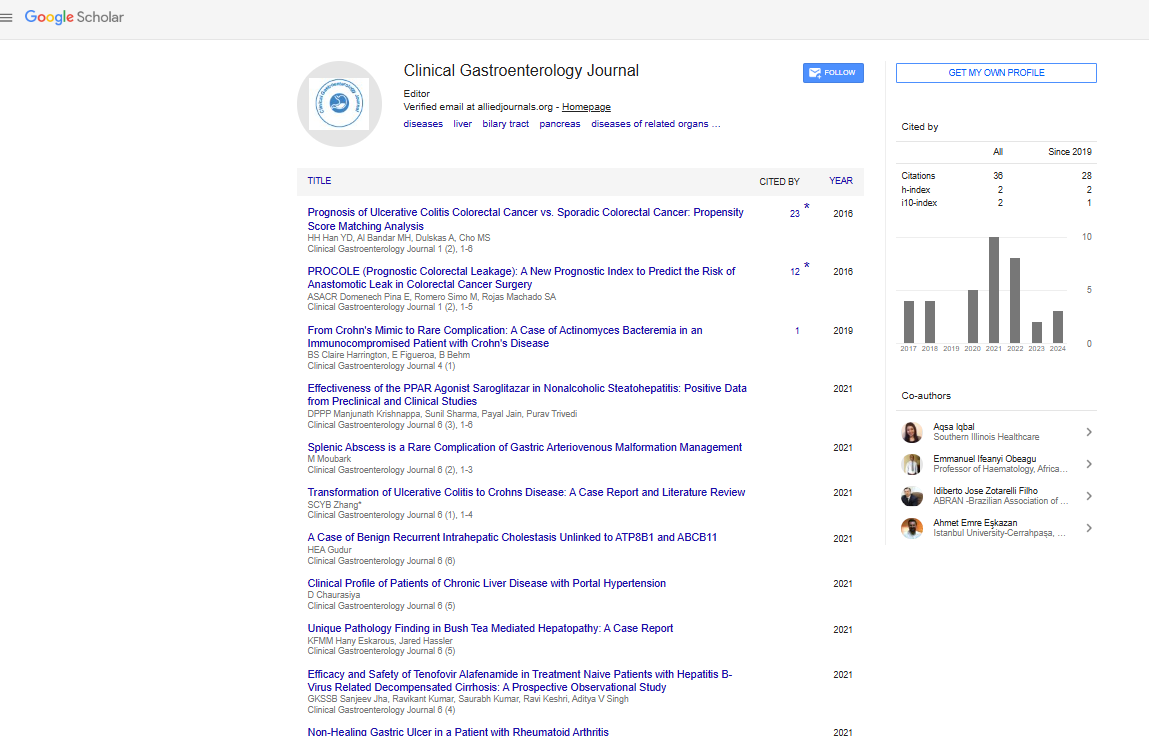
Clinical Gastroenterology Journal received 33 citations as per Google Scholar report