Opinion - (2025) Volume 10, Issue 3
Received: 01-Sep-2025, Manuscript No. jib-25-175274;
Editor assigned: 03-Sep-2025, Pre QC No. P-175274;
Reviewed: 17-Sep-2025, QC No. Q-175274;
Revised: 22-Sep-2025, Manuscript No. R-175274;
Published:
29-Sep-2025
, DOI: 10.37421/2476-1966.2025.10.283
Citation: Al-Bashir, Nour. ”Clonal Selection Drives Immunity, Disease, Therapy.” J Immuno Biol 10 (2025):283.
Copyright: © 2025 Al-Bashir N. This is an open-access article distributed under the terms of the Creative Commons Attribution License, which permits unrestricted use, distribution and reproduction in any medium, provided the original author and source are credited.
Clonal selection is a foundational concept in immunology, explaining how specific lymphocytes recognize and proliferate in response to antigens. This theory remains highly relevant, providing a robust framework for understanding the intricate mechanisms of adaptive immunity. Our immune system is highly specific, picking out and amplifying the cells best suited to fight a particular threat[1].
In T-cell acute lymphoblastic leukemia, clonal selection isn't just about immunity; it plays a critical role in how the cancer develops and progresses. A complex interplay exists between genetic mutations and immune interactions, driving the expansion of specific cancerous T-cell clones. Understanding this helps identify potential targets for therapy and predict disease outcomes[2].
Clonal selection of CD4+ T cells in the thymus is absolutely vital for immune tolerance. This process, where T cells are selected or eliminated based on their reactivity, directly impacts the likelihood of developing autoimmune diseases. This highlights the delicate balance needed to train our immune system to attack pathogens without harming our own tissues[3].
Burnet's clonal selection theory extends beyond traditional adaptive immunity, offering insights into how both innate and adaptive immune responses combat cancer. This perspective explains how the immune system shapes the tumor microenvironment and selects for certain immune cell populations to fight off malignancies, or sometimes, inadvertently promotes tumor escape. It's about understanding the evolutionary pressure within our bodies against cancer[4].
Clonal selection is fundamental to how antigen-specific B cell immunity develops and adapts over time. This process governs the diversification, expansion, and maturation of B cells, ensuring a highly effective humoral immune response against evolving threats. Itâ??s how our bodies learn and remember specific pathogens to provide long-lasting protection, laying the groundwork for long-term immunity[5].
Within the germinal center, B cell clonal selection is a finely tuned balance between recognizing antigens and competing with other B cell clones. This intense competition ensures that only the most effective, high-affinity B cells survive and proliferate, leading to an optimized antibody response. It works like a natural selection process happening inside our lymph nodes, constantly refining our immune defense to be as efficient as possible[6].
In COVID-19 patients, B cell clonal selection provides specific patterns of somatic hypermutation and affinity maturation. This data shows how the immune system adapts its B cell repertoire to effectively combat the SARS-CoV-2 virus, highlighting the dynamic nature of our immune response to novel pathogens. It's essentially a detailed look at how our bodies customize their fight against a new enemy, demonstrating remarkable adaptability[7].
The clonal selection of T-cells is not just about initial immune responses; it's also crucial for generating immunological memory. This process ensures that once an antigen is encountered, a specific subset of T cells will persist, ready to mount a faster and more robust response upon re-exposure. What this really means is that our immune system has a powerful, long-term memory, keeping us protected from previously encountered threats and enhancing future immunity[8].
In primary myelofibrosis, understanding the dynamics of clonal selection is key to unraveling disease progression. This involves identifying which specific hematopoietic stem cell clones expand and contribute to the pathology. By tracking these dominant clones, we gain critical insights into how the disease evolves and how best to intervene, providing crucial information for targeted therapies[9].
Clonal selection of T cells within the tumor microenvironment is a fascinating area of research. It dictates how immune cells interact with cancer cells and influences the success or failure of immunotherapy. Specific clones of immune cells are selected within a tumor, and their activity determines whether the body can fight the cancer effectively, impacting treatment outcomes significantly[10].
Clonal selection forms the bedrock of immunology, elucidating how the immune system precisely recognizes and expands specific lymphocytes when exposed to antigens. This fundamental theory provides a solid framework for understanding the intricate workings of adaptive immunity, ensuring our immune system is not random but highly specific in selecting and amplifying the cells best equipped to combat a given threat [1]. This principle is also fundamental to the development and adaptation of antigen-specific B cell immunity over time. It guides the diversification, expansion, and maturation of B cells, which is essential for a highly effective humoral immune response against evolving pathogens. Essentially, it is how our bodies learn and retain memory of specific pathogens to offer lasting protection [5]. Similarly, the clonal selection of T-cells is critical for generating immunological memory. When an antigen is first encountered, a specialized subset of T cells persists, poised to mount a quicker and more potent response upon subsequent exposures, ensuring our immune system possesses a powerful, long-term memory against previously met threats [8].
The clonal selection of CD4+ T cells in the thymus is crucial for establishing immune tolerance. This intricate process involves the selection or elimination of T cells based on their reactivity, directly influencing the susceptibility to autoimmune diseases. It highlights the delicate balance required to train our immune system to attack pathogens effectively without harming our own healthy tissues [3]. Furthermore, in conditions like T-cell acute lymphoblastic leukemia, clonal selection takes on a critical role beyond typical immunity, influencing the development and progression of cancer. Here, a complex interplay of genetic mutations and immune interactions drives the expansion of specific cancerous T-cell clones, providing insights that are crucial for identifying potential therapeutic targets and predicting disease outcomes [2]. Clonal selection of T cells within the tumor microenvironment is another vital area of research, as it dictates how immune cells interact with cancer cells and significantly influences the success or failure of immunotherapy. It clarifies that the immune cells within a tumor are not random; rather, specific clones are selected, and their activity determines the body's capacity to effectively fight the cancer [10].
Within the germinal center, B cell clonal selection represents a finely balanced dynamic between antigen recognition and competition among B cell clones. This competitive environment ensures that only the most effective, high-affinity B cells survive and proliferate, leading to an optimized and precise antibody response. It functions much like a natural selection process unfolding within our lymph nodes, continuously refining our immune defense mechanisms [6]. This process's adaptability is evident in COVID-19 patients, where B cell clonal selection exhibits specific patterns of somatic hypermutation and affinity maturation. This data reveals how the immune system effectively adapts its B cell repertoire to combat the SARS-CoV-2 virus, underscoring the dynamic nature of our immune response to novel pathogens and demonstrating how our bodies customize their defense against new enemies [7].
Burnet's clonal selection theory extends its insights beyond traditional adaptive immunity to encompass how both innate and adaptive immune responses engage in combating cancer. This expanded perspective helps elucidate how the immune system shapes the tumor microenvironment and selectively favors certain immune cell populations to fight off malignancies, or, in some instances, inadvertently promotes tumor escape. It signifies a deeper understanding of the inherent evolutionary pressure within our bodies against cancer [4]. Moreover, in diseases such as primary myelofibrosis, comprehending the dynamics of clonal selection is essential for understanding disease progression. This involves the critical identification of specific hematopoietic stem cell clones that expand and contribute to the pathology. By diligently tracking these dominant clones, vital insights into how the disease evolves and the most effective intervention strategies can be gained [9].
Clonal selection is a fundamental principle in immunology, explaining how the immune system specifically recognizes and proliferates lymphocytes in response to antigens. This process is not random; it precisely identifies and amplifies cells best suited to fight particular threats. Beyond its role in adaptive immunity, clonal selection plays a critical part in cancer development and progression, such as in T-cell acute lymphoblastic leukemia, where genetic mutations and immune interactions drive the expansion of cancerous T-cell clones. Understanding this interplay helps identify therapeutic targets. The selection of CD4+ T cells in the thymus is vital for immune tolerance, influencing the risk of autoimmune diseases by training the immune system to attack pathogens without harming self-tissues. Burnet's theory extends to innate and adaptive immune responses against cancer, revealing how the immune system shapes the tumor microenvironment and selects immune cell populations, sometimes inadvertently promoting tumor escape. Clonal selection is central to the development and adaptation of antigen-specific B cell immunity, governing their diversification, expansion, and maturation for effective humoral responses and long-lasting protection. In the germinal center, B cell clonal selection balances antigen recognition and competition, optimizing antibody responses. This is evident in COVID-19 patients, where specific patterns of somatic hypermutation and affinity maturation show how B cell repertoires adapt to novel viruses. Furthermore, clonal selection is crucial for generating T-cell immunological memory, ensuring faster, more robust responses upon re-exposure to previously encountered threats. In pathologies like primary myelofibrosis and the tumor microenvironment, understanding clonal selection dynamics helps unravel disease progression and informs immunotherapy strategies by tracking dominant cell clones.
None
None
David GS, Jean-Claude W, Claude-Agnès R. "The Clonal Selection Theory: An Enduring Framework for Understanding Immunity.".Ann. Rev. Immunol. 41 (2023):1-19.
Indexed at, Google Scholar, Crossref
M. AM, D. EM, D. AK. "Clonal selection in T-cell acute lymphoblastic leukemia: A complex interplay of genetics and immunity.".Blood 143 (2024):85-95.
Indexed at, Google Scholar, Crossref
Jianan Y, Huijuan Y, Junxia W. "Clonal selection of CD4+ T cells in the thymus and its role in autoimmune disease.".Front. Immunol. 13 (2022):1032398.
Indexed at, Google Scholar, Crossref
Robert HW, David RS, Janna HP. "Revisiting Burnet's clonal selection theory in the context of innate and adaptive immunity to cancer.".Cancer Immunol. Immunother. 71 (2022):2367-2384.
Indexed at, Google Scholar, Crossref
Gabriel DV, Michel CN, Jeffrey VR. "Clonal selection shapes the dynamics of antigen-specific B cell immunity.".Nat. Rev. Immunol. 21 (2021):497-512.
Indexed at, Google Scholar, Crossref
Jiarui C, Junhua W, Hongbing R. "Clonal selection of B cells in the germinal center is a balance between antigen recognition and competition.".Front. Immunol. 12 (2021):672054.
Indexed at, Google Scholar, Crossref
I. AZ, A. SB, S. MK. "B cell clonal selection in COVID-19 patients suggests specific patterns of somatic hypermutation and affinity maturation.".Cells 10 (2021):3418.
Indexed at, Google Scholar, Crossref
Thomas BNPM, Peter JMvdH, Michiel JJG. "Clonal selection of T-cells and the generation of immunological memory.".Cell Mol Life Sci 78 (2021):3889-3904.
Indexed at, Google Scholar, Crossref
Paola MP, Carolina T, Alessandro B. "Understanding the Dynamics of Clonal Selection in Primary Myelofibrosis.".Hemasphere 4 (2020):e512.
Indexed at, Google Scholar, Crossref
Kai-Wen Y, Hsiao-Lung H, Chin-Chung C. "Clonal Selection of T Cells in the Tumor Microenvironment.".Cancers (Basel) 12 (2020):2901.
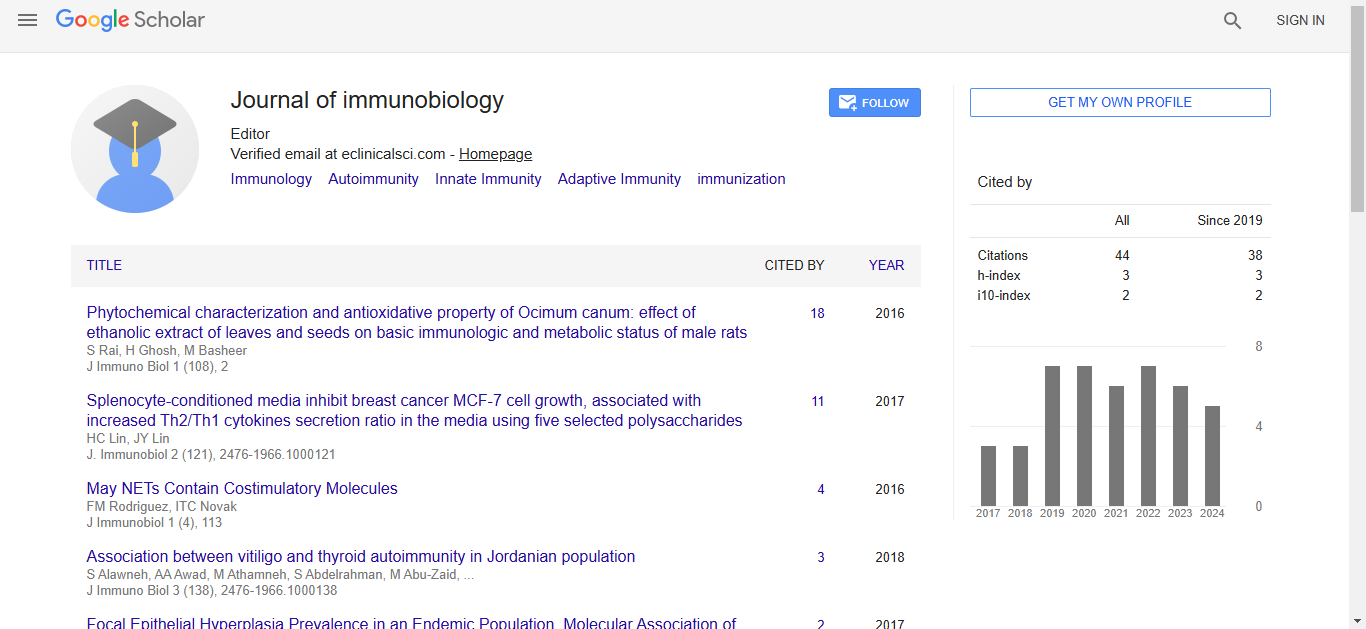
Journal of Immunobiology received 34 citations as per Google Scholar report