Brief Report - (2025) Volume 14, Issue 6
Received: 01-Nov-2025, Manuscript No. jamk-25-177328;
Editor assigned: 03-Nov-2025, Pre QC No. P-177328;
Reviewed: 17-Nov-2025, QC No. Q-177328;
Revised: 24-Nov-2025, Manuscript No. R-177328;
Published:
29-Nov-2025
, DOI: 10.37421/2168-9601.2025.14.584
Citation: Papadopoulos, George. ”Budgeting’s Diverse Evolution, Impact, and Resilience.” J Account Mark 14 (2025):584
Copyright: © 2025 Papadopoulos G. This is an open-access article distributed under the terms of the Creative Commons Attribution License, which permits unrestricted use, distribution and reproduction in any medium, provided the original author and source are credited.
Integrated reporting significantly influences budgeting practices in South African companies. This approach fosters more comprehensive budget creation, enabling closer alignment between financial and non-financial aspects. Organizations can achieve better decision-making for resource allocation by considering a broader range of capitals, ultimately enhancing strategic coherence [1].
Budgeting and organizational slack are critical factors affecting performance in higher education institutions. While robust budgeting is essential for financial stewardship, the presence of organizational slack, characterized by unutilized resources, can improve performance. This slack provides institutions with the necessary flexibility to effectively respond to unforeseen challenges or capitalize on emerging opportunities, highlighting a nuanced balance [2].
The landscape of traditional management control systems is undergoing profound transformation due to concepts such as 'beyond budgeting', agile management, and digital transformation. These contemporary approaches advocate a departure from rigid annual budgets, instead promoting more dynamic and adaptive planning methodologies. Such flexibility is increasingly vital for organizations navigating today's rapidly evolving business environment, signaling a paradigm shift in financial control [3].
Public sector budgeting plays a pivotal role in supporting the achievement of sustainable development goals (SDGs). A systematic review emphasizes the critical need for more integrated budgetary approaches that directly link financial allocations to specific SDG outcomes. This necessitates a shift from conventional line-item budgeting towards performance-based and programmatic budgeting models, aiming for greater global impact and accountability [4].
Performance budgeting within sub-Saharan Africa is shaped by various determinants, yielding significant effects on governance and service delivery. Key drivers include institutional capacity, the political will of leadership, and pressure from external donor organizations. When effectively implemented, performance budgeting demonstrably leads to improved public service delivery and enhanced accountability across these regions, fostering better governance outcomes [5].
Budgetary control exerts a substantial impact on organizational performance, as evidenced by studies in public universities in Ghana. The implementation of effective budgetary control practices, encompassing regular financial monitoring and diligent variance analysis, contributes significantly to superior financial management. This ultimately enhances the overall operational efficiency within these higher education institutions, optimizing resource utilization [6].
Organizations operating under pressure often adjust their budgeting strategies, particularly concerning the interaction between performance measurement and management during times of crisis. Challenging periods frequently compel organizations to prioritize flexibility and adaptiveness in their budgeting practices. This dynamic response can sometimes necessitate a fundamental re-evaluation of long-term strategic goals, ensuring organizational resilience [7].
The post-COVID-19 environment presents distinct challenges and opportunities for public sector organizations regarding budgeting. The pandemic underscored the urgent requirement for more resilient and flexible budgeting frameworks. This global disruption has accelerated trends towards digital transformation and an increased emphasis on robust scenario planning, equipping organizations to navigate future uncertainties more effectively [8].
Sustainability budgeting is intrinsically linked to corporate social responsibility (CSR) performance. Research indicates that when businesses meticulously integrate environmental and social considerations into their budgeting processes, their CSR outcomes are significantly enhanced. This integration serves as a tangible demonstration of an organization's profound commitment to sustainable practices and ethical governance [9].
Budgetary participation holds a crucial role in elevating employee performance by fostering psychological empowerment. When employees are actively involved in the budgeting process, they experience a heightened sense of agency and ownership. This empowerment, in turn, directly correlates with increased job satisfaction and demonstrably improved performance, emphasizing the vital human element in effective financial planning [10].
Integrated reporting offers a sophisticated framework for South African companies to enhance their budgeting practices. It facilitates the creation of budgets that are not only financially sound but also deeply integrated with non-financial capitals such as intellectual, human, social, and natural capital. This holistic approach ensures that resource allocation decisions are made with a comprehensive understanding of all value creation drivers, leading to more sustainable and strategic outcomes. The shift away from purely financial metrics towards a broader capital perspective allows for better long-term planning and value preservation [1]. In higher education, the relationship between budgeting, organizational slack, and performance is multifaceted. Effective budgeting provides a structured financial roadmap, but the strategic utilization of organizational slackâ??reserves of resources or capacityâ??can significantly buffer against unexpected external shocks or internal operational challenges. This flexibility empowers institutions to invest in innovative programs or adapt quickly to changing educational demands, ultimately fostering resilience and improving overall institutional effectiveness and responsiveness without necessarily compromising fiscal prudence [2]. The evolution of management control systems is being driven by innovative concepts like 'beyond budgeting,' agile methodologies, and digital transformation. These contemporary paradigms challenge the limitations of traditional, rigid annual budgeting cycles, advocating for dynamic, continuous, and adaptive planning processes. Such an evolution allows organizations to respond swiftly to market shifts, technological advancements, and competitive pressures, thereby ensuring that financial controls remain relevant and supportive of strategic agility rather than impeding it. This represents a proactive stance towards future-oriented financial governance [3]. Achieving sustainable development goals (SDGs) within the public sector requires a fundamental reorientation of budgeting practices. Current research highlights the imperative for public entities to adopt more integrated approaches that directly align budgetary allocations with specific SDG targets. This transition moves beyond traditional input-focused or line-item budgeting to embrace performance-based and programmatic budgeting. These models emphasize outcomes and impacts, ensuring that public funds are directed towards initiatives that demonstrably contribute to global sustainability agendas, thus maximizing developmental impact [4]. Performance budgeting in sub-Saharan Africa is contingent upon a complex interplay of internal and external factors. The success of such initiatives is primarily determined by robust institutional capacity, a steadfast political will from governmental leadership, and the influence exerted by international donor communities. When these determinants are favorably aligned, performance budgeting emerges as a potent instrument for enhancing public service delivery, fostering greater governmental accountability, and promoting more efficient resource utilization across the region, leading to tangible improvements in citizen welfare [5]. The efficacy of budgetary control in enhancing organizational performance is notably observed in public universities in Ghana. Systematic application of budgetary control mechanisms, including rigorous monitoring of expenditures against budgeted figures and thorough analysis of variances, is paramount. These practices ensure fiscal discipline, optimize resource allocation, and provide actionable insights for corrective measures, thereby directly contributing to improved financial stability and overall operational efficiency within these crucial educational institutions, supporting their mission and sustainability [6]. Organizations frequently encounter scenarios where they must manage budgeting under significant pressure, particularly during economic downturns or crises. During such periods, the dynamic interaction between performance measurement and management practices becomes crucial. It is common for organizations to adopt more flexible and adaptive budgeting strategies, often deferring or re-prioritizing certain expenditures. This adaptive capacity is vital for maintaining operational continuity and, in some cases, may even lead to a strategic re-evaluation of long-term objectives to ensure organizational survival and future viability [7]. The global health crisis of COVID-19 profoundly reshaped the budgeting landscape for public sector organizations, presenting both challenges and novel opportunities. The pandemic unequivocally underscored the necessity for more resilient and adaptable budgeting frameworks capable of responding to sudden and unprecedented disruptions. This environment has spurred greater investment in digital transformation initiatives and elevated the importance of sophisticated scenario planning, enabling public entities to better anticipate and mitigate risks associated with future uncertainties [8]. Integrating sustainability principles into budgeting processes has a direct and measurable impact on corporate social responsibility (CSR) performance. By embedding environmental and social considerations into financial planning, businesses demonstrate a profound and tangible commitment to sustainable practices. This integration not only enhances external perceptions of their CSR efforts but also drives internal efficiencies and fosters a culture of responsible resource management, contributing to long-term value creation and stakeholder trust [9]. Budgetary participation serves as a powerful catalyst for boosting employee performance through the mechanism of psychological empowerment. When employees are actively involved in the formulation of budgets, they gain a deeper understanding of organizational goals and feel a greater sense of ownership over financial outcomes. This involvement cultivates increased job satisfaction, motivates higher levels of performance, and effectively leverages the human capital within the organization, recognizing that engaged employees are more productive contributors to financial planning success [10].
This collection of research highlights diverse aspects of budgeting across various contexts, emphasizing its evolving nature and profound impact. Integrated reporting in South Africa enhances budget comprehensiveness by aligning financial and non-financial capitals. In higher education, organizational slack, balanced with budgeting, improves performance by offering flexibility. The 'beyond budgeting' movement, agile management, and digital transformation are transforming traditional control systems towards dynamic planning. Public sector budgeting is increasingly geared towards achieving sustainable development goals through integrated, performance-based approaches. Studies in sub-Saharan Africa identify institutional capacity, political will, and donor pressure as key determinants for effective performance budgeting. Budgetary control is vital for organizational performance, particularly in public universities in Ghana, ensuring financial efficiency. During crises, organizations prioritize flexibility and adaptiveness in budgeting, often re-evaluating long-term goals. The post-COVID-19 era demands resilient budgeting, digital transformation, and scenario planning in the public sector. Finally, sustainability budgeting positively influences corporate social responsibility, and budgetary participation empowers employees, leading to improved performance and job satisfaction.
None
None
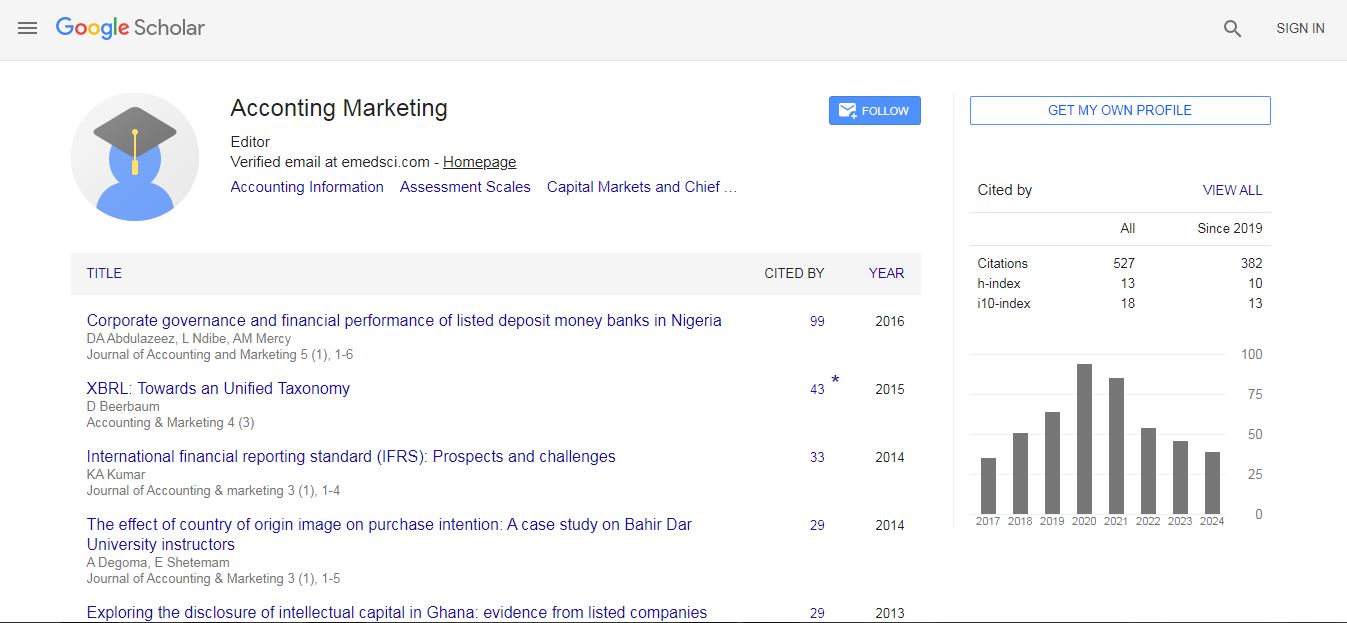
Accounting & Marketing received 487 citations as per Google Scholar report