Brief Report - (2025) Volume 10, Issue 2
Received: 01-Apr-2025, Manuscript No. cgj-26-186504;
Editor assigned: 03-Apr-2025, Pre QC No. P-186504;
Reviewed: 17-Apr-2025, QC No. Q-186504;
Revised: 22-Apr-2025, Manuscript No. R-186504;
Published:
29-Apr-2025
, DOI: 10.37421/2952-8518.2025.10.300
Citation: Wallace, Adrian K.. ”Advancements in IBD Care: Improving Patient Outcomes.” Clin Gastroenterol J 10 (2025):300.
Copyright: © 2025 Wallace K. Adrian This is an open-access article distributed under the terms of the Creative Commons Attribution License, which permits unrestricted use, distribution and reproduction in any medium, provided the original author and source are credited.
Recent advancements in the diagnosis and management of inflammatory bowel disease (IBD) are significantly enhancing patient care by incorporating novel imaging techniques and biomarkers for earlier detection and more precise disease characterization [1].
The therapeutic landscape is rapidly evolving with the development of targeted biologics and small molecules, which are demonstrably improving remission rates and the overall quality of life for affected individuals [1].
Personalized medicine approaches, leveraging genetic and microbiome data, are increasingly vital for tailoring treatment plans to individual patient needs and disease profiles [1].
The integration of sophisticated endoscopic methods, including confocal laser endomicroscopy and capsule endoscopy, is revolutionizing IBD diagnosis. These techniques provide detailed visualization of the intestinal mucosa at a cellular level, allowing for a more precise assessment of inflammation and potential dysplasia, thus complementing traditional histological evaluations [2].
These advanced methods prove invaluable in differentiating IBD from other gastrointestinal conditions and in accurately monitoring disease activity over time [2].
Emerging biomarkers such as fecal calprotectin and serological markers like ASCA and pANCA are now indispensable tools in the ongoing management of IBD. Fecal calprotectin, in particular, acts as a non-invasive indicator of intestinal inflammation, playing a crucial role in disease monitoring, predicting relapses, and guiding necessary treatment adjustments [3].
Its established utility in distinguishing IBD from irritable bowel syndrome further underscores its importance [3].
The pharmacotherapy for IBD has been profoundly transformed by the introduction of biologic therapies. This category encompasses agents like anti-TNF therapies, anti-integrins, and IL-12/23 inhibitors, all of which offer superior efficacy in achieving and maintaining remission compared to conventional treatment modalities [4].
Current research endeavors are focused on optimizing the selection of these biologics, exploring combination therapies, and addressing the challenges of treatment resistance [4].
Small molecule inhibitors, notably Janus kinase (JAK) inhibitors, represent a significant new class of oral therapies for IBD. These drugs offer a convenient administration route and a distinct mechanism of action, providing a valuable alternative for patients who have not responded to or are intolerant of biologic treatments [5].
The efficacy and safety profiles of these small molecule inhibitors are continuously being refined through ongoing clinical trials and real-world data analysis [5].
The critical role of the gut microbiome in the pathogenesis of IBD is becoming increasingly clear, and a deeper understanding of its composition and function is paving the way for innovative therapeutic interventions. Fecal microbiota transplantation (FMT) is showing considerable promise as a treatment option, especially for cases of refractory ulcerative colitis [6].
Further research is also actively exploring the development of rationally designed microbial therapies targeting specific dysbiotic pathways [6].
Personalized medicine in the context of IBD involves customizing treatment strategies based on an individual patient's unique characteristics, which include genetic predispositions, specific serological markers, and the distinct disease phenotype [7].
Pharmacogenomics is beginning to identify genetic variations that can reliably predict a patient's response to or potential toxicity from certain IBD medications, thereby enabling more precise treatment selections and ultimately improving patient outcomes [7].
Artificial intelligence (AI) is rapidly emerging as a powerful tool within IBD management. Its applications span from assisting in the analysis of medical images for diagnostic and surveillance purposes to predicting disease flares and optimizing therapeutic strategies [8].
AI algorithms possess the capability to analyze extensive datasets, identifying subtle patterns that might elude human interpretation, thus leading to more accurate and timely clinical decision-making [8].
A multidisciplinary approach to IBD care, which necessitates close collaboration among gastroenterologists, surgeons, dietitians, specialized nurses, and psychologists, is fundamental for comprehensive patient management. This integrated, team-based approach ensures that all facets of the disease, encompassing medical treatment, psychological well-being, and essential nutritional support, are thoroughly addressed, contributing to improved patient outcomes and enhanced quality of life [9].
The significance of diet and nutrition in the management of IBD is receiving growing recognition within the medical community. Specific dietary interventions, such as adherence to the Mediterranean diet or the implementation of exclusive enteral nutrition, have demonstrated effectiveness in inducing remission, particularly in pediatric populations with IBD [10].
Comprehensive nutritional assessment and ongoing counseling are therefore vital components of holistic IBD care, addressing a critical aspect of patient well-being [10].
Recent progress in inflammatory bowel disease (IBD) diagnosis and management has led to enhanced patient care through the adoption of novel imaging techniques and biomarkers, facilitating earlier detection and more accurate disease characterization [1].
Therapeutic strategies are undergoing significant evolution with the development of targeted biologics and small molecules, contributing to improved remission rates and an enhanced quality of life for patients [1].
The growing importance of personalized medicine, utilizing genetic and microbiome data, is central to tailoring treatment plans effectively [1].
The incorporation of advanced endoscopic modalities, such as confocal laser endomicroscopy and capsule endoscopy, is fundamentally changing the diagnostic approach to IBD. These techniques allow for detailed visualization of the intestinal mucosa at a cellular level, enabling a more precise assessment of inflammation and potential dysplasia, which complements traditional histological methods [2].
These advanced diagnostic tools aid in distinguishing IBD from other conditions and in effectively monitoring disease activity [2].
Emerging biomarkers, including fecal calprotectin and serological markers such as ASCA and pANCA, have become essential components in the management of IBD. Fecal calprotectin, in particular, serves as a valuable non-invasive indicator of intestinal inflammation, assisting in disease monitoring, predicting relapses, and informing treatment adjustments [3].
Its role in differentiating IBD from irritable bowel syndrome is also well-established and clinically significant [3].
The therapeutic arsenal for IBD has been dramatically expanded by the advent of biologic therapies. These include anti-TNF agents, anti-integrins, and IL-12/23 inhibitors, which collectively offer superior efficacy in inducing and maintaining remission when compared to conventional therapeutic approaches [4].
Current research efforts are concentrated on optimizing the selection of these biologics, exploring the potential of combination therapies, and addressing the challenges associated with treatment resistance [4].
Small molecule inhibitors, such as JAK inhibitors, represent a new frontier in oral therapies for IBD management. These agents provide a convenient route of administration and operate via a distinct mechanism of action, offering an alternative treatment option for patients who have experienced failure or intolerance with biologic therapies [5].
The efficacy and safety profiles of these small molecule inhibitors are continually being evaluated and refined through ongoing clinical trials [5].
The critical role of the gut microbiome in the pathogenesis of IBD is increasingly recognized, and a deeper understanding of its composition and function is driving the development of novel therapeutic interventions. Fecal microbiota transplantation (FMT) is demonstrating promising results as a treatment option, particularly for patients with refractory ulcerative colitis [6].
Research is also actively pursuing the development of rationally designed microbial therapies [6].
Personalized medicine in IBD involves tailoring treatment strategies based on individual patient characteristics, including genetic makeup, serological profiles, and specific disease phenotypes [7].
Pharmacogenomics is beginning to identify genetic variations that predict a patient's response or potential adverse reactions to specific IBD medications, facilitating more precise treatment selection and improving therapeutic outcomes [7].
Artificial intelligence (AI) is emerging as a potent tool in the comprehensive management of IBD. AI assists in image analysis for diagnostic purposes and surveillance, aids in predicting disease flares, and contributes to the optimization of treatment strategies [8].
AI algorithms are capable of analyzing extensive datasets to identify subtle patterns that might be overlooked by human interpretation, thereby enabling more accurate and timely clinical decisions [8].
The necessity of a multidisciplinary approach in IBD care, involving a coordinated effort among gastroenterologists, surgeons, dietitians, nurses, and psychologists, is paramount for comprehensive patient management. This collaborative, team-based strategy ensures that all aspects of the disease, from medical treatment to psychological support and nutritional needs, are adequately addressed, ultimately leading to improved patient outcomes and quality of life [9].
Diet and nutrition are increasingly acknowledged for their significant role in IBD management. Specific dietary interventions, such as the Mediterranean diet or exclusive enteral nutrition, have proven effective in inducing remission, especially in pediatric patients with IBD [10].
Therefore, thorough nutritional assessment and ongoing counseling are considered vital components of holistic IBD care, addressing a crucial aspect of patient well-being [10].
Recent advancements in Inflammatory Bowel Disease (IBD) care are enhancing patient outcomes through improved diagnostic tools, such as advanced imaging and biomarkers, and evolving therapeutic strategies, including targeted biologics and small molecule inhibitors. Personalized medicine, leveraging genetic and microbiome data, is crucial for tailoring treatments. Innovations in endoscopic techniques and the increasing understanding of the gut microbiome are also driving progress. Artificial intelligence is emerging as a tool for better diagnosis and treatment planning. A multidisciplinary approach involving various healthcare professionals and attention to diet and nutrition are vital for comprehensive management, leading to better remission rates and quality of life for patients. Future directions include optimizing existing therapies and exploring novel interventions.
None
None
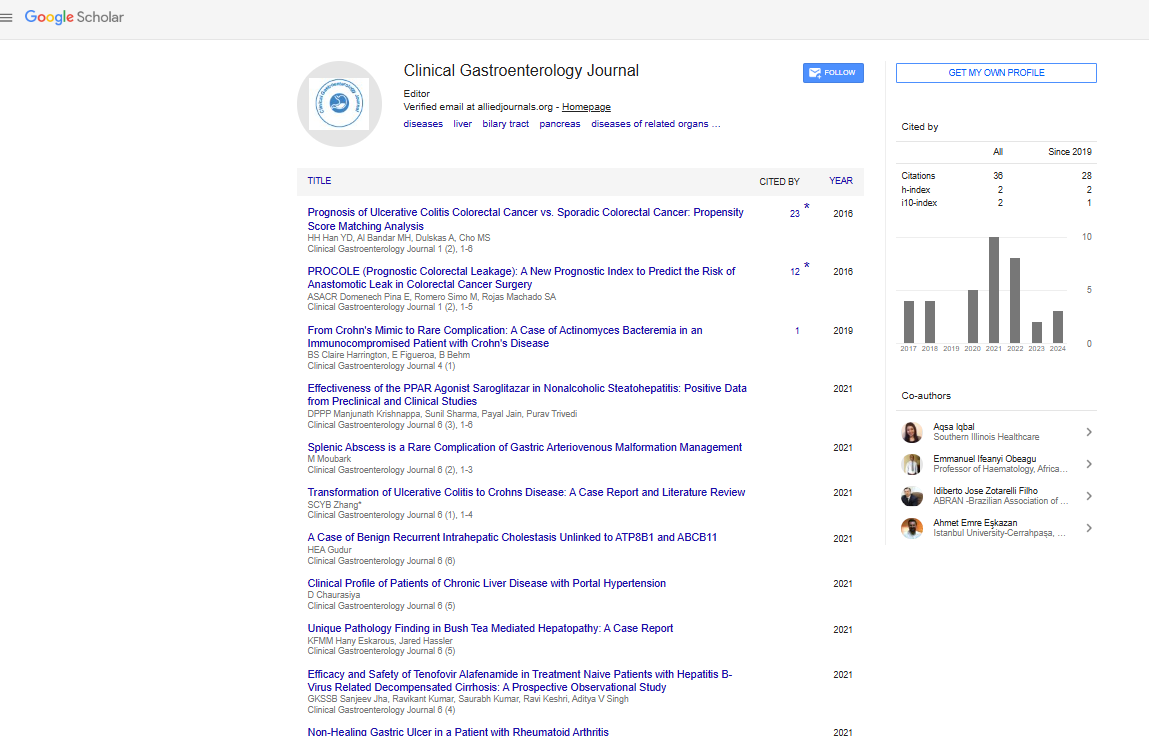
Clinical Gastroenterology Journal received 33 citations as per Google Scholar report