Short Communication - (2025) Volume 10, Issue 4
Received: 01-Aug-2025, Manuscript No. cgj-26-186534;
Editor assigned: 04-Aug-2025, Pre QC No. P-186534;
Reviewed: 18-Aug-2025, QC No. Q-186534;
Revised: 22-Aug-2025, Manuscript No. R-186534;
Published:
29-Aug-2025
, DOI: 10.37421/2952-8518.2025.10.329
Citation: Sanchez, Laura M.. ”Advanced Capsule Endoscopy: Enhancing GI Diagnostics with AI.” Clin Gastroenterol J 10 (2025):329.
Copyright: © 2025 Sanchez M. Laura This is an open-access article distributed under the terms of the Creative Commons Attribution License, which permits unrestricted use, distribution and reproduction in any medium, provided the original author and source are credited.
Recent advancements in capsule endoscopy have significantly enhanced diagnostic capabilities for gastrointestinal disorders, marking a new era in minimally invasive gastrointestinal imaging. Innovations in this field include improvements in image resolution, extended battery life, and the development of steerable capsule technology. These enhancements collectively allow for more precise visualization of the gastrointestinal tract and enable targeted biopsies when necessary, leading to more accurate diagnoses and effective treatment plans for a variety of conditions affecting the digestive system [1].
The integration of artificial intelligence (AI) with capsule endoscopy holds immense promise for revolutionizing how gastrointestinal images are interpreted. AI algorithms are being specifically developed to automatically detect abnormalities such as polyps and ulcers, thereby reducing the workload on endoscopists and potentially improving the overall detection rates of critical findings. This synergy between advanced hardware, like the capsule itself, and intelligent software represents a key driver in the future progression of minimally invasive gastrointestinal diagnostics [2].
Steerable capsule endoscopy represents a significant leap forward in diagnostic capabilities, providing clinicians with the unprecedented ability to actively guide the capsule through the gastrointestinal tract. This enhanced maneuverability is crucial for allowing prolonged examinations of specific areas of concern, improving visualization of difficult-to-reach locations within the digestive system, and even opening possibilities for targeted interventions, thereby moving beyond passive observation to a more interactive and comprehensive diagnostic approach [3].
Wireless imaging techniques in gastroenterology are rapidly expanding beyond traditional capsule endoscopy to include novel ingestible sensors designed for comprehensive physiological monitoring. These advanced devices are capable of tracking crucial physiological parameters such as pH levels, temperature, and pressure, and can also wirelessly transmit images, providing a wealth of physiological data that complements traditional endoscopic findings and aids in a deeper understanding of complex gastrointestinal conditions [4].
The development and implementation of high-resolution imaging sensors for capsule endoscopy are absolutely critical for the effective detection of subtle mucosal changes that might otherwise go unnoticed. Enhanced pixel density and improvements in light-emitting diode (LED) technology together allow for clearer and more detailed visualization of mucosal architecture, villous patterns, and small lesions, which is particularly important in the early diagnosis of conditions like celiac disease and various forms of early-stage gastrointestinal cancers [5].
Longer battery life in modern capsule endoscopes is a crucial practical advancement that directly translates to the ability to perform more comprehensive examinations of the entire gastrointestinal tract, from the esophagus all the way to the colon, within a single diagnostic study. This extended operational time is invaluable as it significantly reduces the need for repeat procedures and ensures that adequate imaging is obtained, even in patients who may exhibit slower gastrointestinal transit times [6].
Real-time data transmission from capsule endoscopes represents another critical advancement that is profoundly impacting the diagnostic process by enabling immediate feedback to the gastroenterologist during the examination. This capability is essential as it allows for timely adjustments in capsule navigation based on live findings or even the immediate identification of urgent pathological findings, thereby significantly enhancing both the efficiency and the overall effectiveness of the diagnostic workflow [7].
The application of machine learning (ML) techniques in the analysis of capsule endoscopy videos is rapidly and demonstrably improving diagnostic accuracy. ML algorithms that have been meticulously trained on large and diverse datasets are capable of identifying subtle patterns indicative of disease that may be easily missed by the human eye, ultimately leading to earlier and more precise diagnoses of a wide spectrum of gastrointestinal pathologies [8].
Miniaturization of wireless imaging components is a fundamental trend that is directly enabling the development of smaller, more comfortable ingestible devices. This ongoing trend is of paramount importance for improving patient acceptance of these technologies and for increasing the feasibility of conducting longer-duration monitoring, particularly for patients with chronic gastrointestinal conditions that require continuous or intermittent assessment over extended periods [9].
The integration of capsule endoscopy with other advanced diagnostic modalities is significantly enhancing the interpretation of the collected findings. This includes the use of advanced imaging software for detailed 3D reconstruction of anatomical structures and the application of augmented reality (AR) technologies, which collectively allow for a more comprehensive understanding of gastrointestinal anatomy and pathology, ultimately leading to more informed and improved clinical decision-making [10].
Recent developments in capsule endoscopy have substantially improved diagnostic capabilities for a wide range of gastrointestinal disorders, fundamentally changing how these conditions are identified and managed. Key innovations include significant enhancements in image resolution, providing clearer and more detailed visual data. Furthermore, the extended battery life of these devices ensures that examinations can cover the entire gastrointestinal tract without interruption. The advent of steerable capsule technology represents a major breakthrough, allowing for active control and more precise visualization of specific areas of interest, and even facilitating targeted biopsies when necessary. These technological strides collectively contribute to more accurate diagnoses and improved patient outcomes in gastroenterology [1].
The integration of artificial intelligence (AI) into capsule endoscopy workflows is poised to revolutionize the interpretation of gastrointestinal imaging data. AI algorithms are being developed to automate the detection of crucial findings such as polyps and ulcers, thereby alleviating the burden on gastroenterologists and potentially increasing the sensitivity of detection. This synergistic combination of advanced hardware and sophisticated software is a cornerstone for the future of minimally invasive gastrointestinal diagnostics, promising greater efficiency and accuracy [2].
Steerable capsule endoscopy technology signifies a pivotal advancement, empowering clinicians to actively maneuver the capsule within the gastrointestinal tract. This increased control allows for extended examination of particular regions, enhanced visualization of anatomically challenging areas, and the potential for targeted therapeutic interventions, transforming the diagnostic process from passive observation to an interactive modality [3].
Beyond capsule endoscopy, wireless imaging technologies in gastroenterology are expanding to include ingestible sensors for physiological monitoring. These innovative devices can continuously track parameters like pH, temperature, and pressure, while also transmitting images wirelessly. This comprehensive physiological data provides valuable insights that complement endoscopic findings and aids in understanding complex gastrointestinal pathologies [4].
The development of high-resolution imaging sensors for capsule endoscopy is indispensable for identifying subtle mucosal abnormalities. Advances in pixel density and LED technology enable clearer visualization of mucosal textures, villous structures, and small lesions, which is critical for the early diagnosis of conditions such as celiac disease and gastrointestinal cancers [5].
Modern capsule endoscopes equipped with extended battery life facilitate more thorough examinations of the entire digestive system, from the esophagus to the colon, in a single session. This extended operational capacity minimizes the need for repeat procedures and guarantees sufficient imaging data acquisition, even in patients with delayed gastrointestinal transit times [6].
Real-time data transmission from capsule endoscopes is a critical technological feature that provides immediate feedback to clinicians during the examination. This functionality allows for prompt adjustments to capsule navigation and the immediate recognition of urgent findings, thereby improving the efficiency and effectiveness of the diagnostic process [7].
The application of machine learning (ML) for analyzing capsule endoscopy videos is significantly enhancing diagnostic accuracy. ML algorithms, trained on extensive datasets, can detect subtle disease indicators that might elude human observation, leading to earlier and more precise diagnoses of gastrointestinal diseases [8].
Ongoing miniaturization of wireless imaging components is facilitating the creation of smaller and more comfortable ingestible devices. This trend is essential for improving patient compliance and enabling longer monitoring periods, particularly for individuals with chronic conditions requiring continuous or intermittent assessment [9].
The integration of capsule endoscopy with complementary diagnostic tools, such as advanced imaging software for 3D reconstruction and augmented reality, is greatly enhancing the interpretation of endoscopic findings. This multidisciplinary approach provides a more holistic understanding of gastrointestinal anatomy and pathology, ultimately supporting improved clinical decision-making [10].
Capsule endoscopy has undergone significant advancements, including improved image resolution, longer battery life, and steerable technology, leading to enhanced diagnostic capabilities for gastrointestinal disorders. The integration of artificial intelligence is revolutionizing image interpretation by automating lesion detection, while steerable capsules offer active navigation and targeted interventions. Wireless imaging extends to ingestible sensors for physiological monitoring, complementing endoscopic findings. High-resolution sensors are crucial for detecting subtle mucosal changes, aiding early diagnosis. Extended battery life allows for comprehensive examinations, and real-time data transmission improves diagnostic efficiency. Machine learning enhances accuracy by identifying subtle patterns. Miniaturization of components promotes patient comfort and longer monitoring. Integration with advanced imaging software and augmented reality provides a more holistic understanding of gastrointestinal conditions, ultimately improving clinical decision-making.
None
None
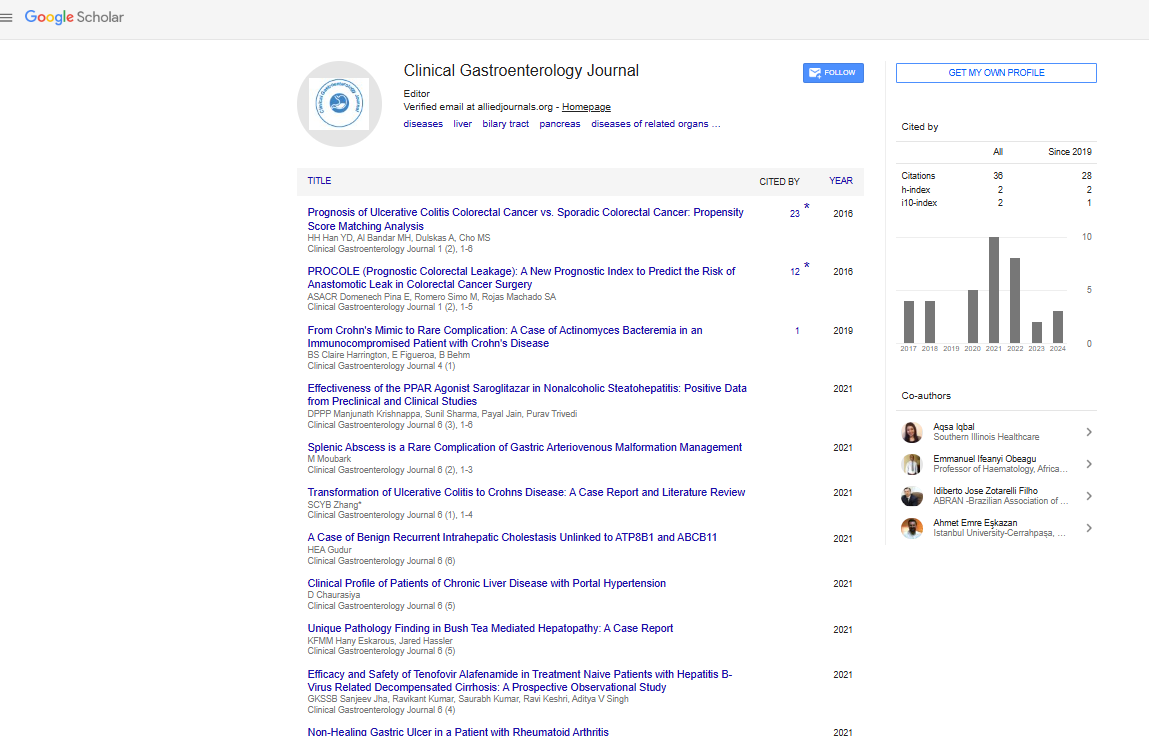
Clinical Gastroenterology Journal received 33 citations as per Google Scholar report