Perspective - (2025) Volume 14, Issue 2
Received: 01-Mar-2025, Manuscript No. jamk-25-177269;
Editor assigned: 03-Mar-2025, Pre QC No. P-177269;
Reviewed: 17-Mar-2025, QC No. Q-177269;
Revised: 24-Mar-2025, Manuscript No. R-177269;
Published:
31-Mar-2025
, DOI: 10.37421/2168-9601.2025.14.549
Citation: Chen, Emily. ”Accounting’s Digital Revolution: Technologies, Impacts, Future.” J Account Mark 14 (2025):549.
Copyright: © 2025 Chen E. This is an open-access article distributed under the terms of the Creative Commons Attribution License, which permits unrestricted use, distribution and reproduction in any medium, provided the original author and source are credited.
The profound influence of digital transformation on the accounting and auditing landscape has been a subject of extensive scholarly inquiry, compelling a critical re-evaluation of established practices and theoretical frameworks. This systematic review synthesizes existing literature, meticulously categorizing key themes, identifying emergent challenges, and delineating critical avenues for future research that are pertinent to both practitioners navigating evolving professional demands and academics shaping future discourse. Such an examination is crucial for comprehensively understanding the evolving nature of the accounting profession and its foundational pillars [1].
Blockchain technology stands out as a revolutionary force poised to fundamentally alter accounting information systems, offering a paradigm shift in data management and verification. Its inherent characteristics, particularly enhanced transparency, immutable security, and streamlined efficiency in record-keeping and transaction verification processes, are thoroughly explored, highlighting how this technology promises to transform how financial data is managed and trusted within organizations, leading to more resilient and verifiable financial infrastructures [2].
Artificial intelligence is rapidly expanding its footprint across diverse accounting functions, ushering in an era of unprecedented automation and sophisticated decision-making capabilities. This comprehensive review highlights how AI not only automates routine tasks, thereby freeing human capital for more strategic endeavors focused on complex analysis and advisory roles, but also cultivates novel opportunities for professional growth and service innovation within the accounting domain, redefining the scope of professional engagement [3].
The transformative potential of big data analytics within accounting and auditing practices represents a significant area of contemporary research, promising to unlock deeper insights and improve operational effectiveness. This review systematically unpacks how big data can yield deeper insights, substantially improve the efficacy of fraud detection mechanisms through advanced pattern recognition, and fundamentally reshape traditional analytical processes, driving a more data-driven and predictive approach to financial scrutiny and risk assessment [4].
Cloud computing continues to redefine accounting information systems, presenting both compelling advantages and notable challenges that warrant careful consideration. This paper meticulously investigates its current trajectories and anticipated future directions, emphasizing the benefits of enhanced scalability, reduced infrastructure costs, and pervasive accessibility, while concurrently addressing critical concerns pertaining to data security, regulatory compliance, and seamless system integration, which are essential for its responsible adoption [5].
In an increasingly digitized operational environment, accounting and auditing functions face escalating cybersecurity risks that demand proactive and sophisticated mitigation strategies. This article meticulously details the imperative for robust essential controls and the strategic development of comprehensive frameworks to vigilantly protect sensitive financial data against an evolving landscape of threats. The integrity, confidentiality, and availability of financial information are paramount in this digital age, directly impacting stakeholder trust and organizational resilience [6].
Accounting education curricula are undergoing a significant metamorphosis to adequately prepare students for the demands of the digital age, requiring a forward-looking approach to professional development. This review meticulously examines the pedagogical adjustments being implemented, underscoring a pivotal shift towards integrating critical digital competencies such as advanced data analytics, artificial intelligence literacy, and foundational cybersecurity knowledge into professional training programs, ensuring graduates are equipped with relevant and future-proof skills [7].
Robotic process automation (RPA) offers substantial promise for augmenting efficiency within accounting operations, particularly through the automation of routine and high-volume tasks. This paper elucidates how RPA can effectively streamline repetitive tasks, markedly enhance accuracy in data processing by minimizing human error, and enable accounting professionals to pivot towards higher-value, analytical activities that require critical thinking and judgment. While significant potential exists, the paper also critically addresses the inherent implementation challenges, including change management and system integration [8].
The integration of digital technologies holds profound implications for improving the rigor and scope of sustainability accounting and reporting, moving beyond traditional financial metrics. This paper rigorously examines how these advanced tools can markedly enhance the accuracy, timeliness, and breadth of reporting, thereby empowering organizations to more effectively measure, monitor, and transparently communicate their environmental and social impacts to a diverse range of stakeholders, fostering greater corporate responsibility and informed decision-making [9].
The burgeoning application of artificial intelligence in accounting and finance introduces a spectrum of complex ethical considerations that necessitate careful scrutiny and proactive governance. This paper thoroughly explores critical issues such as the potential for algorithmic bias in automated decisions, safeguarding robust data privacy protocols, and establishing clear accountability mechanisms within automated decision-making processes, underscoring the necessity for responsible AI development and deployment that aligns with professional ethics and societal values [10].
The ongoing digital transformation fundamentally redefines the scope and execution of accounting and auditing practices globally. This pivotal systematic literature review thoroughly synthesizes the current body of knowledge, meticulously identifying prevalent themes such as automation and data-driven insights, pinpointing significant challenges like skill gaps and regulatory lags, and proposing crucial directions for future academic inquiry and professional innovation. This comprehensive overview is essential for practitioners to adapt and for academics to steer future research [1]. Blockchain technology is rapidly emerging as a foundational element for the next generation of accounting information systems, promising unprecedented enhancements. This detailed article meticulously examines how this distributed ledger technology reshapes traditional accounting by offering unparalleled transparency, bolstering data security through cryptographic principles, and significantly improving efficiency in critical record-keeping and transaction verification processes. The implications for trust and auditability in financial reporting are profound and far-reaching [2]. Artificial intelligence is progressively permeating various facets of accounting, fundamentally altering operational workflows and strategic decision-making paradigms. This insightful paper critically reviews the expanding role of AI, illustrating its capacity to automate mundane, repetitive tasks, thereby enhancing operational efficiency and accuracy, while simultaneously elevating the quality of decision support through advanced analytical capabilities. Furthermore, it explores new opportunities that AI creates for the evolution and specialization within the accounting profession [3]. The advent of big data analytics has instigated a profound, transformative impact on the methodologies and outcomes of accounting and auditing practices. This exhaustive review article thoroughly explores its potential to enhance business intelligence by generating deeper and more granular insights, significantly improving the efficacy of fraud detection through sophisticated pattern recognition, and fundamentally reshaping traditional analytical processes towards predictive and proactive approaches. Its strategic adoption is key for competitive advantage [4]. Cloud computing is actively shaping the architecture and delivery of accounting information systems, presenting a dual landscape of compelling advantages and inherent operational complexities. This paper meticulously investigates its current trajectory and forecasts future directions, accentuating its benefits in terms of enhanced scalability, cost-effectiveness, and ubiquitous accessibility, concurrently discussing the persistent challenges related to robust data security, compliance with privacy regulations, and seamless integration with legacy systems. Strategic planning is crucial for successful implementation [5]. The digital age presents an escalating array of cybersecurity risks that pose significant threats to the integrity and confidentiality of critical accounting and auditing functions. This comprehensive article rigorously addresses these growing risks, detailing the essential controls and robust strategies imperative for safeguarding sensitive financial data against sophisticated cyber threats. The establishment of resilient cybersecurity postures is not merely an operational necessity but a cornerstone for maintaining stakeholder trust and regulatory adherence [6]. In response to the rapid technological evolution, accounting education curricula are undergoing significant structural adaptations to ensure graduates possess the requisite digital competencies for modern practice. This meticulous review examines these curriculum adjustments, highlighting a strategic shift towards embedding core skills in data analytics, artificial intelligence applications, and foundational cybersecurity principles, thereby preparing students for a dynamic professional landscape where technological proficiency is paramount for success [7]. Robotic process automation (RPA) holds substantial promise for revolutionizing efficiency and precision within the accounting domain. This paper comprehensively explores the significant potential of RPA, illustrating its capacity to streamline and automate repetitive, rule-based tasks, which inherently improves accuracy and significantly reduces processing times. This automation strategy allows accounting professionals to redirect their expertise towards higher-value, cognitive activities, while the paper also thoughtfully addresses various implementation challenges and strategic considerations [8]. Digital technologies are playing an increasingly vital role in enhancing the accuracy, timeliness, and comprehensiveness of sustainability accounting and reporting, fostering greater corporate accountability. This paper meticulously examines how these advanced tools can significantly improve an organization's ability to precisely measure, transparently report, and effectively communicate their environmental and social impacts, thereby facilitating informed decision-making by stakeholders and aligning corporate strategies with broader sustainability goals [9]. The escalating integration of artificial intelligence within accounting and finance inevitably gives rise to complex ethical considerations that demand meticulous attention. This paper delves deeply into these critical ethical implications, discussing pressing issues such as the potential for algorithmic bias in financial modeling, the imperative need for robust data privacy safeguards, and the establishment of clear frameworks for accountability in increasingly automated decision-making processes, advocating for responsible innovation and ethical governance in AI deployment [10].
The accounting and auditing professions are experiencing a profound paradigm shift, largely driven by the rapid adoption and integration of various digital technologies. Reviews of digital transformation highlight emergent themes, significant challenges, and crucial future research directions across the field. Specifically, blockchain technology is revolutionizing accounting information systems by promising enhanced transparency, robust security, and unparalleled efficiency in record-keeping and transaction verification. Artificial intelligence is increasingly automating routine tasks, improving complex decision-making, and opening new avenues for professional opportunities. However, the ethical implications of AI, including algorithmic bias and data privacy, demand careful consideration. Big data analytics is enhancing strategic insights and bolstering fraud detection capabilities, while cloud computing offers substantial advantages in scalability and accessibility, albeit with challenges related to data security and integration. Addressing escalating cybersecurity risks is paramount for protecting sensitive financial data. Robotic process automation streamlines repetitive tasks, improving accuracy and freeing human capital for higher-value activities. Moreover, digital technologies are crucial for improving the precision and scope of sustainability accounting and reporting. Consequently, accounting education curricula are proactively adapting to equip future professionals with essential digital competencies, encompassing data analytics, AI literacy, and cybersecurity awareness, to effectively navigate this dynamic and technologically advanced professional landscape.
None
None
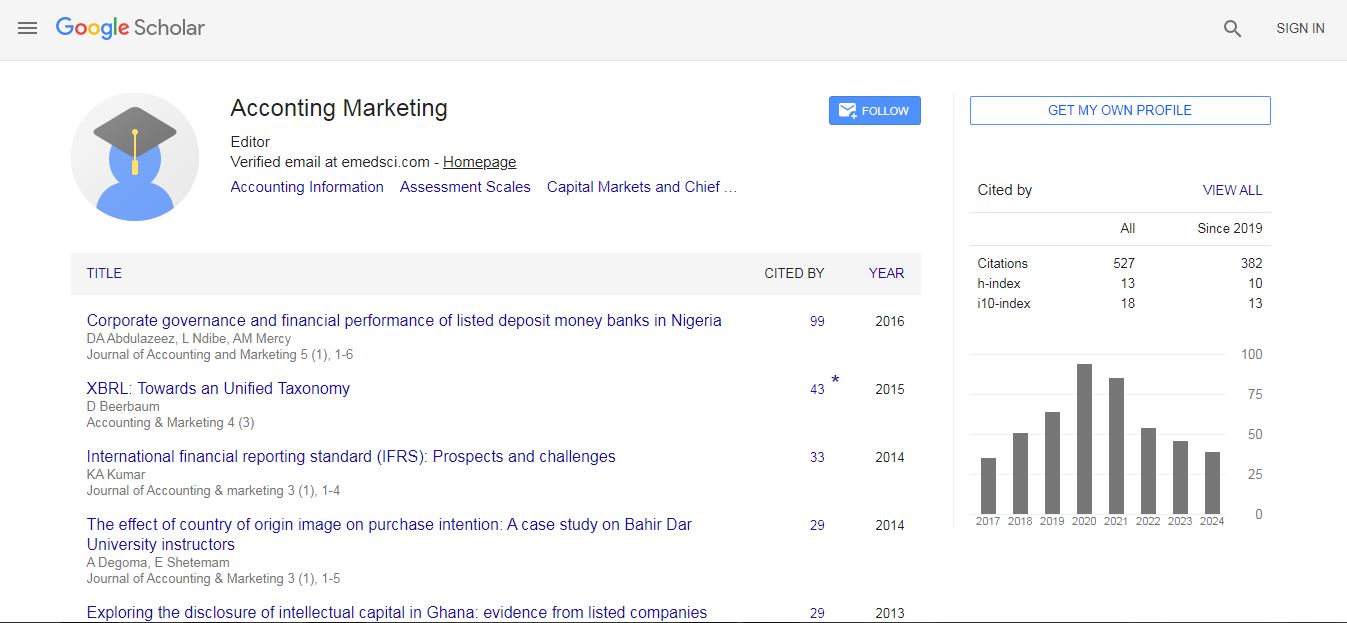
Accounting & Marketing received 487 citations as per Google Scholar report