DOI: 10.37421/2168-9695.2025.14.322
DOI: 10.37421/2168-9695.2025.14.313
DOI: 10.37421/2168-9695.2025.14.314
DOI: 10.37421/2168-9695.2025.14.315
DOI: 10.37421/2168-9695.2025.14.316
DOI: 10.37421/2168-9695.2025.14.317
DOI: 10.37421/2168-9695.2025.14.318
DOI: 10.37421/2168-9695.2025.14.320
DOI: 10.37421/2168-9695.2025.14.321
Soorya B, M. Dharane Dharan and Sridhar Jagadesan*
DOI: 10.37421/2168-9695.2025.14.315
The purpose of this review article is to offer a thorough overview of part feeders, which are automated devices used in manufacturing to feed and position components for subsequent processing. The article begins by presenting component feeders and detailing their important tasks in the manufacturing industry. It then describes the many types of component feeders available, such as vibratory, centrifugal, and pneumatic feeders, as well as their advantages and drawbacks. The study also discusses part feeder design factors such as part properties, feeding rate, and orientation precision. It also examines the difficulties connected with component feeding, such as part jams, misalignments, and handling fragile parts, as well as the solutions utilised to solve these difficulties. Lastly, the report provides a review of the important findings as well as recommendations for future research in the topic of part feeders. Overall, this review article is a helpful resource for academics, engineers, and manufacturers interested in learning about the present status of component feeding technology and its potential to improve production processes.
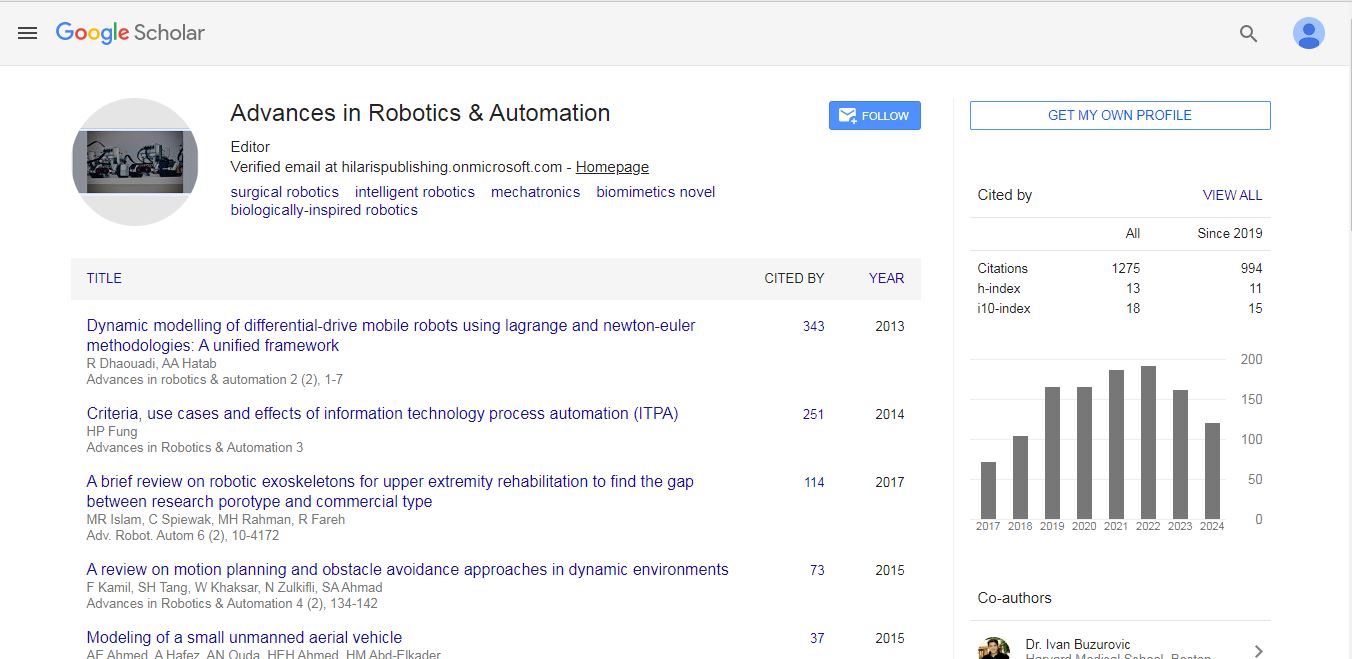
Advances in Robotics & Automation received 1275 citations as per Google Scholar report
 Spanish
  Chinese
  Russian
  German
  French
  Japanese
  Portuguese
  Hindi
Hindi 